Trade Duplication in Futures: What Every Trader Should Know
TradeDupe
10 min read
Discover what is trade duplication in futures and how it enables efficient order execution across multiple accounts, maximizing your trading strategy.
Trade duplication in futures is the automated replication of every order event from a single lead account to multiple follower accounts simultaneously. When you place a buy order, adjust a stop loss, or close a position on the master account, the trade copier software mirrors that action across every linked follower account in real time. The goal is straightforward: consistent strategy execution without the manual overhead of managing each account individually.
Key concepts to understand before going further:
- Lead (master) account: The account where all trading decisions originate
- Follower accounts: Accounts that receive and replicate the lead's orders automatically
- Order synchronization: The process of matching entries, exits, and modifications across all accounts in real time
- Pre-order validation: A risk filter layer that checks each follower account's parameters before submitting any order
Prop trading firms and multi-account traders rely on this approach to enforce strategy consistency at scale. Regulatory bodies like the CFTC govern futures markets broadly, and any duplication setup must operate within those exchange and firm-level rules.
Table of Contents
- How does trade duplication actually work in futures markets?
- What are the real benefits of trade duplication for futures traders?
- Risk management considerations you cannot afford to ignore
- What technology powers effective trade duplication tools?
- Trade duplication in action: two practical scenarios
- Trade duplication vs. alternative execution methods
- Specific risks and downsides worth knowing
- Best practices for implementing trade duplication effectively
- Key Takeaways
How does trade duplication actually work in futures markets?
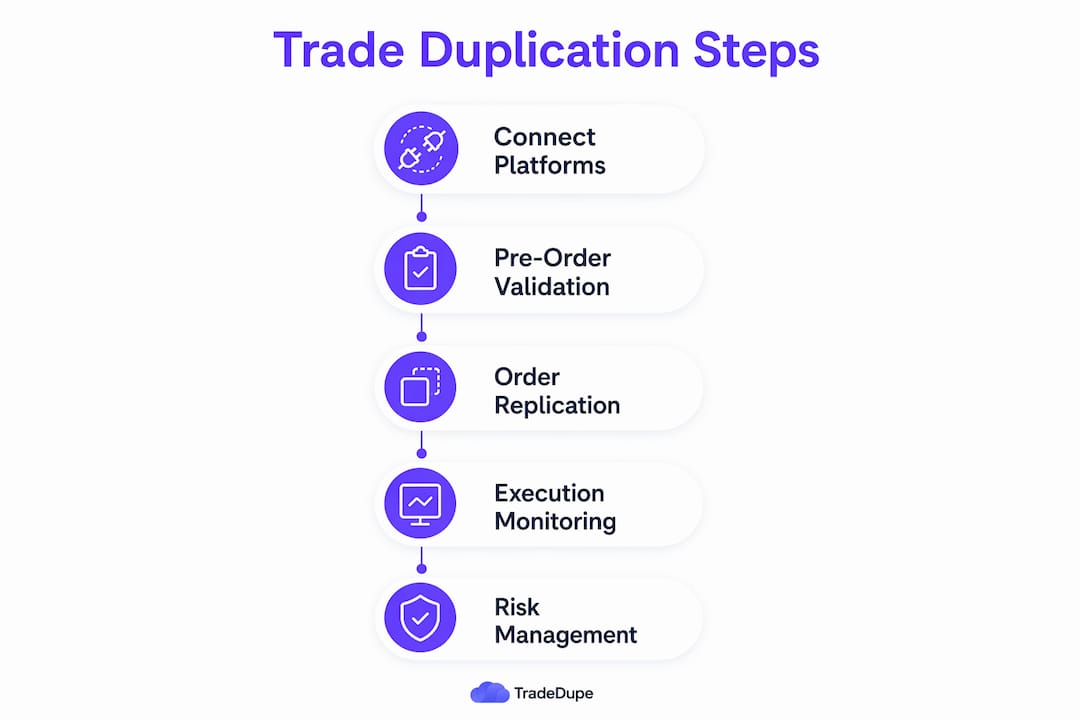
The process follows a clear sequence, though the technology behind it is anything but simple.
- Step 1 — Order detection: The copier software monitors the lead account's API feed continuously, watching for any order event: new entries, modifications, partial fills, or closes.
- Step 2 — Pre-order validation: Before pushing the order to follower accounts, the system checks each follower's risk filters — daily loss limits, maximum contract sizes, and account-specific restrictions.
- Step 3 — Size adaptation: The software scales the trade to fit each follower account using methods such as ratio-based sizing, fixed contracts, account value percentage, or notional value. Accounts receive proportionally scaled trades rather than identical contract counts based on their size.
- Step 4 — Order submission: Validated, sized orders are sent to each follower account through the broker's API.
- Step 5 — Sync confirmation: The platform logs execution results and flags any discrepancies for review.
Both the lead and follower accounts must run on compatible platforms simultaneously. Tradovate is a common choice for prop firm setups because its API supports the low-latency connections that effective duplication demands.
Pro Tip: Pre-order validation is the most overlooked layer in any duplication setup. Without it, a single oversized order on a follower account can breach a prop firm's daily loss limit and trigger an account breach. Always confirm your copier validates against each account's specific rules before submission, not after.
What are the real benefits of trade duplication for futures traders?
The efficiency gains are immediate, but the deeper advantages show up in risk control and scalability.
- Time savings: Managing five accounts manually during a fast-moving ES or NQ session is nearly impossible. Duplication collapses that workload to managing one.
- Error reduction: Manual re-entry across accounts introduces fat-finger risk and timing gaps. Automated synchronized execution eliminates both.
- Strategy consistency: Every follower account executes the same trade logic, which matters when you are running trend-following or breakout strategies across multiple funded accounts.
- Scalability: Prop trading firms managing dozens of funded accounts can deploy a single strategy across all of them without adding headcount.
- Automated risk enforcement: Sizing rules and loss limits are applied programmatically, removing the emotional variable from position management.
Common use cases include personal traders managing multiple prop firm evaluation accounts simultaneously, funded traders scaling a proven strategy across several live accounts, and trading firms deploying systematic approaches across a roster of trader accounts. Futures trading strategies like trend following, breakout trading, and scalping all translate well to duplication setups, provided the latency is low enough to preserve entry quality.
Risk management considerations you cannot afford to ignore
Trade duplication amplifies both gains and mistakes. A flawed order on the lead account replicates instantly to every follower, which makes risk controls at the system level non-negotiable.
- Pre-order validation: As noted, this layer checks each follower account against its specific risk parameters before any order is submitted. It is the primary defense against prop firm rule violations.
- Daily loss limits: Most prop firms enforce hard daily drawdown caps. Your duplication software must read and respect these limits per account, not as a blanket rule.
- Contract size restrictions: Some accounts have maximum position sizes. The copier must cap orders accordingly rather than passing through the lead's full size.
- Rogue-trade detection: Platforms with this feature identify orders that fall outside expected parameters and flag or block them before execution. This protects against API glitches or corrupted order data.
- Auto-recovery: When a sync failure occurs, auto-recovery restores order synchronization without manual intervention, minimizing the window where accounts are out of alignment.
On the compliance side, trade duplication must align with both exchange rules and prop firm agreements. Firms like Apex Trader Funding and Alpha Futures have specific policies on copy trading that traders must review before deploying any duplication setup. Audit trails and real-time monitoring logs are not just useful — they are often required for demonstrating compliance.
What technology powers effective trade duplication tools?
The architecture of a trade duplication platform determines its reliability under real market conditions.

| Feature | What it does | Why it matters |
|---|---|---|
| Low-latency execution | Replicates orders with minimal delay | Preserves entry quality across accounts |
| Pre-order validation | Checks risk filters before submission | Prevents prop firm rule violations |
| Rogue-trade detection | Flags anomalous orders | Protects against API errors or bad data |
| Auto-recovery | Restores sync after failures | Minimizes account misalignment windows |
| Per-account toggles | Enables/disables individual followers | Gives granular control without stopping all accounts |
| Real-time dashboard | Monitors sync status and activity | Supports fast decision-making and oversight |
Tradedupe is built specifically for this environment. Operating on the Tradovate brokerage infrastructure, it delivers real-time trade mirroring with a median latency of 34ms and integrates directly with prop firms including Apex, Tradeify, Lucid Trading, and Alpha Futures. Its dashboard surfaces leader and follower activity simultaneously, and its AI-powered analytics layer adds post-session reporting that most platforms do not offer.
Latency and execution accuracy remain the core technological challenges in any duplication setup. Broker API differences, network conditions, and order queue depth all affect how cleanly trades replicate. Platforms that handle these variables through dedicated infrastructure rather than generic webhooks deliver meaningfully better results in fast markets.
Proper trade copier security practices, including VPS hosting and strong API credential management, further reduce execution risk and protect account access.
Trade duplication in action: two practical scenarios
Scenario 1 — Prop firm evaluation scaling: A trader passes one Apex evaluation and wants to run the same NQ scalping strategy across three additional evaluation accounts. Rather than watching four screens and entering orders four times, the trader designates the first account as the lead. The copier validates each evaluation account's daily loss limit, scales contracts to each account's size, and submits orders within milliseconds of the lead execution. All four accounts stay in sync through the session.
Scenario 2 — Live funded account management: A prop desk manages 20 funded accounts across multiple traders. A single lead account runs a trend-following strategy on crude oil futures. The duplication platform scales each follower's position to its account value, enforces per-account drawdown caps, and logs every order for compliance review. When one follower account hits its daily loss limit mid-session, the copier automatically disables that account's order flow without affecting the others.
Trade duplication vs. alternative execution methods
Trade duplication is not the only way to run multiple accounts, and understanding where it fits helps you choose the right tool.
Manual execution across multiple accounts is the baseline. It works for one or two accounts in slow markets, but timing gaps and entry errors compound quickly as account count grows or market speed increases.
Algorithmic trading (algo/bot execution) runs strategy logic independently on each account. There is no lead account; each instance makes its own decisions. This approach suits fully automated strategies but requires separate infrastructure per account and offers no centralized control point.
Mirror trading replicates predefined systematic strategies rather than a live trader's decisions. It is more structured than copy trading but less flexible, since the strategy is fixed rather than responsive to a trader's real-time judgment.
Trade duplication sits between manual and fully algorithmic execution. It preserves the trader's decision-making on the lead account while automating the distribution of those decisions across followers. For prop traders running discretionary or semi-systematic strategies across multiple funded accounts, that balance is often exactly what the workflow requires.
Specific risks and downsides worth knowing
Beyond general risk management, trade duplication carries failure modes that are specific to the model itself.
Amplified lead account errors: Any mistake on the lead account, whether a misclicked contract size or a wrong instrument, replicates instantly. There is no human review step between the lead order and follower execution.
Latency-driven slippage: Even at 34ms median latency, fast markets can move between the lead fill and the follower submission. In scalping strategies where a few ticks determine profitability, this gap matters.
API dependency: The entire system depends on broker API stability. An API outage or rate-limit breach can leave follower accounts unhedged while the lead account holds open positions.
Cross-broker complexity: Running cross-broker duplication introduces additional variables: different margin requirements, tick sizes, and order types across venues can cause sizing mismatches if the platform does not account for them explicitly.
Prop firm policy risk: Some prop firms restrict or prohibit copy trading on their accounts. Violating these terms can result in account termination regardless of trading performance.
Best practices for implementing trade duplication effectively
Getting the setup right from the start prevents most of the failure modes above.
- Audit each follower account's rules before connecting it. Daily loss limits, maximum contracts, and copy trading policies vary by firm and account type. Map these before your first live session.
- Test on a demo or evaluation account first. Confirm that sizing, validation, and sync behavior match your expectations before risking funded capital.
- Use a VPS for the copier software. A local machine that sleeps or loses internet connectivity breaks the sync. A dedicated virtual private server keeps the connection stable around the clock.
- Set per-account toggles conservatively. Start with fewer follower accounts and add more as you confirm the setup performs as expected under live conditions.
- Review sync logs after every session. Discrepancies between lead and follower fills are early warnings of latency issues, API problems, or sizing miscalculations.
- Keep the lead account's strategy within the follower accounts' risk capacity. If the lead trades 10 contracts and the smallest follower can only handle 1, the sizing math must be verified explicitly, not assumed.
Tradedupe's futures trade copier is built around these principles, with prop firm integrations and real-time monitoring designed to surface problems before they become account-level events.
*
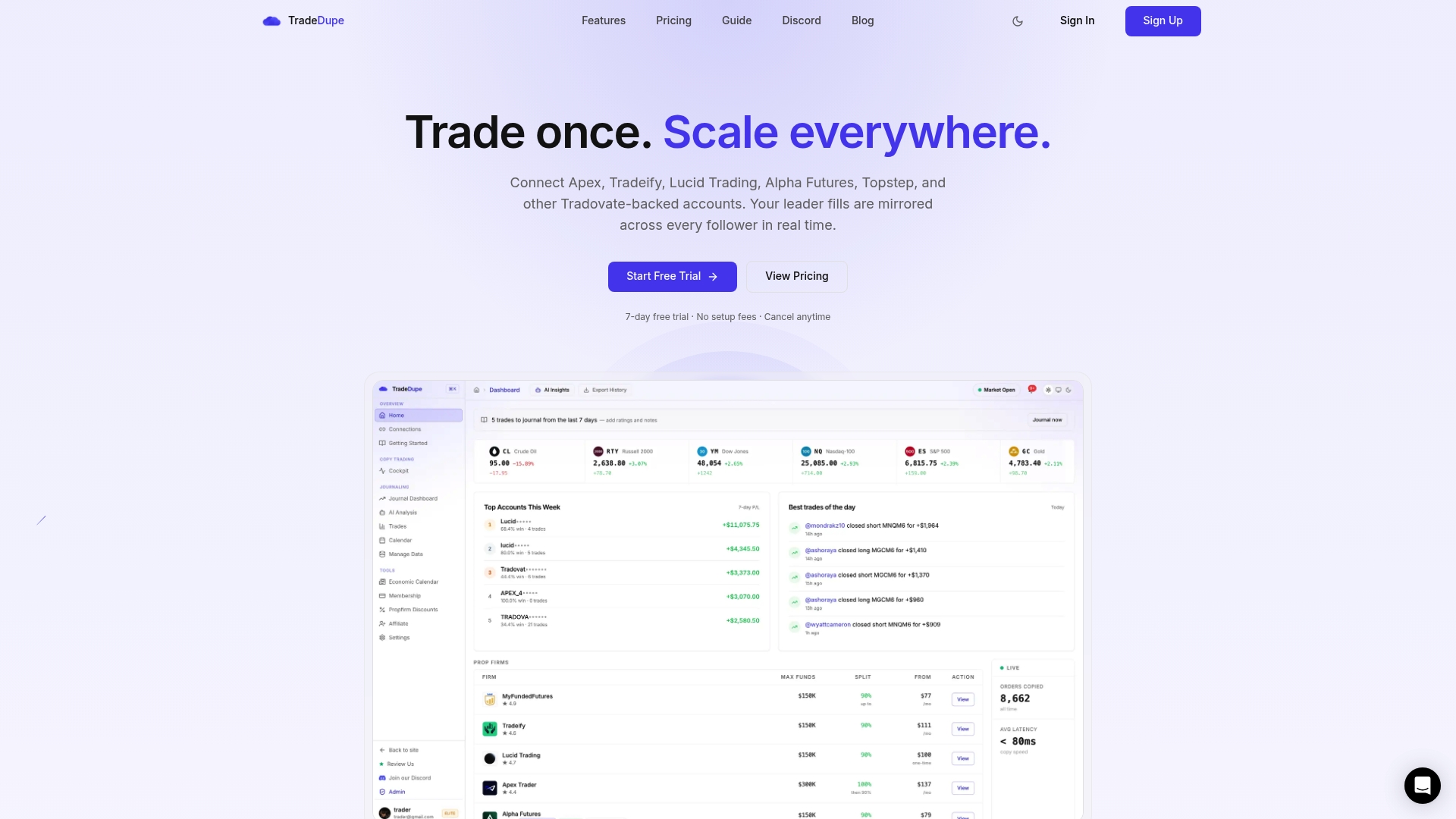
Traders managing multiple Tradovate accounts can get started with Tradedupe's full feature set, including pre-order validation, rogue-trade detection, and prop firm integrations, through the platform setup guide.
*
Key Takeaways
Trade duplication in futures automates order replication from a lead account to multiple followers, with pre-order validation and real-time monitoring as the critical layers that separate reliable setups from risky ones.
| Point | Details |
|---|---|
| Core definition | Trade duplication replicates every order event from a lead account to follower accounts automatically and in real time. |
| Pre-order validation | Checking each follower's risk parameters before order submission is the primary defense against prop firm rule violations. |
| Latency matters | Tradedupe reports a median latency of 34ms, which directly affects entry quality in fast-moving futures markets. |
| Amplified errors | Any mistake on the lead account replicates instantly to all followers, making lead account discipline non-negotiable. |
| Prop firm compliance | Copy trading policies vary by firm; always verify each account's terms before connecting it to a duplication setup. |