
Why Traders Use Lucid Trading Accounts: 2026 Guide
TradeDupe
18 min read
Discover why traders use Lucid Trading accounts for a 90/10 profit split, quick payouts, and flexible trading strategies. Learn more!
Traders choose Lucid Trading accounts for a specific, verifiable reason: the combination of a 90/10 profit split as a base rate, payouts that process in roughly 15 minutes, and trading rules that permit news trading, scalping, and automated systems puts Lucid in a category most futures prop firms simply do not occupy. Lucid Trading launched recently and experienced rapid growth compared to many futures firms in that period, and the growth was not accidental.
Here is what drives that preference at a glance:
- 90/10 profit split on every funded plan, with no paid upgrade required to access it
- Payout speed averaging around 15 minutes, with a contractual commitment of up to 2 business days
- Soft daily loss breach policy that pauses trading rather than failing the account
- End-of-day trailing drawdown that only checks at session close, not intraday
- Permissive strategy rules covering news trading, scalping, bots, and trade copiers
- Four account types (LucidFlex, LucidPro, LucidDirect, LucidMaxx) designed for different risk tolerances and trading styles
- Integration with platforms like Tradedupe for real-time copy trading across multiple Lucid accounts
*
Table of Contents
- What is Lucid Trading and why is it growing so fast?
- How do LucidFlex, LucidPro, LucidDirect, and LucidMaxx differ?
- What are Lucid Trading's most important rules and policies?
- How does the evaluation process work, and what are the payout terms?
- Why do traders prefer Lucid over more traditional prop firms?
- How Tradedupe enhances trading with Lucid accounts
- Pros and cons of Lucid Trading accounts
- How to open and fund a Lucid Trading account
- What risk management tools does Lucid Trading provide?
- What does Lucid Trading's customer support look like?
- Common challenges traders face with Lucid accounts and how to work through them
- Scale your Lucid accounts with Tradedupe
- Key Takeaways
What is Lucid Trading and why is it growing so fast?
Lucid Trading Group LLC, incorporated in Delaware, launched in early 2025 as a futures-only proprietary trading firm. Its founder, AJ Campanella, built the firm around a straightforward premise: give traders genuinely fair terms, publish the rules clearly, and pay out fast. The market responded. Lucid's Trustpilot rating is high with many verified reviews, and the firm earned a strong PropScore from independent trackers.
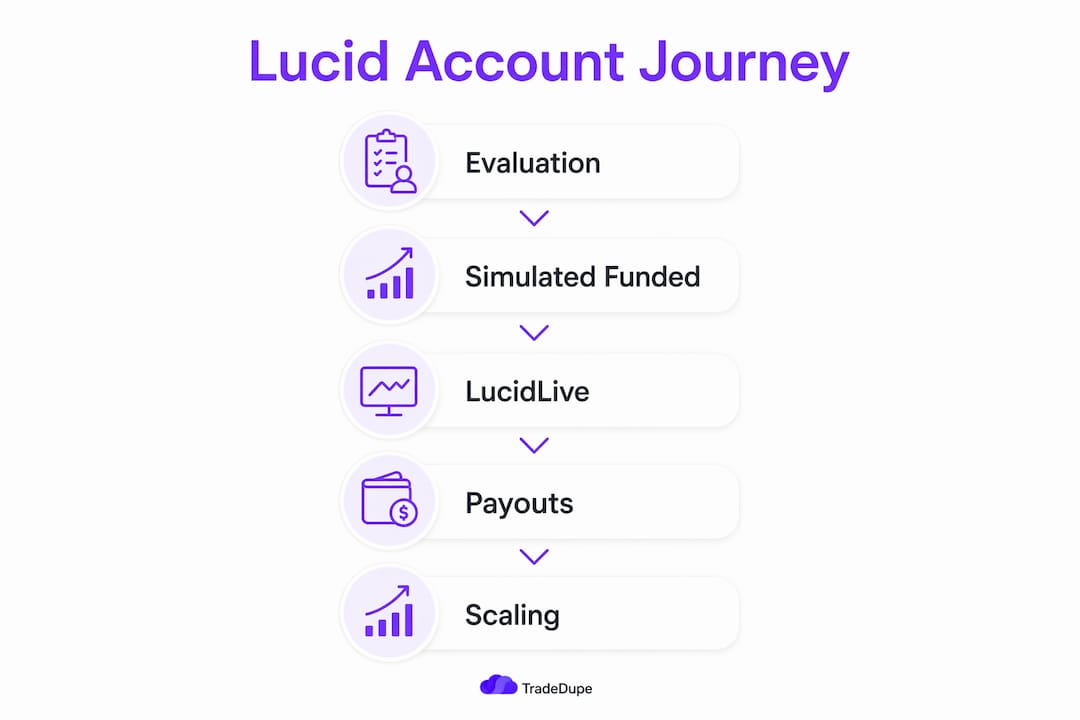
The business model follows a simulated-to-live progression. Traders start in a simulated environment during evaluation and funded phases, then graduate to LucidLive, where real capital from the firm backs the account. That distinction matters: the "earn real capital" language in Lucid's marketing refers specifically to the LucidLive stage, not the evaluation or initial funded phases.
What separates Lucid from older, more established futures firms is the combination of rule transparency and payout proof. Shared payout screenshots circulate across YouTube, Discord, and Reddit trading communities, creating organic credibility that paid advertising rarely achieves. Analysts at PropScorer note that Lucid's rule clarity and payout documentation quality score among the highest they track, contributing directly to its rapid adoption.
*
How do LucidFlex, LucidPro, LucidDirect, and LucidMaxx differ?
Lucid offers four account structures, each targeting a distinct trader profile. Account sizes cover a range of common public tiers.

| Account Type | Evaluation Required | Daily Loss Limit | Consistency Rule | Profit Split | Best For |
|---|---|---|---|---|---|
| LucidFlex | Yes (simulated eval) | None once funded | None once funded | 90/10 | Disciplined traders wanting maximum freedom |
| LucidPro | Yes (simulated eval) | Fixed DLL (soft breach) | 40% on funded | 90/10 | Structured traders comfortable with targets |
| LucidDirect | No (instant funded) | Fixed DLL (soft breach) | 20% (strictest) | 90/10 | Proven traders skipping evaluation |
| LucidMaxx | Invite only | Varies | Varies | 90/10 | Experienced, high-performing traders |
LucidFlex is the standout account for traders who want clean, uncomplicated funded rules. Once funded, there is no daily loss limit and no consistency rule. You need profit on five separate days per cycle, with a minimum daily profit threshold that scales by account size. The freedom cuts both ways: undisciplined traders can blow through capital without the guardrails that LucidPro provides.
LucidPro runs a traditional evaluation with a profit target, then transitions to a funded account carrying a 40% consistency rule and a fixed daily loss limit. The consistency rule means your single largest day cannot exceed 40% of total cycle profits. Payouts are available as often as every three days once eligible, which suits active traders who want frequent liquidity.
LucidDirect skips the evaluation entirely for a higher upfront fee. The trade-off is the tightest consistency rule at 20%, meaning profits need to be spread across more trading days before a payout clears. Longer payout timelines also apply compared to LucidFlex. This path suits traders with a documented, consistent track record who want to bypass the evaluation phase entirely.
LucidMaxx is invite-only and details are not publicly listed. It targets experienced traders who have demonstrated performance within the Lucid ecosystem.
Key pros and cons by account:
- LucidFlex: no DLL, no consistency rule once funded; demands strong self-discipline
- LucidPro: cheaper entry point, structured evaluation; consistency rule adds complexity
- LucidDirect: no evaluation wait; higher upfront cost, strictest consistency
- LucidMaxx: premium terms for top performers; not accessible to new traders
*
What are Lucid Trading's most important rules and policies?
Lucid's rule architecture is genuinely different from the intraday-trailing model most futures firms use, and understanding the specifics prevents costly mistakes.
The end-of-day trailing max loss limit only updates at session close. An intraday drawdown, no matter how deep, does not trigger a breach. Once your account closes above the initial trail balance, the max loss limit locks permanently at your starting balance plus $100 and stops moving entirely. That structural feature alone removes a category of stress that intraday-trailing models impose on every trade.
The LucidScale daily loss limit replaces the fixed daily loss limit once a funded account closes above its initial trail balance. The formula is straightforward: your highest end-of-day profit multiplied by 60%. A $4,000 best day sets a $2,400 daily limit that never shrinks on a drawdown. The limit only ever increases, which is the structural opposite of tightening intraday models.
> "The daily loss limit is a soft breach — a bad day pauses you, it does not fail the account. Once a funded account closes above its initial trail balance, the flat daily limit is replaced by the LucidScale DLL: highest EOD profit × 60%, a figure that only ever increases." — JoinProp, Lucid Trading Review 2026
Allowed strategies:
- News trading, with no blackout windows around scheduled events
- Scalping, with no minimum time-in-trade requirement
- Automated systems, expert advisors (EAs), and trade copiers
- Dollar-cost averaging (DCA) and scaling into positions
Prohibited behaviors:
- Microscalping: if more than 50% of your profits come from trades held 5 seconds or less, those profits are forfeited
- High-frequency trading (HFT): first offense triggers a warning; repeat offenses result in profit removal and account restriction
- Hedging opposing positions across accounts, users, or firms
Position close time: All positions must close by 4:45 PM EST Monday through Friday. Open positions auto-close at the cutoff, but this does not fail the account. Overnight and weekend holding is only available on LucidLive real-capital accounts.
Pro Tip: The microscalping rule catches many bot users who assume "scalping is allowed" covers all short-duration trades. If your automated strategy holds positions for 5 seconds or less on a regular basis, audit your trade duration distribution before running it on a Lucid account.
*
How does the evaluation process work, and what are the payout terms?
Lucid's progression follows three phases, with one shortcut available.
Phase 1: Evaluation (LucidPro or LucidFlex). Traders work through a simulated evaluation account with a profit target. LucidPro can be passed in approximately one day; LucidFlex typically takes around two days. There is no hard minimum day requirement to pass.
Phase 2: Simulated Funded. After passing the evaluation, traders upgrade to a simulated funded account and begin working toward payouts. This is still a simulated environment, not real capital.
Phase 3: LucidLive. After five approved payouts, traders are eligible for graduation to LucidLive, where the firm funds a real brokerage account with its own capital. Consistency rules are fully waived at the LucidLive stage.
LucidDirect skips Phase 1 entirely. Traders pay a higher upfront fee and move directly into the simulated funded environment, subject to the 20% consistency rule.
| Program | Evaluation Required | Funded in | Consistency Rule | Payout Minimum | Payout Speed |
|---|---|---|---|---|---|
| LucidPro | Yes | ~1 day | 40% (funded) | — | ~15 min / 2 business days |
| LucidFlex | Yes | ~2 days | None (funded) | — | ~15 min / 2 business days |
| LucidDirect | No | Immediate | 20% | — | ~15 min / 2 business days |
| LucidLive | Via graduation | After 5 payouts | None | Varies | Live account |
> "The profit split is 90/10 on all funded plans, as the base rate. It is not a paid upgrade and there is no higher tier to buy." — JoinProp, Lucid Trading Review 2026
The minimum payout across all plans is $500, which can be requested any day once eligible. Lucid's Terms commit to disbursement within 2 business days; the platform markets a 15-minute average, which reflects domestic Plaid transfers. International transfers can take the full 2 business days. Treat the 2-business-day figure as the binding commitment when planning cash flow.
One structural detail that catches traders off guard: LucidPro and LucidDirect accounts carry a "trapped buffer" equal to the initial max loss limit plus $100. You cannot withdraw funds down into that buffer, so your withdrawable balance is always net of that floor. LucidFlex has no buffer, which is one reason experienced traders gravitate toward it.
*
Why do traders prefer Lucid over more traditional prop firms?
The advantages of Lucid Trading accounts become clearest when you compare feature categories rather than brand names.
Profit split structure. A 90/10 base split with no paid upgrade is genuinely rare in futures prop trading. Many firms advertise high splits but require a premium tier purchase to access them. Lucid's split applies from the first funded payout on every plan.
Drawdown model. End-of-day trailing drawdown is materially more forgiving than intraday trailing. A trade that goes against you intraday but recovers by session close does not move your drawdown floor. That structural difference changes how you size positions and manage risk during volatile sessions.
Soft breach policy. Hitting the daily loss limit pauses your trading until the next session rather than terminating the account. Analysts at JoinProp and TradingVPS both flag this as a major structural advantage over firms that use hard liquidation on daily limit breaches. Traders recover from bad days instead of restarting from scratch.
Strategy permissiveness. News trading, scalping, bots, and trade copiers are all allowed. Many prop firms prohibit at least one of these, forcing traders to modify strategies that work in live markets. Lucid's permissive stance means your actual trading approach is more likely to transfer without behavioral changes.
Payout speed and transparency. Payout proof shared publicly across trading communities creates accountability. When traders post real withdrawal confirmations, it builds trust in a way that marketing copy cannot replicate.
Fee structure. Lucid charges a one-time fee with no monthly subscription, no activation fee, and no auto-rebill. The total cost of holding an account is the upfront evaluation or direct funding fee, period.
*
How Tradedupe enhances trading with Lucid accounts
Running multiple Lucid accounts simultaneously is where Tradedupe's capabilities become directly relevant. Tradedupe is a SaaS platform built specifically for prop traders using Tradovate, enabling real-time trade mirroring from a single leader account to multiple follower accounts with a median latency of 34ms.
For traders managing several Lucid funded accounts, that latency figure matters. A 34ms mirror means follower accounts execute at nearly the same price as the leader, preserving the trade logic and risk parameters the strategy was built around. Slippage from delayed copying can erode the profit split advantage quickly, particularly on scalping strategies where entry precision is everything.
> "TradeDupe enables real-time copy trading for Lucid accounts with minimal latency and powerful risk management features including rogue-trade detection and auto-recovery." — Tradedupe, Lucid Trading Copy Trading 2026
Tradedupe's feature set for Lucid account holders includes:
- Rogue-trade detection that flags and halts unauthorized or anomalous orders before they execute
- Auto-recovery that reconnects and resynchronizes follower accounts after connection interruptions
- Per-account toggle controls allowing you to pause or activate individual follower accounts without affecting others
- Real-time dashboard showing leader and follower sync status, open positions, and account-level analytics
- AI-powered trade analysis for reviewing performance patterns across the full account set
Tradedupe supports Lucid Trading alongside other major prop firms including Apex and Alpha Futures, making it practical for traders who hold accounts across multiple firms. Tiered subscription plans cover individual traders through to enterprise-level prop desks with unlimited broker connections. The copy trading benefits compound when you hold LucidFlex accounts specifically, since the absence of a daily loss limit and consistency rule means the leader's full strategy translates cleanly to each follower without rule conflicts.
*
Pros and cons of Lucid Trading accounts
Pros:
- 90/10 profit split as a base rate on every funded plan, no upgrade required
- Payouts averaging around 15 minutes, among the fastest in the futures prop sector
- Soft daily loss breach: a bad day pauses trading, it does not end the account
- End-of-day trailing drawdown removes intraday breach risk
- LucidFlex carries no daily loss limit and no consistency rule once funded
- News trading, scalping, bots, and trade copiers all permitted
- One-time fee structure with no monthly subscription or activation charge
- Clear, published rules with detailed per-plan documentation
- Path to real capital via LucidLive graduation after five payouts
- Strong Trustpilot reputation with a high rating from many reviews
Cons:
- Launched in 2025, giving the firm under two years of operational history
- Microscalping detection forfeits profits on trades held 5 seconds or less if they exceed 50% of gains
- LucidPro carries a 40% consistency rule that requires spreading profits across multiple days
- LucidDirect has the tightest consistency rule at 20% and longer payout timelines
- The buffer on Pro and Direct accounts restricts withdrawals below a certain level
- No overnight or weekend holding on simulated accounts
- LucidFlex's lack of guardrails can accelerate losses for undisciplined traders
- Rule set is still evolving; industry analysts recommend verifying current terms before purchasing
*
How to open and fund a Lucid Trading account
The process is straightforward and largely automated.
Step 1: Choose your account type. Decide between LucidFlex, LucidPro, or LucidDirect based on your trading style, risk tolerance, and whether you want to complete an evaluation. LucidMaxx requires an invitation.
Step 2: Select your account size. Options run $25K, $50K, $100K, and $150K. Your max loss limit and daily loss limit scale with account size.
Step 3: Pay the one-time fee. Lucid charges a single upfront fee with no recurring charges. Pricing starts from an affordable entry level, with the exact amount depending on account type and size. No activation fee applies.
Step 4: Account setup. Most accounts become tradeable quickly through automated setup. Higher-load periods or provider-dependent activations may take longer.
Step 5: Connect your trading platform. Lucid supports NinjaTrader, Tradovate, TradingView, Quantower, Sierra Chart, and a range of Rithmic-supported platforms including Bookmap, Jigsaw, ATAS, and MultiCharts. Platform access depends on your data provider (CQG/Rithmic).
Step 6: Complete the evaluation (LucidPro/LucidFlex). Hit the profit target while respecting the max loss and daily loss limits. LucidDirect traders skip this step.
Step 7: Upgrade to funded. After passing the evaluation, upgrade your account through the dashboard to begin the funded phase and work toward payouts.
Step 8: Request payouts. Once eligible, submit a payout request through Dashboard → Payouts, complete KYC verification if prompted, and select your payout method. Domestic Plaid transfers typically process in minutes; international transfers take up to 2 business days.
Account limits: Lucid allows up to 10 active evaluation accounts and up to 5 active funded accounts per household, with a combined cap of 10 total across both categories.
*
What risk management tools does Lucid Trading provide?
Lucid's risk architecture is built around structural protections rather than manual interventions, which suits traders who want rules that work automatically rather than requiring active monitoring.
The end-of-day trailing max loss limit is the primary structural safeguard. It updates only at session close, so intraday volatility does not trigger breaches. Once the account closes above the initial trail balance, the max loss locks at starting balance plus $100 permanently. That lock is a ceiling on downside risk for the firm and a floor on account stability for the trader.
The LucidScale DLL functions as a dynamic daily risk budget that grows with your performance. Because it is calculated from your highest end-of-day profit and only moves upward, a profitable trader's daily allowance expands over time rather than tightening. This design rewards consistency and gives profitable traders more room to operate.
Automated position close at 4:45 PM EST prevents overnight exposure on simulated accounts. Positions that remain open at the cutoff auto-close without failing the account, which removes the risk of unexpected overnight gaps affecting your drawdown floor.
For traders using Tradedupe alongside Lucid accounts, the platform adds a second layer of risk control through rogue-trade detection and per-account toggle controls. If a follower account approaches a risk threshold, you can pause it independently without disrupting the leader or other followers. The security architecture behind Tradedupe is designed specifically for multi-account prop trading environments where a single error can cascade across accounts.
Pro Tip: If you are running multiple Lucid accounts through a copy trading setup, configure Tradedupe's per-account toggles to reflect each account's specific drawdown floor. A follower account with a smaller remaining drawdown buffer should carry a lower position size than the leader, not a 1:1 mirror.
*
What does Lucid Trading's customer support look like?
Lucid has invested in the support infrastructure that fast-growing prop firms often neglect. The dashboard experience covers account monitoring, objective tracking, and payout requests in a single interface, reducing the volume of support tickets that arise from navigation confusion.
Support resources include a detailed Help Center with per-plan documentation, FAQ pages covering evaluation rules, payout mechanics, and platform setup, and community channels where traders share experiences and ask questions. The Help Center articles are maintained and updated when rules change, which is a meaningful commitment for a firm that has been evolving its rule set since launch.
Response quality is reflected in the Trustpilot rating. With a score around 4.7/5 from thousands of reviews, the firm's support performance is clearly a factor in trader retention. Analysts at TradingVPS note that fast customer support and transparent communication will become increasingly important as Lucid's customer base continues to expand.
One practical note: Lucid's FAQ explicitly states that accounts with no net P/L of at least $1 within 30 calendar days are deemed abandoned and permanently deleted. Breached evaluation accounts are also auto-deleted after 30 days if not reset. Neither deletion is reversible, so traders who step away from an account need to be aware of the inactivity threshold.
*
Common challenges traders face with Lucid accounts and how to work through them
The microscalping trap. Traders who run high-frequency or very short-duration strategies often discover the microscalping rule after the fact. The rule does not prohibit scalping; it prohibits a situation where more than 50% of your profits come from trades held 5 seconds or less. The fix is straightforward: audit your strategy's average trade duration before running it on a Lucid account, and adjust hold times if the distribution skews heavily toward sub-5-second exits.
The consistency rule on LucidPro and LucidDirect. A single outsized trading day can push your largest-day-to-total-profit ratio above the 40% or 20% threshold, blocking a payout. The account does not fail; the payout is simply denied until you dilute that ratio by trading additional profitable days. Traders who experience this should continue trading normally rather than forcing trades to hit the ratio, since forced trades often create new problems.
The trapped buffer on Pro and Direct accounts. The buffer (initial max loss limit plus $100) is a floor you cannot withdraw below. Traders who do not account for this when calculating withdrawable profits find their first payout request denied. LucidFlex eliminates this issue entirely, which is one reason it attracts traders who prioritize payout simplicity.
Selecting the wrong account type. Industry analysts consistently flag this as the most common avoidable mistake. LucidFlex, LucidPro, and LucidDirect share the 90/10 split and soft daily loss policy, but differ enough on consistency rules, buffers, and payout timelines that the wrong choice can make an otherwise sound strategy fail the payout criteria. Match the account to your actual trading pattern before purchasing.
Managing multiple accounts without a copy trading system. Traders who hold several Lucid funded accounts and attempt to manage them manually face execution timing problems and inconsistent position sizing. A futures trade copier like Tradedupe resolves this by mirroring the leader account to all followers in real time, keeping execution consistent across the full account set. For traders evaluating options trade ideas across multiple accounts, resources like Morning Options can complement a systematic copy trading workflow by providing pre-market analysis to inform the leader account's decisions.
*
Scale your Lucid accounts with Tradedupe
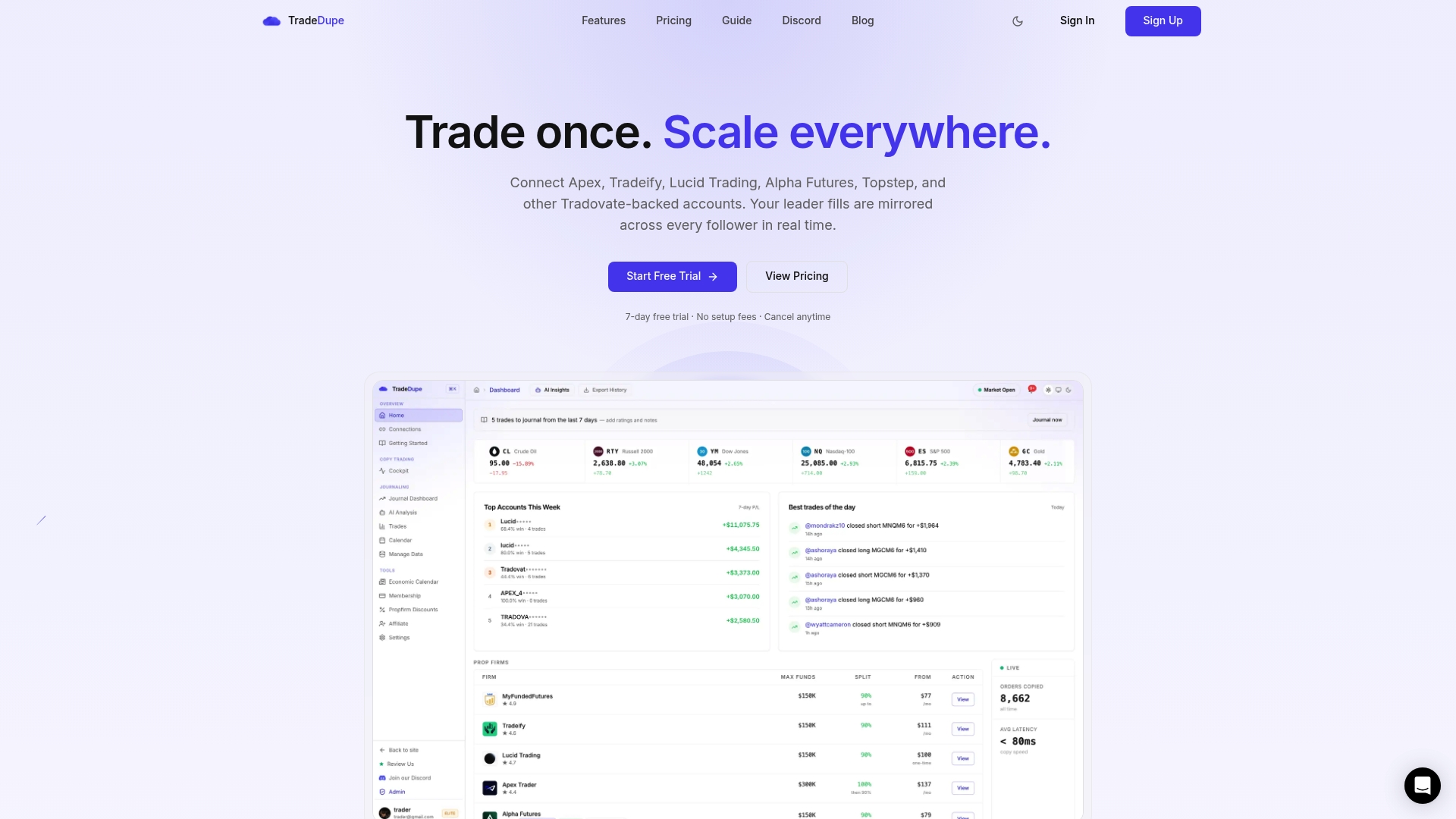
Tradedupe is built for exactly the scenario Lucid Trading creates: a trader with multiple funded accounts who needs consistent, low-latency execution across all of them. With a median mirror latency of 34ms, rogue-trade detection, and per-account risk controls, Tradedupe turns a single well-executed trade on your leader account into a coordinated position across your entire Lucid account set.
The platform integrates natively with Tradovate, which Lucid supports, and offers tiered plans from individual traders to enterprise prop desks. Setup takes under 10 minutes. Start mirroring your Lucid accounts and let your edge work at full scale.
*
Key Takeaways
Lucid Trading accounts stand out in 2026 because the 90/10 base split, soft breach policy, and end-of-day drawdown combine to create a risk model that is materially more forgiving than the intraday-trailing standard most futures firms use.
| Point | Details |
|---|---|
| 90/10 split is the base rate | Every funded plan pays 90% to the trader with no paid upgrade required. |
| Soft breach protects accounts | Hitting the daily loss limit pauses trading until the next session, not account termination. |
| EOD drawdown removes intraday risk | The max loss limit only updates at session close, so intraday dips do not trigger breaches. |
| LucidFlex offers maximum freedom with no daily loss limit or consistency rule once funded. It has a $500 minimum payout. | |
| Account type selection is critical | LucidFlex, LucidPro, and LucidDirect differ on consistency rules and buffers; matching your strategy to the right plan determines payout success. |