
Auto Trade Recovery for Tradovate Prop Accounts: Test Before Trading
TradeDupe
8 min read
Learn how automated recovery repairs missed copies across Tradovate prop accounts with checks on the server, monitoring, and test drills before live trading.
Auto trade recovery is the automated reconciliation and replay of fills a follower account missed, and for Tradovate copy trading it is a practical safety layer, provided it runs server-side and you verify it. We built TradeDupe around that idea, and industry risk-control guidance from FIA and the CFTC points the same way: automation works when controls and checks surround it.
*
> TL;DR: > > - Compare follower positions with broker and exchange execution reports first; replay only recent misses, cap retries, and require approval for larger or older gaps. > - Price collars, size caps, message throttles, disconnect cancellations, partial fills, and firm risk locks can block copies; confirm each prop firm's rules directly. > - After an incident, match order IDs, execution IDs, and timestamps; if capped retries leave a mismatch, stop repair on that account and flatten manually. > - Rehearse drops, rejections, and partial fills on paper accounts, with weekly checks and monthly full drills; resume funded trading only after records match.
*
Table of Contents
- How does automated recovery work in a copy-trading system?
- What causes desync and missed copies?
- Which automatic recovery techniques should you use?
- How do you set up Tradovate accounts for reliable recovery?
- What should you monitor to confirm recovery worked?
- How do you test recovery before it matters?
- Why automation needs routine verification
- How we handle recovery in TradeDupe
- FAQ
- Sources
How does automated recovery work in a copy-trading system?
Recovery starts with a clean picture of what the leader account did. Every fill, cancel and modification has to reach the copier, and each follower has to be compared against that record. When the two disagree, the system repairs the gap.
The building blocks look like this:
- Leader events: fills arrive from Tradovate over live WebSocket streams, so the copier sees what the leader did as it happens.
- State reconciliation: the copier tracks orders, fills and cancels per follower and flags any follower whose position no longer matches the leader.
- Replay: the copier re-sends an order a follower never received, inside a limited window and with capped retries.
- Report-based reconciliation: instead of replaying, the system compares positions against execution reports and corrects the difference. Replay fixes a missed event, while reconciliation fixes the resulting position. They overlap, but they are not the same repair.
Latency matters because a stale repair can fill at a very different price than the original. Server-side mirroring keeps the gap small, and our copying typically runs under 100ms. Nothing runs on your PC or VPS, so a home internet drop does not take the copier down with it.
What causes desync and missed copies?
Before you lean on recovery logic, rule out the usual root causes. Most missed copies trace back to a short list.
- Connection drops: a disconnect can trigger cancel-on-disconnect behavior at the exchange or broker, which cancels working orders you expected to stay live.
- Price collars and quantity limits: exchange-enforced screens reject orders outside a reasonable price band or above a size cap, so a follower order can bounce while the leader's fills.
- Message throttles: rate limits can delay or drop messages when many accounts send orders at once.
- Partial fills and manual edits: a partly filled leader order, or a manual change on a follower, leaves order states that no longer line up.
- Firm-side blocks: a prop firm rule or risk lock can reject an order for reasons unrelated to the copier. Confirm the specifics with each firm.
FIA best-practice commentary lists price collars and quantity limits alongside execution throttles and cancel-on-disconnect as standard controls. Automation without oversight is itself an operational risk, so treat recovery as a backstop, not a substitute for watching your accounts.
Which automatic recovery techniques should you use?
Different failures call for different repairs. These are the techniques worth having, in rough order of priority:
- Execution-report reconciliation first. Compare follower positions against what the exchange and broker actually recorded. Real-time drop-copy feeds are widely used for exactly this, and they give you evidence rather than assumptions.
- Server-side replay with a short window. Replay a missed order only if it is recent enough that the price is still reasonable. Set a maximum replay age so a stale order never fires.
- Capped retries. Allow a small, fixed number of attempts per order. An endless retry loop against a rejecting account makes things worse.
- Cancel-on-disconnect awareness. Know which working orders disappear when a session drops, so recovery does not double up on orders the exchange already removed.
- Safe-limit repair orders. Any repair order should respect size and price limits and your firm's daily loss limit. Automatic repair should never exceed what you would place by hand.
- Human sign-off for large gaps. Let small, recent mismatches repair automatically and route anything bigger to manual review.
Pro Tip: Allow automatic repair for small gaps inside a short window, and require your own confirmation for anything larger or older.
How do you set up Tradovate accounts for reliable recovery?
Work through this checklist before your next session, in order:
- Connect each account through Tradovate's official OAuth flow and confirm the connection shows healthy. Never hand a copier your password.
- Choose your leader account and enable only the followers you intend to trade.
- Confirm any trade-report or execution feed your setup offers, and check that order IDs and timestamps line up between leader and follower.
- Review the daily loss limits and profit targets set on Tradovate, since the broker enforces them and they can block a repair order.
- Set the replay window, retry cap and size or price limits for automated repair.
- Write down your manual-repair steps and who to contact at the firm or broker if an account locks.
Inside the copier, confirm these controls too:
- Per-account copy toggles so you can pause one follower without touching the rest.
- Rogue-trade detection to catch follower trades the copier did not place.
- Execution mode controls that match how you want orders handled.
Rules differ across Apex Trader Funding, Tradeify, Lucid Trading, MyFundedFutures, Alpha Futures and TakeProfit Trader, so confirm copy-trading and automation policies with each firm directly. If you want more detail on the full workflow, our Tradovate trade copier page covers account sync in depth.
What should you monitor to confirm recovery worked?
A repair you cannot verify is just a guess. Check evidence after every incident, not only when something looks wrong.
- Match identifiers: compare order ID, exchange execution ID and timestamps between the leader event and each follower event.
- Read the reconciliation output: a repeated pattern, such as one follower always lagging, points to a specific account or firm rule rather than random noise.
- Set alerts: trigger notifications for failed replays, repeated rejections and position mismatches past your threshold.
- Know when to step in: if a mismatch persists after the capped retries, flatten manually and stop automated repair on that account.
- Write it down: note what happened, what recovered it and what you changed, so the next incident is faster to diagnose.
Our guide to trade copier audit logs walks through verifying each copied trade, and our post on order desync and recovery covers a step-by-step repair workflow.
How do you test recovery before it matters?
Confidence comes from rehearsal on a paper account, never from hoping it works live. Run these tests:
- Simulate a connection drop and confirm which orders cancel on disconnect.
- Force a rejection and a partial fill, then watch whether replay and reconciliation correct the follower.
- Run an end-to-end comparison of leader and follower records and time how long a repair takes.
- Repeat on a schedule: a quick check weekly and a full drill monthly.
Pass means every follower ends flat or matched with the leader, inside your replay window, with a clean log trail. Fail means any unexplained mismatch, and that gets fixed before you trade funded accounts again.
Why automation needs routine verification
Here is where I land after thinking hard about recovery: it is valuable, and it is not a reason to stop checking. A copier can repair a missed fill in seconds, but it cannot know that your firm changed a rule overnight or that a payout depends on a consistency threshold. Treat recovery tests as part of your pre-session checklist, the same way you check your calendar, and confirm every firm rule directly with the firm. Automation plus oversight is what protects funded accounts and payouts.
> — Andres
How we handle recovery in TradeDupe
If you run several Tradovate prop accounts, we built TradeDupe to do this job. It connects through Tradovate's official OAuth flow, mirrors fills server-side typically under 100ms, and includes rogue-trade detection and per-account copy toggles. It works with the Tradovate-based firms listed above.
[CTA_PLACEHOLDER]
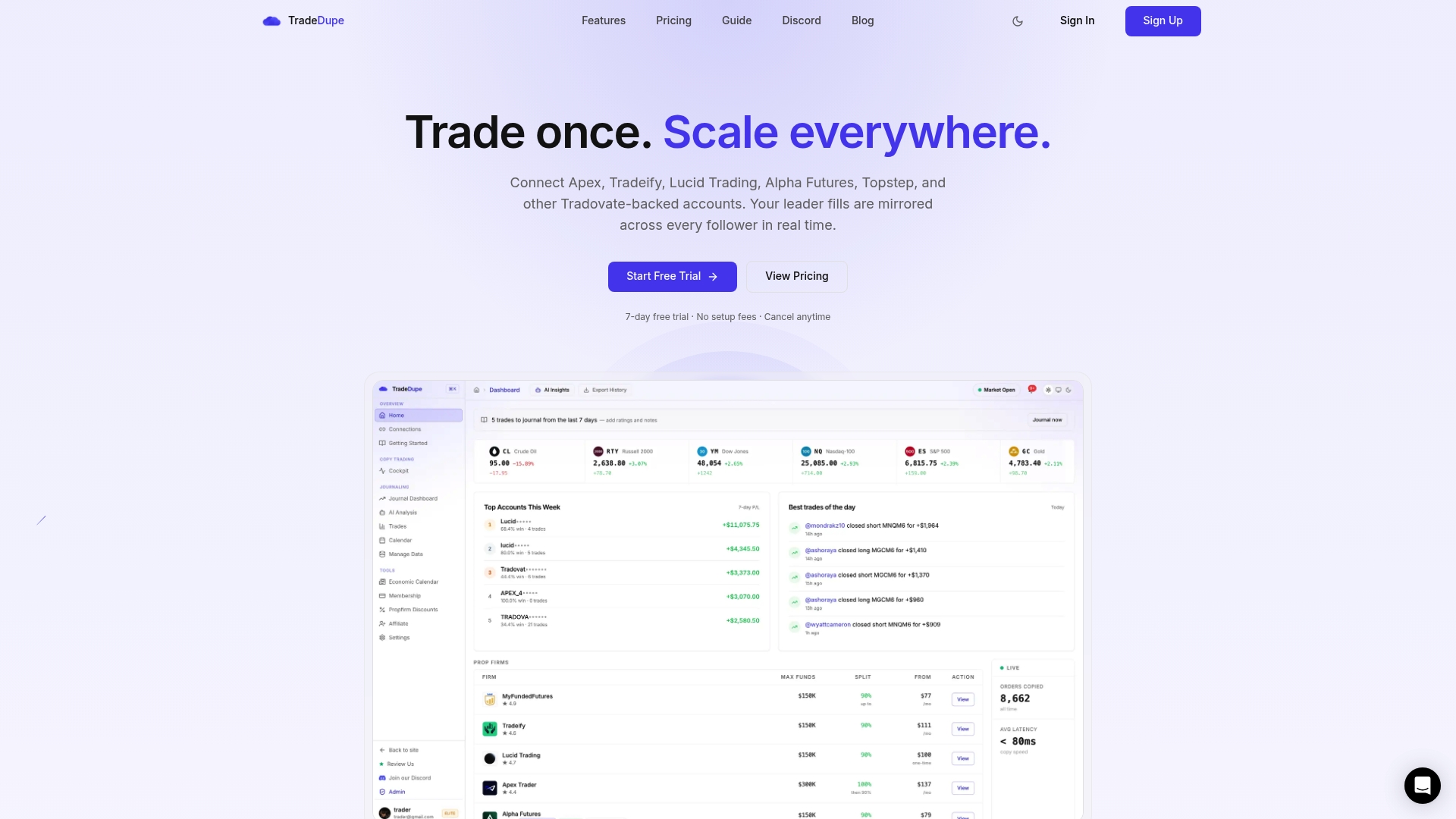
You can read how copying works in our copy trading explainer, compare options on our features page, and see current pricing. Plans start at $20/month billed yearly, and every plan includes a free trial with cancellation available. Start the trial, connect your leader and one follower, and run the drills above before you add the rest.
FAQ
What is auto trade recovery in copy trading?
It is the automated detection and repair of follower trades that failed to mirror the leader. The copier compares positions, then replays or corrects the gap within safe limits.
Does auto trade recovery guarantee every trade is copied?
No. Rejections, firm rules and exchange limits can still block a repair, so you should verify results with logs and routine checks.
How fast does recovery need to be?
Faster is better, because late repairs can fill at worse prices. Our server-side mirroring typically runs under 100ms, and a short replay window keeps stale orders from firing.
Should I let recovery fix mismatches automatically?
Allow it for small, recent gaps and require your sign-off for larger or older ones. Industry guidance treats unsupervised automation as an operational risk.
Sources
- Comments
- Technology Advisory Committee Presentation: Automated and Modern Trading Markets Subcommittee - FIA Best Practices for Exchange Risk Controls
Recommended
- 34ms Mirroring: Per Account Disaster Recovery Trading on Tradovate
- Trade Reconciliation Automation for Tradovate Prop Desks: 6 Essentials
- Tradovate Trade Copier | Real-Time Account Sync
- Tradovate Copy Trading: Pro Setups for Multi-Account Traders
For educational purposes only. Not financial advice. Futures trading involves substantial risk of loss and is not suitable for every investor.