34ms Copy Mirroring for Tradovate Prop Desks, Not Retail VPS
TradeDupe
9 min read
Operations-first how-to for Tradovate prop desks: set up server-side copy mirroring (34ms median), follow the checklist, test failover, and keep...
For prop desks running Tradovate, "copy trading on VPS" means server-side trade mirroring, not a retail VPS running an expert advisor. The correct architecture is a dedicated SaaS copier that replicates a leader account's fills to multiple follower accounts with per-account safeguards, audit logs, and low-latency execution. One example is a purpose-built server-side mirroring solution engineered specifically for Tradovate's API, with a reported median replication latency of 34ms.
*
> TL;DR: > > - Prop firms often restrict or prohibit copying trades across accounts they own, so verify compliance with each firm's specific rules before implementation. > - Median replication latency of a dedicated server-side trade copier is around 34ms, which is within the acceptable window for futures trading speed. > - Proper setup requires generating individual API tokens, mapping followers, setting risk limits, and establishing real-time monitoring to ensure reliability and security. > - Testing should include isolated contract runs, volume scaling, disconnect recovery, and detailed audit reconciliation before full deployment. > - Human oversight and auditability remain more critical to desk safety than marginal improvements in latency speed.
*
Table of Contents
- Why Server-Side Mirroring Fits Multi-Account Tradovate Desks
- How Does Trade Mirroring Actually Work on Tradovate?
- What Prop-Firm Rules Should You Check Before Copying?
- Setup Checklist for Configuring Copy Mirroring on Tradovate
- Monitoring, Latency, and Reliability Controls That Matter
- How Do You Test Before Going Live With Multi-Account Copying?
- Author Perspective: Operations-First Priorities for Prop Desks
- Getting Started With Server-Side Mirroring on TradeDupe
- Sources
- FAQ
Why Server-Side Mirroring Fits Multi-Account Tradovate Desks
Retail-style copy trading, where a VPS hosts an EA that watches one terminal and clicks orders on another, was never built for prop-firm scale. Tradovate desks running six, twelve, or thirty funded accounts need something that behaves like infrastructure, not a script.
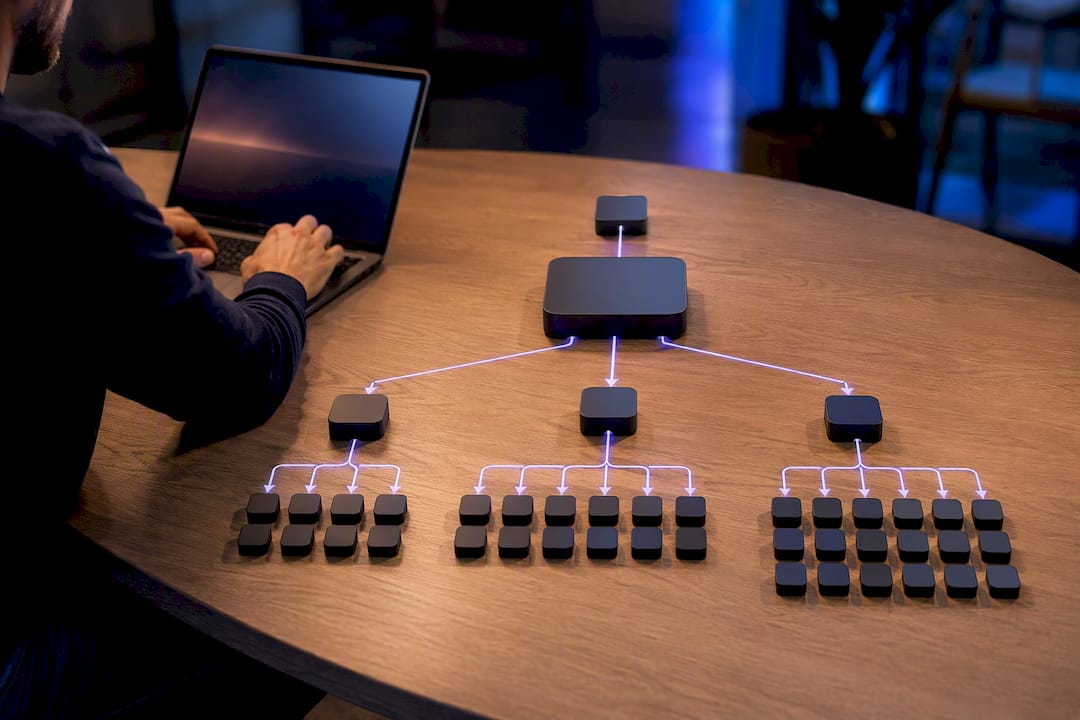
Server-side mirroring solves three problems retail setups can't: centralized risk rules that apply the same daily loss cap across every follower, per-account toggles so one account can be paused without touching the rest, and a single audit trail an operator (or a prop firm) can actually review. Tradovate's own native group trade function handles market-order copying, but only within accounts sharing one login, and it doesn't cover bracket orders or cross-login replication.
Desks running mixed firms and multiple logins need more. Requirements that drive the server-side model include:
- Multi-login support across accounts that don't share a single Tradovate credential
- Compatibility with different prop firms holding different rule sets on the same desk
- Per-account position sizing rather than a uniform lot multiplier
- Consolidated logging that satisfies both internal risk review and firm audits
How Does Trade Mirroring Actually Work on Tradovate?
The mechanics are straightforward once you see the pipeline: the leader account places an order, a server-side engine intercepts and evaluates it against each follower's rule set, then it fires replicated orders through each follower's own Tradovate API token. No terminal-to-terminal clicking, no shared login.
- Capture. The leader's order fires and the engine reads instrument, direction, size, and order type.
- Rule evaluation. The engine checks each follower's sizing mode, instrument filters, and account-specific constraints before touching that account.
- Execution. Orders route to followers through their individual API tokens, extending copying across separate logins and prop firms in ways Tradovate's native tool cannot.
- Confirmation. Fill data returns to the dashboard for reconciliation against the leader's execution.
Sizing usually runs on one of three modes: fixed contract ratio, percentage-based scaling relative to account size, or a flat fixed contract count per follower. Some setups add instrument filtering so a follower only mirrors specific products.
Statistic Callout: TradeDupe reports a median replication latency of 34ms across leader-to-follower execution, well inside the sub-50ms window generally considered a reasonable target for server-side systems at futures-trading speed. The metrics worth demanding from any copier: median latency in milliseconds, replication success rate, and reconciliation completeness between leader and follower fills.
What Prop-Firm Rules Should You Check Before Copying?
Before you flip a single toggle, read your firm's fine print. This is the step desks skip and regret. Prop firms vary widely on copy-trading permissions: many prohibit identical trades across multiple accounts under the same ownership, and some ban cloud-based copiers outright regardless of how the trades are sized.
Confirm these before go-live:
- Whether the firm restricts or bans copying between accounts you own
- Whether cloud-based or third-party copier tools require specific approval
- Any correlated-trading prohibitions that could flag near-identical entries
- Account-type restrictions that differ between evaluation and funded accounts
Operationally, you also need documented account ownership, a clean API token management process, and written sizing rules per account before you go live.
Pro Tip: Build in small, verifiable differentiators between accounts, timing offsets of a few seconds or minor size variance, and keep dated records of every rule change your firm publishes. Auditability is often what separates a compliant multi-account program from one flagged for review, according to analysis of multi-account compliance risk.
Setup Checklist for Configuring Copy Mirroring on Tradovate
Wiring a desk for server-side mirroring is a sequence, not a single configuration screen. Skip a step and you'll find it the hard way, usually during a drawdown.
- Generate API tokens per account. Issue individual Tradovate API credentials for the leader and every follower, applying least-privilege access and a rotation schedule.
- Map leader to followers. Assign each follower account its multiplier, instrument filters, and any contract caps before enabling live sync.
- Set risk limits. Configure daily loss caps, maximum contract counts, permitted trading hours, and per-account on/off toggles.
- Enable safety logic. Turn on rogue-trade detection, auto-recovery for connection drops, and a defined emergency stop.
- Stand up monitoring. Connect a real-time dashboard, reconciliation logging, and alerts for replication failures.
Beyond the sequence, a few operational habits matter as much as the setup itself:
- Test each API token in isolation before mapping it into the group
- Document every multiplier and filter choice in case a firm asks for it
- Review the emergency-stop procedure with every desk member, not just the engineer who built it
- Schedule periodic reconciliation audits rather than relying only on real-time alerts
The Tradovate trade copier architecture is worth studying here, since real-time sync design differs meaningfully between a native group-trade feature and a purpose-built server-side engine.
Monitoring, Latency, and Reliability Controls That Matter
Setup is the easy part. What separates a desk that runs copy mirroring for years from one that has a bad week is what happens after go-live, when a connection drops or a follower account hits a limit mid-session.
Track these continuously:
- Replication latency distribution, not just an average, since tail latency is where slippage hides
- Order success rate per follower account
- Sync drift between leader position and follower position over time
Reliability design comes down to a real decision: fail-open, where the system keeps trying quietly, or fail-safe, where it halts copying and alerts a human. Most desks running funded accounts should lean fail-safe. Documented risk-management practice for multi-account futures trading recommends controlled retry logic paired with automatic recovery on reconnect, rather than either silent failure or an immediate full stop on every hiccup.
Security matters just as much as uptime here: API key access should be scoped and logged, every order needs a timestamped audit trail, and daily reconciliation between leader and follower fills should be a standing task, not an afterthought. Dashboards should surface the worst deviation first. A follower ten seconds behind on one contract is a footnote; a follower that stopped syncing entirely is the fire.
How Do You Test Before Going Live With Multi-Account Copying?
Never flip on full-size copying across a live desk without a dry run. The sequence that actually catches problems:
- Run single-contract tests across every leader-follower pair to confirm basic execution parity.
- Scale up to realistic contract sizes and repeat, watching for slippage that only shows up at volume.
- Force a disconnect and reconnect mid-session to confirm auto-recovery behaves as designed.
- Reconcile every fill against the audit log, leader and follower side by side.
- Run a simulated audit query, as if a prop firm's compliance team asked for your records right now.
Once that passes, roll out in stages: enable a handful of accounts, review daily for a week, then expand, with the emergency stop procedure documented and known to everyone on the desk before you add the next batch.
Author Perspective: Operations-First Priorities for Prop Desks
The obsession with shaving milliseconds off replication latency is mostly misplaced. What actually protects a multi-account desk is auditability and a human override that works every time, not a copier that's 5ms faster than the last one. Complexity creeps in fast once you're running a dozen accounts across different firms, and every added feature is another thing that can fail silently. Keep one emergency-stop path, keep it simple, and make sure someone always knows how to pull it.
> — Andres
Getting Started With Server-Side Mirroring on TradeDupe
Certain trade mirroring platforms are built around this checklist: real-time trade mirroring with low latency, rogue-trade detection, auto-recovery on disconnect, and per-account toggles that let you pause a single follower without touching the rest of the desk.
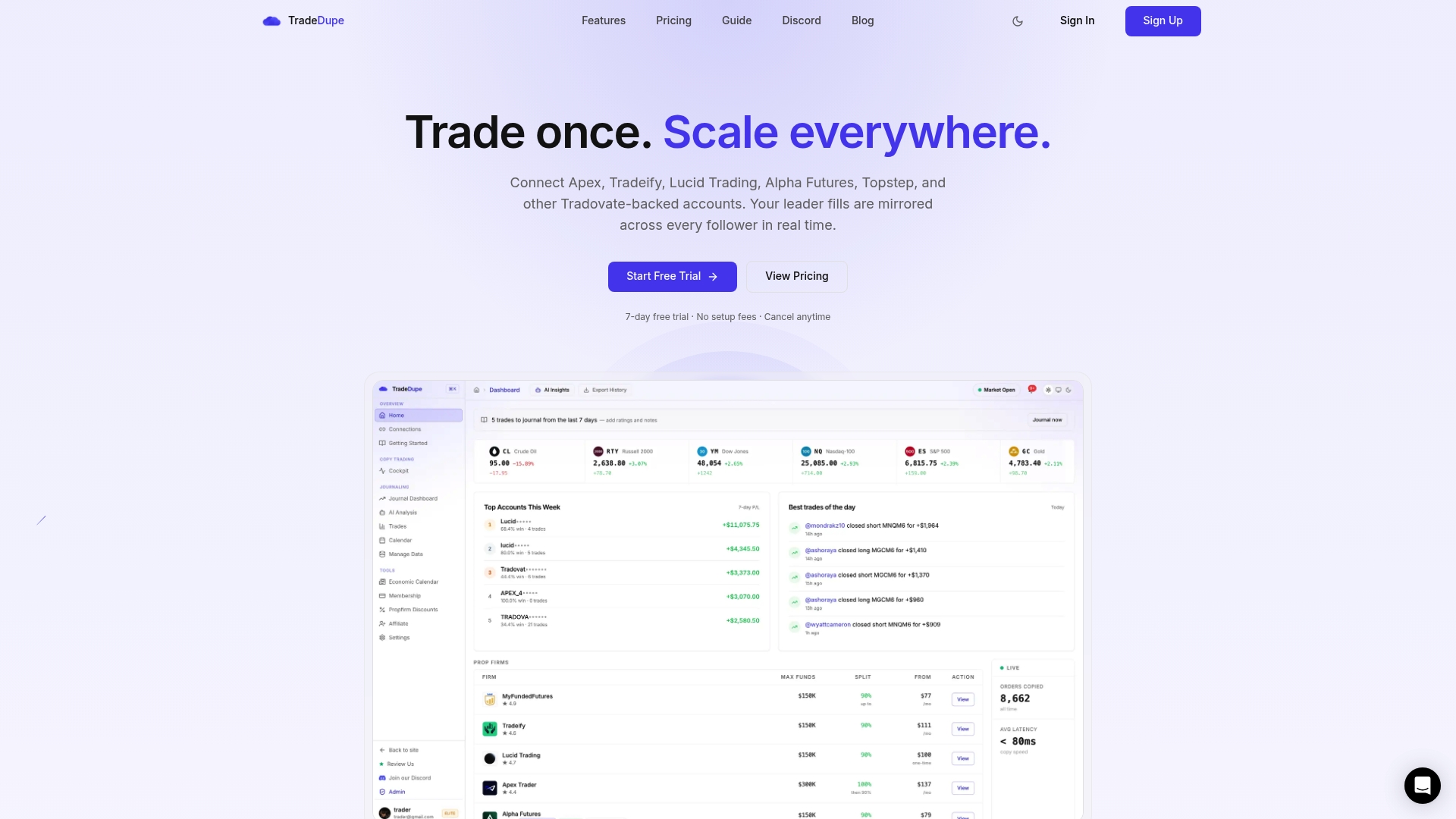
Analytics and reporting sit on top of the sync layer, so reconciliation between leader and follower fills isn't a manual chore at the end of the day. The platform supports unlimited broker connections across firms including Apex, Tradeify, Lucid Trading, and Alpha Futures, which matters if your desk spreads risk across more than one funded-account provider. If your desk is still running the setup checklist on paper, a staged trial with TradeDupe is the faster way to see the dashboard, sync metrics, and toggle controls before committing a full account group to it.
Sources
FAQ
Is Copy Trading on VPS the Same as Using a Retail EA on a VPS?
No. For Tradovate prop desks, copy trading on VPS refers to server-side trade mirroring through a dedicated SaaS engine, not a retail virtual server running an expert advisor.
Does Tradovate Support Copy Trading Natively?
Tradovate's native group trade feature copies market orders within accounts sharing one login, but it doesn't handle cross-login replication or bracket orders, which is why desks running multiple logins use a server-side copier instead.
What Latency Should I Expect From a Server-Side Copier?
Median replication latency under 50ms is a reasonable benchmark for server-side systems; Some service providers report median latencies around 34ms across leader-to-follower execution.
Will Copying Trades Across Accounts Violate My Prop Firm's Rules?
It depends entirely on the firm. Many prohibit identical copying across owned accounts or restrict cloud-based copiers, so confirm the specific policy in writing before enabling anything live.
What Should I Test Before Scaling Copy Mirroring to a Full Desk?
Run single-contract tests, then scaled tests, then force a disconnect and reconnect to confirm auto-recovery, and reconcile every fill against the audit log before expanding beyond a small pilot group.