
Prevent Daily Loss Limit Breaches for Prop Traders via Tradovate
TradeDupe
12 min read
Trader first playbook to compute and enforce daily loss limits across multiple prop accounts. Set 50–70% personal stops and automate enforcement with...
A daily loss limit is a hard ceiling on how much a funded account can lose in a single trading day. Hit it, and the firm pauses your trading, disables the account, or ends the evaluation outright, depending on the program's rules. Daily loss limit protection exists to guard the firm's capital and to physically stop revenge trading before it compounds into a blown account.
*
> TL;DR: > > - Most firms calculate the daily loss limit based on account equity rather than realized balance, making unrealized losses a key risk factor. > - Breaching the limit often occurs due to unaccounted floating losses, commissions, slippage, or misreading reset times, which can accumulate quickly. > - Traders should set personal stops at 50% to 70% of the firm's limit and program alerts at 50%, 70%, and 90% thresholds to prevent revenge trading. > - Disciplining account management across multiple accounts is best enforced through broker-enforced limits and real-time alerts integrated with platforms like TradeDupe. > - Common mistakes include ignoring unrealized losses, misunderstanding reset timings, underestimating trading costs, and over-sizing after winning streaks, which all increase breach risk.
*
Table of Contents
- What Is a Daily Loss Limit and Why Do Prop Firms Enforce It?
- How Do Firms Calculate Your Daily Loss Limit?
- Daily Loss Limit vs Maximum Drawdown: Which Floor Fires First?
- What Are the Best Strategies to Avoid Breaching a Daily Loss Limit?
- How Do You Enforce Daily Loss Limits Across Multiple Accounts?
- What Mistakes Cause Most Daily Loss Limit Breaches?
- Why Systems Beat Willpower in Risk Management
- Automate Your Daily Loss Limit Enforcement With TradeDupe
- Where to Verify Your Firm's Exact Rules
- Sources
- FAQ
What Is a Daily Loss Limit and Why Do Prop Firms Enforce It?
A daily loss limit (DLL) caps the dollar or percentage loss you're allowed to take between one reset and the next. Many prop firms set that ceiling around 4% to 5% of account balance, though some programs use a tighter threshold or a flat dollar figure regardless of account size, according to PropJournal's breakdown of daily loss limit rules.
The rule isn't arbitrary. Firms are underwriting your access to their capital, and a trader without a hard floor can turn one bad morning into a total loss of buying power. DLL protection is the firm's insurance policy against exactly that scenario, and it doubles as a circuit breaker against the psychological spiral traders call revenge trading, where a loss triggers bigger, sloppier trades trying to win it back.
What happens when the limit fires varies by firm:
- Pause: trading locks for the rest of the session, resuming at the next reset.
- Fail: the evaluation or funded account ends immediately, with no grace period.
- Auto-close: the platform force-flattens every open position the instant the floor is touched.
Some programs blend these, pausing new orders while auto-closing existing risk. The mechanics differ enough between firms that assuming "my last prop firm's rules" applies to a new one is a common way traders get blindsided.
How Do Firms Calculate Your Daily Loss Limit?
The single biggest source of confusion around daily loss limit protection is whether the firm measures against your balance or your equity. A balance-based limit only counts realized losses, the ones from trades you've actually closed. An equity-based limit counts your entire open position's floating loss the moment it happens, whether you've closed it or not.
That distinction changes your entire day. Say your account balance is $50,000 and your firm sets a 5% daily limit, or $2,500. Under a balance-based rule, an open trade sitting $3,000 underwater hasn't technically breached anything yet, since nothing is realized. Under an equity-based rule, that same open position trips the limit the second it crosses $2,500 in floating loss, and the account locks with the position still open. Firms like FTMO calculate on an equity basis specifically so unrealized losses count in real time, according to PROP NAVI's comparison of daily loss and max drawdown rules.
> Statistic Callout: Breaches tied to unrealized losses, not just closed trades, are a leading reason funded traders fail their accounts, per PropJournal's data on daily loss limit breaches.
Commissions and slippage almost always count toward your floor too, and traders who size positions against a round-number limit without leaving room for costs routinely eat into their cushion faster than expected.
Reset timing adds another trap. FTMO resets at midnight CE(S)T; Topstep resets at 5:00 PM CT, per PropJournal. Hold a losing position through your firm's reset window and that unrealized loss can carry straight into the next day's calculation, effectively starting you in the hole before the new session even begins.
Before you place a single trade, run this quick math:
- Confirm whether your firm calculates on balance or equity.
- Multiply your current balance (or equity, if that's the basis) by the daily percentage, or note the fixed-dollar figure.
- Subtract any open floating loss already on the books from a position held overnight.
- Note your firm's exact reset time in your own time zone, not theirs.
Daily Loss Limit vs Maximum Drawdown: Which Floor Fires First?
Daily loss limit and maximum drawdown are separate rules, monitored independently, and you can breach one without ever touching the other, according to Tradeclaris's explainer on daily vs max drawdown. The daily limit resets every session. Maximum drawdown tracks your account's entire lifetime and comes in two flavors:
- Static floor: a fixed dollar line that never moves, typically set below your starting balance.
- Trailing floor: a line that rises as your equity climbs, locking in gains but also shrinking your cushion the higher you climb.
A trailing floor is where traders get caught off guard. A strong run of green days pulls the trailing floor up behind your equity, and the buffer you thought you had shrinks even though your balance looks healthy. The safer move after a hot streak is trimming size until that new floor locks in, rather than assuming yesterday's cushion still applies, a point PROP NAVI makes about trailing-drawdown dynamics.
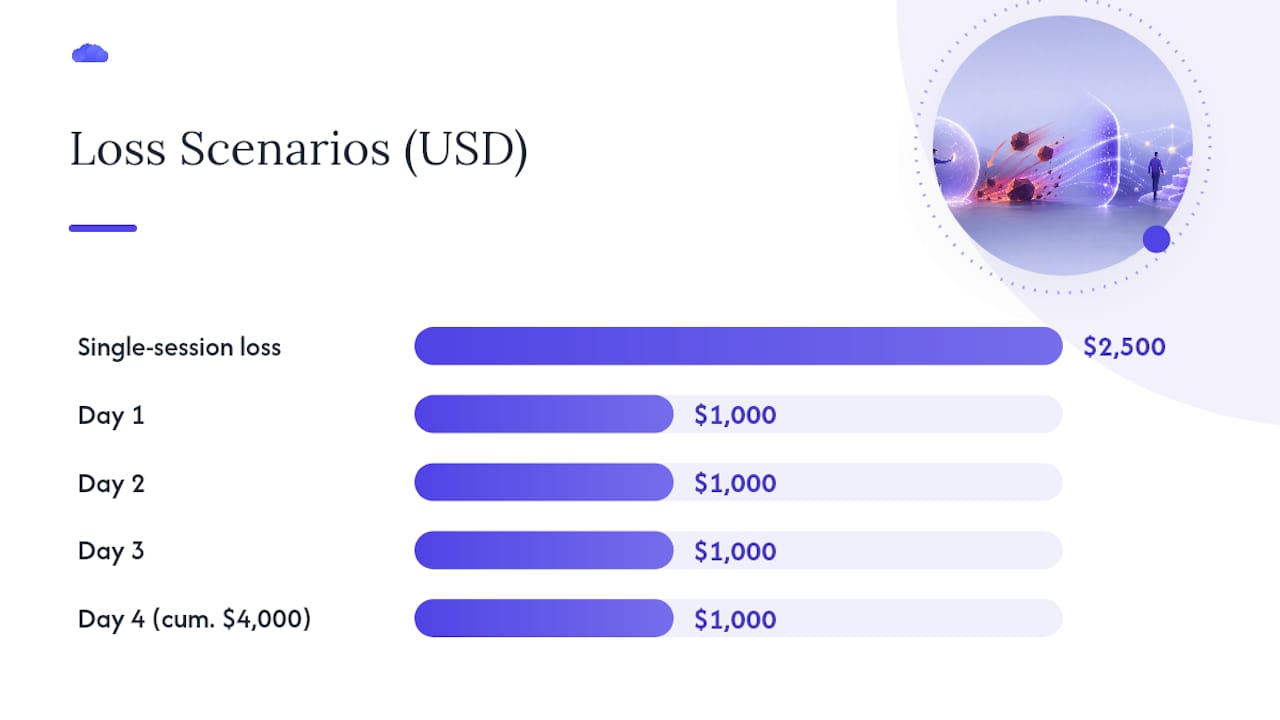
Picture two accounts with a $2,500 daily limit and a $4,000 trailing drawdown, each 10% below peak equity. One trader loses $2,500 in a single session and trips the daily limit first, account intact for tomorrow. Another loses $1,000 a day for four straight days, never touching the daily floor once, but crosses the $4,000 max drawdown on day four. Same total loss, two entirely different failure points.
The action rule is simple: always trade against whichever floor is more restrictive on that specific day, not whichever one is easier to calculate. Read up on trailing drawdown mechanics before assuming your cushion is fixed.
What Are the Best Strategies to Avoid Breaching a Daily Loss Limit?
The firm's daily loss limit is a wall, not a target. The traders who survive funded evaluations treat it as the absolute last line, with several personal safeguards standing in front of it.
- Set a personal stop tighter than the firm's. A personal daily stop at 50% to 70% of the firm's limit gives you room to recover from a bad stretch without ever seeing the firm's floor, a threshold recommended in PassPropTradingFirms' guide to daily loss limit rules. On a $2,500 firm limit, that means stopping yourself at $1,250 to $1,750, hard, no exceptions, no "one more trade."
- Size positions against your remaining distance to the floor, not your account balance. If you've already used $800 of a $2,500 limit, your next trade's size should reflect the $1,700 left, factored for commissions and slippage, not the full account.
- Build session rules before the bell. Write your loss cap, your max number of trades, and a hard stop time on paper before the session opens. A simple three-strike rule, stop trading after three consecutive losers, prevents the tilt that turns a manageable red day into a breach.
- Program alerts at 50%, 70%, and 90% of your limit. Real-time threshold alerts are one of the most effective ways to interrupt revenge trading before it starts, since they force a decision point instead of letting losses accumulate silently in the background, per PropJournal's research on daily loss limit behavior.
Pro Tip: Set your 90% alert to trigger an automatic full stop, not just a notification. By the time you consciously register a warning at 90% of your limit, the emotional pull to "win it back" is already working against you.
How Do You Enforce Daily Loss Limits Across Multiple Accounts?
Discipline works until it doesn't, especially for traders running several funded accounts across different prop firms at once. That's where enforcement needs to move from a personal habit to something the platform itself guarantees.
Real-time alerts matter more than most traders assume. A threshold notification that lands 20 minutes late because you were watching a chart isn't protection, it's a postmortem. Native platform alerts, Telegram or email pings, and webhook integrations close that gap by surfacing a breach risk the moment it develops rather than after the damage is done.

Broker-enforced limits solve a different problem entirely. When a daily loss limit is set directly on the broker side, as with Tradovate, the enforcement doesn't depend on a dashboard staying open or a trader reacting fast enough. The broker simply stops the account, no exceptions.
TradeDupe was built around that principle for traders running multiple Tradovate-based prop accounts simultaneously. Its safeguards include:
- Rogue-trade detection that flags follower trades the copier didn't place.
- Per-account copy toggles to disable mirroring on a single account without touching the rest.
- Execution mode controls for how orders get mirrored across followers.
- Daily loss limits and profit targets set directly on Tradovate, so the broker enforces them, not a third-party script.
- Fills mirrored in real time over live WebSocket streams, typically within 100ms, per TradeDupe's documentation of its prop desk risk controls.
None of that replaces judgment. TradeDupe automates synchronization and enforcement across accounts; it doesn't decide your personal stop percentage or write your session rules. The tooling handles consistency at scale. The trader still has to set the numbers correctly in the first place.
What Mistakes Cause Most Daily Loss Limit Breaches?
Most breaches trace back to the same handful of errors, repeated across different accounts and different firms.
- Ignoring unrealized losses on an equity-based account, assuming a floating loss "doesn't count yet."
- Misreading the reset time, especially when a firm's server time doesn't match the trader's local time zone.
- Underestimating commissions and slippage, which quietly eat into a limit that looked like it had room left.
- Scaling up size right after a winning stretch, without checking whether a trailing drawdown floor moved up too.
A pre-session checklist closes most of these gaps in under five minutes: compute today's floor, set a personal stop inside it, program alerts at 50/70/90%, confirm the reset time in your own time zone, and decide your session-end rule before the first trade.
| Mistake | Checklist Fix |
|---|---|
| Treating unrealized loss as "not real" | Confirm balance vs equity basis before trading |
| Missing the reset window | Convert firm reset time to your local zone in writing |
| Underpricing costs | Size trades against limit minus estimated commissions |
| Oversizing after a win streak | Recheck trailing floor before increasing size |
Why Systems Beat Willpower in Risk Management
The traders who blow funded accounts rarely lack skill. They lack a system that overrides them at the exact moment their judgment gets worse, right after a loss. Disciplined stops and automated monitoring aren't a concession to weakness; they're what preserve your option value to trade again tomorrow, which is the entire point of the account in the first place.
> — Andres
Automate Your Daily Loss Limit Enforcement With TradeDupe
TradeDupe is the tool for traders running several Tradovate-based prop accounts who need daily loss limit protection enforced the same way on every account, every session, without manually checking each dashboard. Daily loss limits and profit targets get set directly on Tradovate, so the broker itself enforces the floor, and rogue-trade detection flags any follower trade the copier didn't place before it turns into an unmonitored breach.
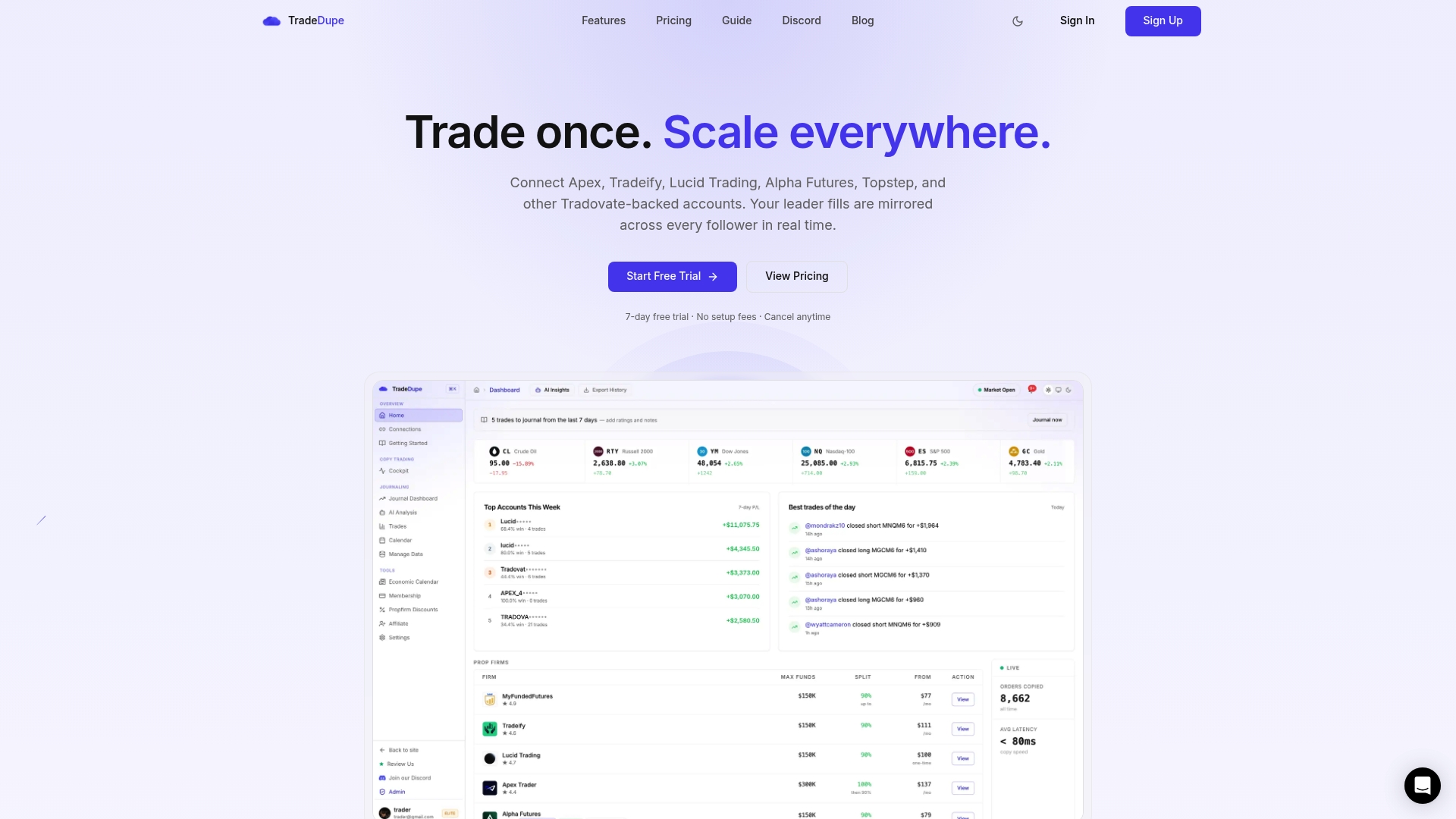
Plans work through copy trading built specifically for Tradovate prop firms like Apex Trader Funding, Tradeify, and MyFundedFutures, with per-account toggles that let you pause mirroring on one account without touching the rest. Standard plans start at $20/month billed yearly, and every plan includes a free trial with flexible cancellation options. If you're running multiple funded accounts and want enforcement that doesn't depend on you watching a screen, get started with TradeDupe and connect your first account in minutes.
Where to Verify Your Firm's Exact Rules
Firm-specific rules on reset time and calculation basis change often, so confirm them directly before trading.
- CFTC's futures market basics for regulatory context on margin and clearing.
- NFA BasicNet to verify a prop firm's registration status.
- Your firm's own rule page for the exact reset time and balance vs equity basis.
This article is general information, not a substitute for advice from a qualified financial advisor. Consult a qualified financial professional about your own circumstances before acting on anything here.
Sources
- Daily Loss Limit Rules: 5% That Kills 80% of Funded Traders (2026) | PropJournal
- Daily Loss Limit vs Maximum Drawdown: How Prop Firm Risk Rules Actually Work | PROP NAVI
- Futures market basics | CFTC
FAQ
What Happens if I Hit My Daily Loss Limit?
Trading stops for the rest of the session, and depending on the firm, that means a pause until reset, an automatic account failure, or a force-close of open positions. Which outcome applies depends entirely on your specific firm's rules, so check them before you trade, not after a breach.
Can I Day Trade With Less Than $25,000?
The minimum equity rule applies to pattern day trading in margin accounts with a broker-dealer under FINRA rules, not to futures trading through a prop firm's funded account. Prop firms set their own capital requirements and daily loss limits independent of that equity threshold.
Is There a Prop Firm Without a Daily Loss Limit?
Some prop firms skip a standalone daily loss limit and rely solely on a maximum drawdown rule instead, though this is less common than firms using both. Always confirm which risk rules apply, and at what percentage, directly on the firm's own rule page rather than assuming based on other programs.
What Is the 3-5-7 Rule in Day Trading?
There's no single standardized "3-strike rule" recognized across the industry, and definitions vary depending on the source.
Should I Set a Personal Stop Below the Firm's Limit?
Yes.
Recommended
- Prop Desk Playbook: Daily Drawdown Protection
- Protect Prop Desk Capital With 34ms Tradovate Selective Copy Trading
- Tradovate Trade Copier | Real-Time Account Sync
- The Best Risk Manager Dashboard for Tradovate Multi-Account Trading
For educational purposes only. Not financial advice. Futures trading involves substantial risk of loss and is not suitable for every investor.