
Drawdown Breach Response: What to Do When a Prop Account Fails
TradeDupe
13 min read
A step-by-step drawdown breach response for prop traders: what to do in the first hour, how copied accounts are affected, and how to avoid a repeat.
When a prop firm account breaches its drawdown limit, the right response is to stop trading, confirm what happened to any open positions, save your records, and find the exact cause before you place another order. If you run several accounts from one leader, add one more step: check every follower account, because a breach on one account rarely stays on that account. This guide walks through the response in order, then covers what to do about the next one.
TL;DR
- Stop first, diagnose second. Step away from the platform, confirm the account status and any open positions, and do not try to win the money back the same day.
- Know which rule you hit. Daily loss limits, static drawdown and trailing drawdown behave differently, and firms word them differently. Confirm the details with your firm.
- Save evidence immediately. Export your trade history and write a raw timeline before memory fades.
- Check every copied account. If you mirror trades from a leader, review each follower for the same exposure.
- Ask about resets in writing. Reset and reinstatement terms vary by firm and by account type, so confirm them with the firm's support rather than assuming.
Table of Contents
- What counts as a drawdown breach
- The first hour: a drawdown breach response checklist
- What happens to the account afterward
- Copied accounts: one breach, several consequences
- Find the cause before you reset anything
- Resets, reinstatement and what to ask support
- Reducing the chance of another breach
- Putting safeguards on the broker side
- FAQ
- Sources
What counts as a drawdown breach
A breach happens when your account equity or balance touches a floor your firm defines. The exact wording differs, so read your own rules, but the main types are consistent across the industry.
| Rule type | How the floor behaves | What a breach usually means |
|---|---|---|
| Daily loss limit | Resets each trading day at the firm's day boundary | Often a session lockout, though some firms treat it as a failure |
| Static drawdown | Fixed, based on the starting balance | Account closed when equity falls below the floor |
| Trailing drawdown (intraday) | Rises with unrealized profit | Account fails the moment equity touches the floor |
| End-of-day trailing | Recalculated after the session | Updated at rollover but enforced during the session |
These distinctions come from published firm documentation. One firm's explainer says a static floor stays fixed while a trailing floor rises with new highs, and that the daily limit resets at the server's day boundary while maximum drawdown does not reset. Another firm separates intraday trailing, end-of-day trailing and static drawdown, and notes that a threshold is enforced intraday, so an account fails immediately when its balance falls below it. A third firm's help center says a live-equity daily-loss breach closes open positions at market, while its end-of-day trailing threshold is recalculated at the 5:00 PM ET rollover.
Two details trip up traders most often:
- Momentary touches count. One firm's help page states that a trailing breach occurs when equity reaches or falls below the active threshold, even briefly, and later recovery does not reverse it.
- Your balance can look fine. A breached threshold can close an account even when the displayed balance still looks large, because the rule tracks equity against a floor that may have risen.
If the trailing mechanic is the part you are unsure about, our glossary entry on trailing drawdown explains how the floor moves.
The first hour: a drawdown breach response checklist
You are most likely to make a second mistake in the first hour after the first. Work through these steps in order.
- Stop trading. Close the order ticket. One firm's recovery guide recommends stopping for at least 24 hours to avoid emotional decisions and to assess the account properly. Revenge trading on another account is still revenge trading.
- Check the account status. Log in to your firm's dashboard and Tradovate and confirm whether the account is closed, paused or locked for the session. Do not rely on a notification email alone.
- Check open positions. If you see a position still running on a breached account, do not assume it is yours to manage. Some firms close positions automatically at market when a limit is hit. Confirm the actual state on the platform, then contact support if it does not match what the rules say.
- Save your records. Export your trade history, fills and screenshots of the account status while they are available.
- Write down the sequence. Note each order, time, size and what you were thinking. Do it now, not tomorrow.
- Contact support only after you have the facts. Ask a specific question with a timeline, not a plea.
If a position is still open
This is the scenario that generates the most panicked searches. The platform's own policies matter here. Tradovate's published policy says that if an account does not meet margin requirements at all times during a trade, the entire position may be liquidated and the account owner emailed (the policy page is dated 2022, so check the current version). Its risk disclosure also states that futures losses can exceed deposited funds, that positions may be liquidated if required funds are not provided, and that market conditions can make liquidation difficult or impossible.
The practical reading: a breach does not guarantee a clean, instant exit at your preferred price. If you hold a live position on a funded or evaluation account, check whether you are trading a simulated account under firm rules or a brokerage account with its own margin rules, and confirm with the firm which applies.
The National Futures Association adds a useful habit: its investor guidance advises you to review whether your account agreement authorizes automatic liquidation and account closure when losses exceed a stated amount. Read that clause in your firm's agreement before you need it.
What happens to the account afterward
Outcomes depend on the firm, the account type and the rule you hit. In broad terms you will see one of three patterns:
- Session lockout. A daily-limit breach on some products liquidates positions and locks trading for the rest of the session without ending the account. Topstep's published material describes its daily loss limit as a liquidation and lockout for the session that does not end the account or require a reset. We mention it only as an example of this pattern, not as a firm TradeDupe supports.
- Account closure. A maximum or trailing drawdown breach typically ends the account. The Top One Futures page above says trading stops and the account is closed or paused depending on account type.
- Evaluation fail versus funded fail. A fail in an evaluation usually means paying for a new attempt or a reset. A fail on a funded account can have different consequences for your payouts and for any future eligibility.
Which of these applies to you is a question for your firm's current rules. Firms change their products often, so do not rely on a forum post from last year. If you are still working out how evaluations are structured, see our explanation of a prop firm evaluation.
Copied accounts: one breach, several consequences
If you mirror a leader account onto several followers, a breach is no longer a single event. The same trade, at the same size, hits accounts with different balances, different floors and sometimes different firms. A leader that sits comfortably above its trailing floor can leave a follower that started the day closer to its limit in breach.
After a breach, review every account in the group:
- Which accounts took the losing trade? Check fills, not just your intended settings.
- Which accounts are now close to a limit? Pause copying to those accounts before the next session.
- Did any follower take a trade the leader did not? A manual order or a stray order on a follower can create exposure you did not plan.
- Are the account sizes still compatible? A multiplier that was fine on one account can be too large on a smaller one.
On copy trading rules themselves, firms differ and change them. One summary reports that Tradeify allows copying between personally owned accounts but prohibits opposing positions across accounts as hedging. That summary is a secondary source, so confirm the current wording with the firm. We keep a running comparison of which futures prop firms allow copy trading, but the firm's own rules always win.
Find the cause before you reset anything
A breach is information. Before you pay for a new attempt, work out what actually failed. Two categories matter:
- Market loss. Your setup took a normal loss, perhaps larger than your plan allowed.
- Workflow failure. Something in your process did what you did not intend: wrong size, a duplicated order, a manual override, a follower that was left enabled.
A recovery guide from one firm suggests writing down the exact trade or behavior that caused the failure and practicing under a written risk plan before returning live. Build your own review around five questions:
- What was the raw timeline, from the first order to the breach?
- What exposure did I intend, and what exposure did I actually have?
- Was the loss within my written plan, or did I break the plan?
- Which accounts were affected, and were they affected equally?
- What single change would have prevented it?
Write the answer to the fifth question as a rule, not a feeling. "Trade smaller" is a feeling. "No more than two contracts per account until the account is $1,500 above its floor" is a rule. Use your own numbers, and check them against your firm's limits.
Resets, reinstatement and what to ask support
Whether you can reset, buy a new evaluation or appeal depends entirely on the firm and the account type. We do not publish fees or conditions for any firm here because they change, and you should not trust anyone else's cached version either. Ask support directly:
- Is a reset available for this account type, and what does it cost today?
- Does a reset restore the starting balance and the drawdown floor?
- Are funded account failures treated differently from evaluation failures?
- Does the breach affect any pending payout or consistency calculation?
- Is there a limit on the number of active accounts I can hold after buying again?
Get answers in writing, through the support ticket system, and keep the ticket number. If your account was breached by something that looks like a platform or data issue, send your timeline and screenshots with the first message.
Before you re-enter, make sure your next attempt fits the firm's other rules too. Our comparison of prop firm consistency rules shows how profit-concentration rules can catch traders who recover too aggressively.
> ## Our perspective > > Most breaches we hear about are not single bad trades. They are small process gaps stacking up: a follower account left on, a size that no longer fit a smaller balance, a limit that existed only as a mental note. When you run six accounts, every manual step is another place for that to happen. > > That is why we built TradeDupe only for Tradovate prop traders. You connect through Tradovate's official OAuth flow, so your password is never stored. You pick a leader, and each fill is mirrored to your enabled followers, typically under 100ms. Per-account toggles let you switch off any account that is close to its floor, and rogue-trade detection flags follower trades the copier did not place. > > Daily loss limits and profit targets are set directly on Tradovate, so the broker enforces them rather than a program on your PC. We think the right response to a breach is to move the safeguard to where it cannot be forgotten, and that is the design we have followed. > > Andres
Reducing the chance of another breach
The goal is not to avoid losses. It is to make sure no single session, and no single mistake, can end an account.
Set a session stop that is smaller than the firm's limit. Your firm's daily limit is the last line, not the working line. A loss-streak rule, such as ending the session after two or three planned losses, keeps you away from the edge.
Respect the math of recovery. Losses are not symmetrical: a 50% loss needs a 100% gain to get back to even. The maximum drawdown math is a good reminder of why a deep early drawdown is so costly on a small evaluation balance, and why a smaller loss tolerance protects the next attempt.

Treat the limit as a tool. Firms present daily loss limits as risk-management tools that help control losses and preserve capital. Use them as a design constraint: size your trades so that a full stop-out on the worst day leaves you well above the floor.
Keep a buffer on trailing accounts. Because a trailing floor rises with profit, the distance between equity and floor can shrink after a good day. Calculate that buffer every morning. Our articles on daily loss limit protection and trailing drawdown buffer math go through the calculations step by step.
Confirm every rule in writing. If you are unsure whether a behavior is allowed, such as holding through a news release or copying between accounts, ask the firm before you do it, not after.
For a broader plan, our practical playbook for trading prop firms covers passing and keeping a funded account.
Putting safeguards on the broker side

If you manage multiple Tradovate accounts, a futures trade copier can take the manual steps out of the process. TradeDupe mirrors your leader account to the followers you enable, with per-account toggles, rogue-trade detection and daily loss limits set on Tradovate. It supports Tradovate-based firms including Apex Trader Funding, Tradeify, Lucid Trading, MyFundedFutures, Alpha Futures and TakeProfit Trader.
Plans start at $20/month billed yearly, and every plan includes a 7-day free trial with one-click cancellation. Month-to-month, Standard is $30, Pro is $60 and Elite is $120.
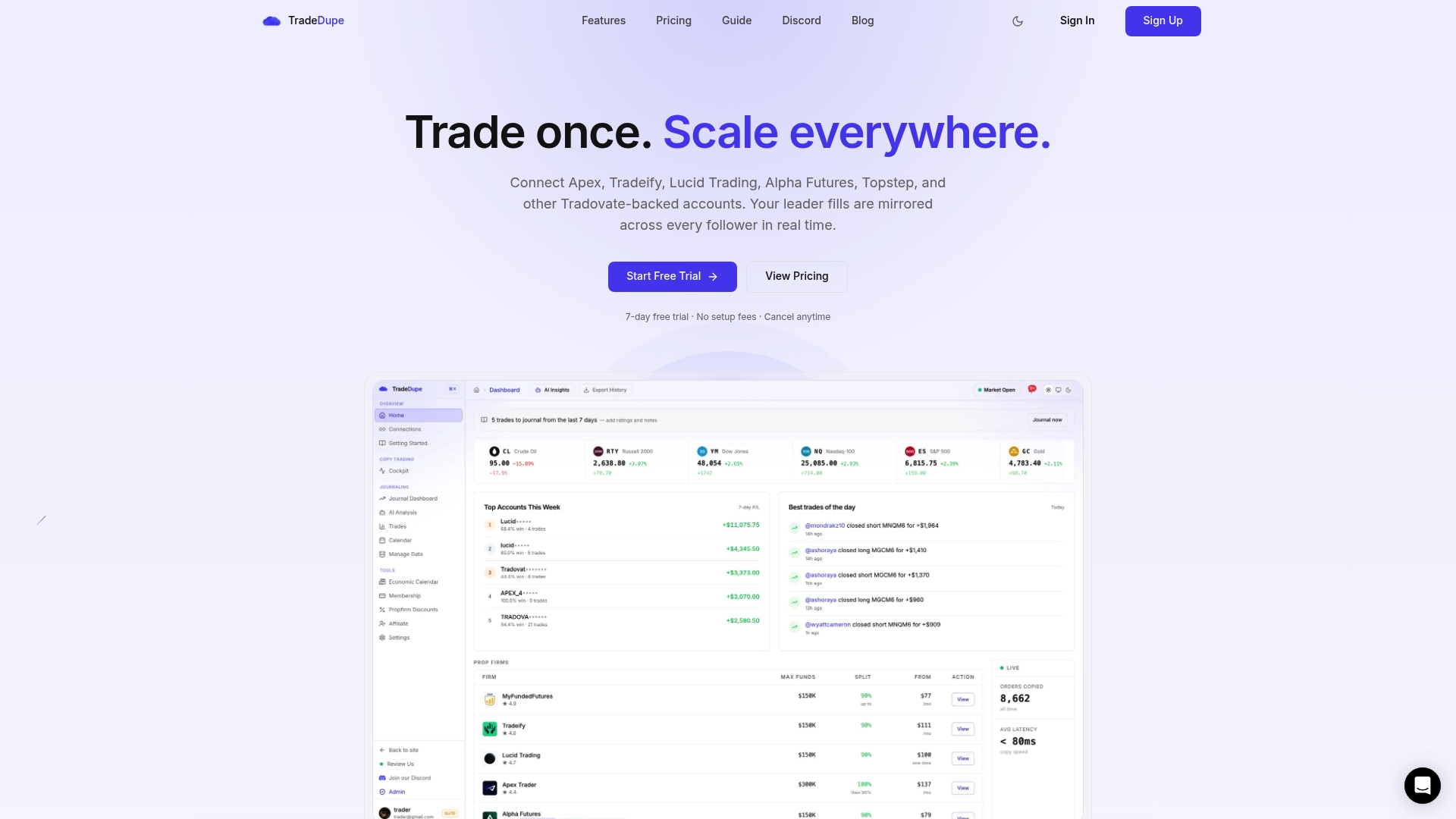
To see whether it fits your setup, start a trial from tradedupe.com and test it on your own accounts. Check your firm's current copy trading rules first.
FAQ
Should I keep trading after I breach a drawdown limit?
No. Stop for the day at least, and ideally for 24 hours, so you can check the account status and review what happened. Trading immediately to recover the loss is the most common way to compound a breach. Use the time to write your timeline.
Can a breached account be restored?
That depends on the firm and the account type. Some firms offer resets for evaluations and none for certain funded accounts. Ask support in writing what is available for your specific account and what it costs now.
What happens to open positions when a limit is hit?
It varies. Some firms close positions at market automatically when a live-equity limit is hit, and Tradovate's policy allows liquidation of positions that do not meet margin requirements. Confirm the actual status on your platform and read your firm's rules.
Does a breach on one copied account affect the others?
Not automatically, because each account has its own balance and floor. But the same trade usually hits all of them, so review every follower for exposure and pause any that sit close to their limits.
Is a daily loss limit breach the same as failing the account?
Not always. Some products lock you out for the rest of the session, while others treat it as a failure. Check the exact wording in your firm's rules.
Sources
- Blown Trading Account Recovery: What to Do Next
- Investor Best Practices, NFA
- Risk Disclosure Statement for Futures and Options, Tradovate
- Liquidation Policy, Tradovate
- Daily vs Max vs Trailing Drawdown: $100K Examples
- Daily drawdown and the 5 PM ET reset, Upcomers Help Center
- Max drawdown types, Purdia Capital
- Understanding the Drawdown in Elite Accounts, Top One Futures
- How daily loss limits build discipline for funded traders, Topstep
- Does Tradeify Allow Copy Trading in 2026?
- Maximum Drawdown for Traders, Backtestify
Recommended
- Prop Desk Playbook: Daily Drawdown Protection
- Prevent Daily Loss Limit Breaches for Prop Traders via Tradovate
- Trailing Drawdown: What It Means for Futures Trading
- How to Trade Prop Firms \(2026\): A Practical Playbook to Pass and Keep a Funded Account
For educational purposes only. Not financial advice. Futures trading involves substantial risk of loss and is not suitable for every investor.