

Avoid the 100 Contract Limit: Follower Allocation for Tradovate
TradeDupe
13 min read
A practical checklist for Tradovate operators: use risk scaled sizing, per account ceilings, and TradeDupe routing to avoid 100 contract ticket limits and...
Risk-scaled sizing with hard per-account ceilings and independent drawdown enforcement is the allocation approach we recommend when mirroring a leader across multiple funded follower accounts. The single rule that matters most: treat every follower as an independent risk unit, never as a clone of the leader. Tools like TradeDupe running on Tradovate make this practical, but the sizing logic has to come first.
*
> TL;DR: > > - Risk-scaled sizing is essential to maintain consistent per-account risk levels, especially when managing heterogeneous fleets with varying loss limits and volatility tolerances. > - Trade copiers like Tradovate's have built-in order quantity restrictions that require splitting large orders into smaller tickets or routing through per-account APIs to avoid rejections. > - Setting conservative per-account ceilings and risk limits before live deployment helps prevent cascading failures and ensures each follower remains within acceptable drawdown levels. > - Regular monitoring of fill latency, slippage, rejection rates, and drawdown ratios significantly improves early detection of issues and enhances fleet management. > - Fully testing the entire allocation and routing system over a week in simulated or paper trading conditions reduces the risk of unexpected failures when scaling to real capital.
*
Table of Contents
- Allocation methods: equal quantity, proportional, and risk-scaled sizing
- Building an operator checklist for safe allocation
- Tradovate's technical quirks that shape your allocation plan
- Per-account safeguards that protect follower health
- Testing and rollout before committing real capital
- Strategies for dynamic reallocation based on follower performance
- Handling followers with different risk tolerances or trading styles
- Procedures for notifying and managing follower account issues or slippage
- Legal and regulatory considerations affecting follower allocation
- Metrics and KPIs to monitor and optimize follower allocation effectiveness
- Operator perspective: recurring mistakes and brief recommendations
- Putting the checklist into practice with TradeDupe
- FAQ
- Sources
Allocation methods: equal quantity, proportional, and risk-scaled sizing
Three approaches dominate how operators size follower trades, and each fits a different fleet profile.
Equal quantity allocation sends the same contract count to every follower regardless of account size. It's simple to audit and easy to explain to a prop firm, but it ignores the fact that a $25,000 account and a $150,000 account carry very different risk tolerances. This method works acceptably only for small fleets with identical account sizes and identical daily loss limits. Scale it past five or six accounts with mixed sizes, and you're exposing smaller accounts to drawdown that was never calibrated for them.
Proportional-to-equity sizing scales contract count to each account's current balance or starting capital. If the leader trades 3 contracts against a $100,000 reference account, a $50,000 follower gets roughly 1 to 2 contracts. This requires ongoing bookkeeping: you need current equity per account, not just the opening balance, because funded accounts fluctuate with daily P&L.
Risk-scaled sizing, often ATR-based, sizes each follower's position as a percentage of that account's defined risk tolerance rather than a flat equity ratio. This is the preferred method for heterogeneous fleets where accounts differ in loss limits, evaluation stage, or volatility tolerance.
Example across 10 accounts with a 5-contract leader trade:
- Equal quantity: all 10 accounts receive 5 contracts, totaling 50 contracts regardless of account differences.
- Proportional to equity: a mix of $50,000 and $150,000 accounts might receive 2 to 6 contracts each, totaling roughly 35 to 40 contracts.
- Risk-scaled (ATR-adjusted): accounts near their daily loss limit might receive 1 contract while well-capitalized accounts receive 4, keeping per-account risk roughly level rather than per-account quantity equal.
Building an operator checklist for safe allocation
Before any leader fires a live trade across a fleet, a short pre-deployment pass saves you from a failed trade cascade or an unexpected prop-firm flag.
- Confirm each follower's max contract limit and margin profile against the firm's rules, not just the platform default.
- Set daily loss limits and profit targets directly on each Tradovate account so the broker enforces them, not your copier logic alone.
- Map every accountId you'll route to, and verify the mapping against account nicknames before go-live.
- Default to risk-scaled sizing and set a hard per-account contract ceiling that cannot be exceeded regardless of leader size.
- Avoid a single global kill switch. Use per-account toggles so a problem on one follower doesn't force you to pause the entire fleet.
- Stagger large total order sizes into smaller, acceptable ticket sizes rather than sending one oversized combined order.
- Verify that stop-loss and take-profit levels replicate correctly to every follower before relying on them unattended.
- Enable alerts for correlation spikes, order rejections, and P&L attribution mismatches across the fleet.
Pro Tip: Run your per-account ceilings tighter than the firm's stated max for the first week; you can loosen them once you've confirmed fills, rejections, and reconciliation all behave as expected.
Tradovate's technical quirks that shape your allocation plan
Tradovate's own infrastructure imposes constraints that no allocation theory can route around, so your sizing plan has to be built with these in mind from the start.
- The built-in Tradovate Trade Copier requires the quantity entered on the order ticket to be a multiple of the group's combined per-account quantities, and it disallows bracket (ATM) orders entirely.
- Community reports describe an order-ticket input ceiling, commonly cited around 100 contracts, that blocks equal-allocation totals once a fleet grows large. A 20-account fleet allocating 35 contracts each needs a 700-contract total, which simply cannot be typed into a 100-contract maximum field.
- The Tradovate placeOrder API accepts an accountId or account Spec field for routing to specific accounts, and returns failureReason codes including MaxOrderQtyLimitReached, MaxPosLimitReached, and MultipleAccountPlanRequired that your allocation logic needs to handle, not just log.
- Routing by accountId means each follower order is placed individually rather than as one combined ticket, which sidesteps the group multiple requirement but means your mirroring logic needs to loop per account.
The practical fix when totals exceed ticket limits is to split the combined order into smaller tickets, stagger submission, or route through per-account API calls rather than the built-in group copier. Server-side mirroring places orders independently per follower account rather than relying on one combined group ticket, which avoids the ceiling problem by design.
Per-account safeguards that protect follower health
Each funded account lives or dies by its own daily loss limit, so independent drawdown enforcement on every follower is not optional. A single breach on one account should never threaten the others.
- Daily loss limits and profit targets set directly on Tradovate mean the broker enforces the stop, not a copier process that might lag or fail silently.
- Per-account copy toggles let you pull one follower out of the mirror instantly if it's behaving oddly, without disrupting the rest of the fleet.
- Execution mode controls give you a way to switch a follower to a more conservative mode (reduced size, manual confirmation) without a full disconnect.
- Rogue-trade detection flags a follower trade that the copier didn't originate, which matters for spotting manual interference or a stuck order repeating.
- Correlation monitoring across the fleet can surface identical, suspiciously deterministic fills across many accounts before a prop firm's own audit does.
Pro Tip: Build a simple daily dashboard that shows per-account P&L, open positions, and rejection counts side by side; most allocation problems show up as a pattern across accounts long before they show up as a single catastrophic loss.
Testing and rollout before committing real capital
A new allocation setup deserves a full validation cycle before live capital is at risk.
- Paper-trade the complete setup for at least one full trading week, deliberately including a high-volatility session so you see how the copier handles fast fills and slippage.
- Confirm stop-loss and take-profit replication, partial closes, and how each follower handles order rejections differently.
- Stress-test with larger-than-normal orders and sequential splits to confirm auto-recovery and reconciliation logic actually catches a failed leg.
- Log every discrepancy automatically and run a final reconciliation pass comparing leader fills to follower fills before increasing size or adding accounts.
Strategies for dynamic reallocation based on follower performance
Static allocation rules work until a follower account's circumstances change, and funded accounts change constantly as daily P&L shifts them closer to or further from their loss limit. A practical reallocation approach adjusts position size downward as an account approaches a defined buffer zone above its daily loss limit, rather than waiting for a breach to force a pause.
Reallocation also works in the other direction. An account that's built a comfortable equity cushion after a strong stretch can reasonably take a slightly larger proportional share of the next leader trade, within the fleet's overall risk-scaled framework rather than as an ad hoc bump.
The practical trigger points worth automating:
- Reduce size automatically once an account's daily loss reaches a defined percentage of its limit.
- Pause new entries, but let existing positions manage normally, once an account nears its trailing drawdown threshold.
- Resume standard sizing only after equity recovers past a defined buffer, not immediately after a single winning trade.
Dynamic reallocation should never mean chasing a losing account with larger size to "catch up." That instinct is understandable but it inverts the entire purpose of per-account risk controls, and it's one of the fastest ways to turn one blown account into a pattern across the fleet.
Handling followers with different risk tolerances or trading styles
A fleet of ten funded accounts rarely means ten identical risk profiles. Accounts at different evaluation stages, under different prop firm rules, or simply funded at different sizes need different treatment even when they're mirroring the exact same leader trade.
The most reliable way to handle this heterogeneity is to group accounts by risk profile rather than treat the fleet as one undifferentiated pool. A newer evaluation account with a tight daily loss limit should run meaningfully smaller size than a seasoned funded account with a wider cushion, even if both are nominally following the same leader signal. Risk-scaled sizing handles this naturally once each account's risk parameters are configured correctly, since the sizing math adjusts per account rather than applying one flat rule.
Trading style differences matter too. Not every follower needs to mirror every leader trade type. An account with tighter restrictions on overnight exposure, for instance, might need its execution mode set to skip or flatten specific trade categories rather than copy them blindly. Per-account execution mode controls exist precisely for this kind of exception handling, letting you keep a follower in the fleet without forcing it into trades that don't suit its constraints.

Procedures for notifying and managing follower account issues or slippage
Slippage and execution issues are inevitable once you're running fills across a dozen or more accounts simultaneously, and the operational question is how fast you find out and how cleanly you respond.
A working notification setup flags three categories of issue in real time: order rejections, unusual fill price deviation relative to the leader, and position mismatches between leader and follower after execution completes. Waiting to discover these during an end-of-day review means a problem can compound across multiple trades before anyone notices.
When an issue does surface, the response should isolate the affected account rather than halt the fleet. Per-account toggles let you pull one follower out of the mirror immediately, investigate the fill discrepancy, and reconnect once resolved, without interrupting the other accounts still trading normally. Keeping a simple log of every flagged incident, including timestamp, account, and resolution, also gives you a record if a prop firm ever asks about unusual activity on a specific account.

Legal and regulatory considerations affecting follower allocation
Copy trading across your own multiple funded accounts sits in a different category than signal-selling or managing other people's capital, but it still carries terms-of-service obligations you need to respect. Every prop firm sets its own rules on simultaneous trading, account correlation, and what counts as an unacceptable pattern across a trader's accounts, and those rules vary by firm.
The practical implication is that allocation strategy isn't purely a risk-management question, it's also a compliance question specific to whichever firm issued each funded account. Identical, deterministic fills replicated across many accounts can resemble patterns that prop-firm evaluations are specifically built to flag, so varying sizing and timing slightly across accounts, within your risk-scaled framework, is as much a compliance safeguard as a risk one. Before scaling a fleet, read your specific firm's terms on multi-account trading rather than assuming one firm's rules apply to another.
Metrics and KPIs to monitor and optimize follower allocation effectiveness
Running a fleet without metrics means you're reacting to problems instead of catching them early. A small, consistent set of numbers tells you whether your allocation strategy is actually working.
- Fill latency per account: how long after the leader trade each follower's order executes, flagging accounts that lag consistently.
- Slippage relative to leader: the price difference between leader and follower fills, tracked per account to spot a pattern rather than a one-off.
- Rejection rate: how often a follower's order fails outright, which often points to a margin or contract-limit issue worth fixing at the source.
- Drawdown-to-limit ratio: each account's current daily loss as a percentage of its limit, the clearest early warning for reallocation.
- P&L attribution accuracy: whether each follower's recorded P&L matches what the mirrored trades should have produced, catching reconciliation errors early.
Reviewing these weekly, rather than only after an incident, is what turns an allocation strategy from a one-time setup into something you actually optimize over time.
Operator perspective: recurring mistakes and brief recommendations
The most common mistake we see is a single global kill switch standing in for real per-account risk controls, followed closely by ignoring order-ticket ceilings until a trade fails mid-session. Insufficient paper-testing compounds both. Our recommendation: configure per-account limits first, iterate conservatively, watch correlation metrics daily, and keep thorough logs. Always check your specific prop firm's terms before scaling a fleet.
> — Andres
Putting the checklist into practice with TradeDupe
Everything in this guide, risk-scaled sizing, per-account ceilings, independent drawdown enforcement, maps directly onto features we built into TradeDupe for exactly this kind of fleet.
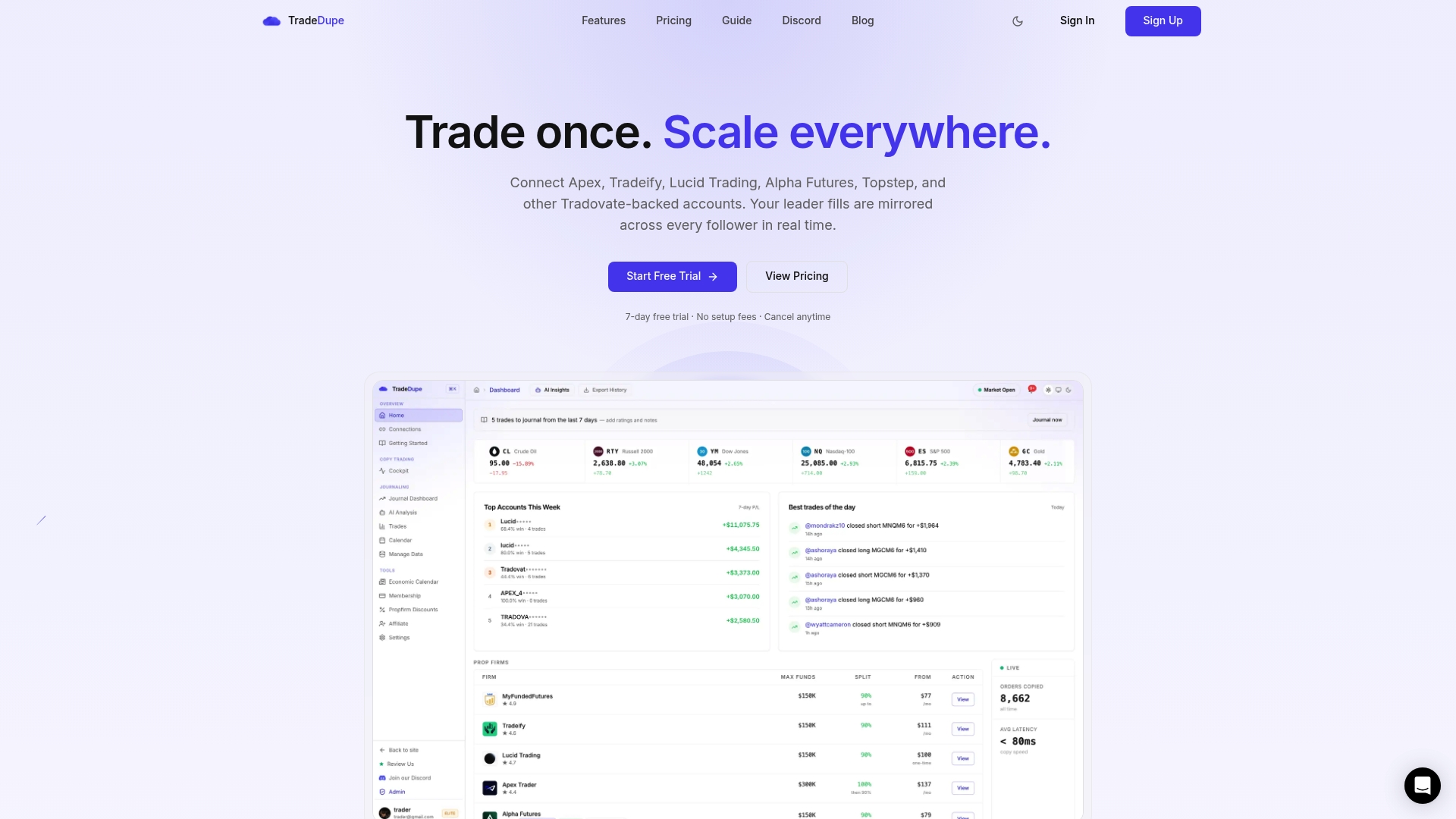
- Rogue-trade detection flags follower trades the copier didn't originate, catching manual interference before it compounds.
- Per-account copy toggles let you isolate one follower instantly without pausing the rest of the fleet.
- Execution mode controls give you exception handling for accounts with different restrictions or risk profiles.
- Daily loss limits and profit targets are enforced by Tradovate itself, not by our software alone.
- Fills mirror over live WebSocket streams, typically within 100ms, which matters once you're running the per-account sizing math this guide recommends.
We'd suggest starting with a small set of follower accounts on the 7-day free trial and running the testing checklist above in live simulation before adding size. For more on how the mirroring works, our copy trading overview is a good next stop.
FAQ
What is the safest default allocation method for a funded account fleet?
Risk-scaled sizing, often ATR-adjusted, is generally the safer default because it sizes each follower's position against that account's own risk tolerance rather than a flat quantity or equity ratio. It performs better across heterogeneous fleets with mixed account sizes and loss limits than equal-quantity allocation does.
Why does Tradovate's built-in copier sometimes reject my order total?
The built-in Tradovate Trade Copier requires the order ticket quantity to be an exact multiple of the group's combined per-account quantities, and separately, community reports describe an input ceiling around 100 contracts on the order ticket itself. A large fleet with proportional sizing can easily need a total that exceeds that ceiling, which forces a rejection.
How long should I paper-trade before allocating real capital across followers?
At least one full trading week, including a high-volatility session, is the practical minimum for validating fills, stop-loss replication, and rejection handling across your fleet. Shorter tests tend to miss the edge cases that only show up under faster market conditions.
Can TradeDupe route orders to specific accountIds directly?
Yes, mirroring on TradeDupe routes each follower's order individually by account, similar in principle to how the Tradovate placeOrder API accepts an accountId field for per-account routing. This approach sidesteps the combined-ticket ceiling that affects the built-in group copier.
What is the single biggest risk in follower allocation across a fleet?
Treating all followers as a single risk unit rather than independent accounts is the biggest risk, since a single global kill switch or deterministic equal-quantity sizing can turn one account's problem into a fleet-wide one. Per-account ceilings and independently enforced daily loss limits are the primary safeguard against that.
Sources
Recommended
- Order Throttle Limits for Tradovate Copy Trading: Pace Fan Out to Avoid Outages
- Size Trades to Strictest Follower: Tradovate Leader Risk Controls
- Six Follower Account Health Checks Tradovate Operators Need
- Protect Prop Desk Capital With 34ms Tradovate Selective Copy Trading
For educational purposes only. Not financial advice. Futures trading involves substantial risk of loss and is not suitable for every investor.