
Size Trades to Strictest Follower: Tradovate Leader Risk Controls
TradeDupe
15 min read
Tradovate playbook: pair broker side loss limits with copier safeguards. Size to the strictest follower, stage rollout, confirm 100ms exit sync.
Size the leader account to protect your strictest follower, enforce daily loss and profit triggers directly on Tradovate Risk Settings, and confirm every entry, modification, and exit syncs to followers in real time. Add per-account toggles and rogue-trade detection on top, and you have closed the gaps that turn a single bad leader trade into a multi-account blowout. Tools like Tradovate and TradeDupe handle different layers of this stack, but the sizing rule matters more than any single feature.
*
> TL;DR: > > - Sizing trades based on the strictest follower's drawdown limits prevents larger accounts from breaching smaller ones' risk thresholds. > - Broker-enforced daily loss limits and profit triggers, when properly configured, automatically exit trades and lock accounts, reducing manual oversight needs. > - A WebSocket-based copier like TradeDupe can sync exits in under 100 milliseconds, significantly reducing risks during fast market conditions. > - Regular review of account balances, multipliers, and audit logs is essential to maintain effective risk controls and catch drift or rogue trades early. > - Testing with demo accounts and staged rollouts helps identify timing issues, fill mismatches, and synchronization failures before risking live capital.
*
Table of Contents
- What Are the Core Leader Account Risk Controls?
- How Do Tradovate Risk Settings Work for Leader Accounts?
- How Do You Size Leader Trades for Multiple Followers?
- Why Does Copier Sync Speed Matter for Follower Accounts?
- What Operational Safeguards Protect Leader Accounts Daily?
- What Should a Go-Live Checklist Include Before Trading Live?
- What Regulatory and Compliance Issues Apply to Leader Accounts?
- How Often Should You Review Leader Account Risk Controls?
- What Can Past Copy Trading Failures Teach You?
- A Practical Take on Leader Account Risk Controls
- Put These Leader Account Risk Controls to Work With TradeDupe
- Sources
- FAQ
What Are the Core Leader Account Risk Controls?
A leader account without layered risk controls can expose followers to risk. Four safeguards help distinguish a well-run leader account.
Daily loss limits and profit triggers set at the broker level stop trading automatically once a threshold hits, regardless of what the leader wants to do next. These differ from personal mental stops because they execute without human hesitation, and they apply to the account, not the trader's discipline.
Per-account copy toggles let you pull a single follower out of the mirror without disrupting the rest. Execution mode controls decide whether orders route server-side (recommended, since it keeps working even if your laptop sleeps) or through a local bridge.
Rogue-trade detection flags any follower fill that the copier didn't originate, catching manual overrides or platform glitches before they compound. Exit-sync enforcement guarantees that when the leader closes, every follower closes too, no exceptions.
- Daily loss limits and profit triggers (broker-enforced)
- Per-account copy toggles for instant isolation
- Rogue-trade detection on unauthorized follower fills
- Synced exits across every mirrored account
Pro Tip: Keep one follower account permanently excluded from copying and use it purely to test new strategies. It gives you a clean control group without risking your funded accounts.
The emergency stop, a full flatten across leader and followers, exists for the scenario none of the above catch: a data feed glitch, a fat-finger order, or a connectivity drop mid-trade. Use it the moment something looks wrong. Hesitation costs more than a false alarm ever will.
How Do Tradovate Risk Settings Work for Leader Accounts?
Tradovate lets you configure daily and weekly loss limits and profit triggers directly on the account, and when either fires, the platform auto-closes open positions, cancel working orders, and can lock the account until the next session reset. That lock is not cosmetic. Community reports confirm support cannot unlock an account before the session opens again, so set the limit deliberately, not as a guess.
A few operational cautions matter here:
- Liquidation triggers close positions at market, which means slippage in volatile conditions can realize a loss larger than the configured limit.
- Margin policy takes precedence over your custom risk settings in a margin call scenario.
- Lock timing follows the session schedule, not the clock, so a limit hit at 2:00 PM might lock you out until the next session opens, not until midnight.
Prop trading guidance generally recommends setting personal limits tighter than the firm's own thresholds and pairing them with automated bracket orders and stops rather than relying on manual exits, a practice echoed in prop trading risk management guidance. The best combination pairs a Tradovate-side daily loss limit with a copier-level rogue-trade check, so you get broker enforcement and mirror-level oversight working together instead of leaving either to cover the whole risk alone.
How Do You Size Leader Trades for Multiple Followers?
The rule is simple to state and easy to get wrong in practice: size every leader trade to the account with the least room to lose, not the account with the most.
- Calculate the follower multiplier. Divide each follower's account balance by the leader's balance. A $50,000 follower mirroring a $150,000 leader runs at a 0.33 multiplier.
- Identify the strictest follower. Compare each account's daily loss limit or maximum drawdown allowance, not just its balance, since a smaller account with a looser drawdown rule might tolerate more risk than a larger one on a tight trailing drawdown schedule.
- Size the leader trade to that account's limit, then let the multiplier scale everyone else down proportionally.
- Check correlated exposure. Three "different" trades that are all long equity index futures act as one concentrated bet once they land in the same follower account simultaneously.
Here's a worked example: your leader risks $600 on a trade. The strictest follower has a $50,000 account with a $1,000 daily loss cap and is already down $400 today. That leaves $600 of room, exactly matching the leader's risk, so the trade passes at full size. If that follower were down $700 instead, you'd need to cut the leader trade by more than half before firing it. Sizing to the strictest follower preserves every funded account in the group rather than sacrificing the weakest one for the sake of the strongest.
Why Does Copier Sync Speed Matter for Follower Accounts?
Desynchronization rarely starts at the entry. It starts at the exit. A leader closes a position, the signal lags or drops, and a follower account sits in a trade the leader has already abandoned. That gap is where most catastrophic follower losses originate, since exits failing to sync is a documented root cause of outsized follower drawdowns.
Latency is the variable that decides how often this happens. TradeDupe's WebSocket-based mirroring typically syncs fills within 100 milliseconds, a speed that matters most in fast futures markets where a few hundred milliseconds can be the difference between a matched exit and a follower left holding risk the leader no longer carries.
Before trusting any copier with live capital, validate it against these scenarios:
- Partial fills on the leader replicate proportionally across every follower, not just the full-size ones.
- Stop-loss and target modifications on an open leader position propagate immediately, not on the next new order.
- A dropped connection reconnects and resyncs state without duplicating or missing fills.
- Manual intervention on a follower account triggers a rogue-trade alert rather than going unnoticed.
Pair those tests with ongoing monitoring: connection-status alerts, per-account profit-and-loss tracking, and failed-order notifications. A copier that syncs perfectly in calm markets and silently fails during a fast open is the one that costs you funded accounts.
What Operational Safeguards Protect Leader Accounts Daily?
Risk controls only work if someone actually runs them every session. Build a routine, not a hope.
Use per-account copy toggles to isolate any follower going through firm evaluation review or sitting close to its drawdown limit, and default to server-side execution modes so mirroring keeps running even when your desktop app is closed. Keep audit logs and reconcile them against your trade journal at the end of every session; a mismatch caught the same day is a footnote, and one caught a week later is a forensic project.
Before the open, run a short pre-trade checklist:
- Confirm multipliers still match current account balances.
- Verify Tradovate risk locks are active and set at the intended thresholds.
- Review open exposure across all followers for hidden correlation.
- Check that yesterday's fills reconciled cleanly with no orphaned positions.
Pro Tip: Set up Discord webhook alerts for failed orders and connection drops so you find out in seconds, not when a follower calls asking why their account looks wrong.
Practice the kill-switch workflow on a demo account until flattening every position across leader and followers takes you under ten seconds under pressure, per the prop desk risk control playbook.
What Should a Go-Live Checklist Include Before Trading Live?
Nobody should mirror a leader account to five funded followers on day one. Treat the rollout like a controlled experiment, because that's exactly what it is.
- Run demo tests first. Confirm entry and exit parity, partial-fill replication, slippage behavior, and stop adjustment propagation across simulated accounts.
- Log discrepancies methodically. Track 50 to 100 test trades before trusting the setup with real capital, noting any timing gaps or fill mismatches.
- Stage the rollout. Start with one follower account, hold it stable for a defined window, then expand to a small group before opening the full follower list.
- Recalculate multipliers regularly. Every material change in a follower's balance, whether from a payout, a drawdown, or a firm's monthly reset, should trigger a fresh multiplier check.
- Document your rollback plan. Write down exactly how to flatten and disconnect, then rehearse it before you need it under stress.
Skipping the staged rollout is the single most common mistake among traders who scale a leader account too fast.
What Regulatory and Compliance Issues Apply to Leader Accounts?
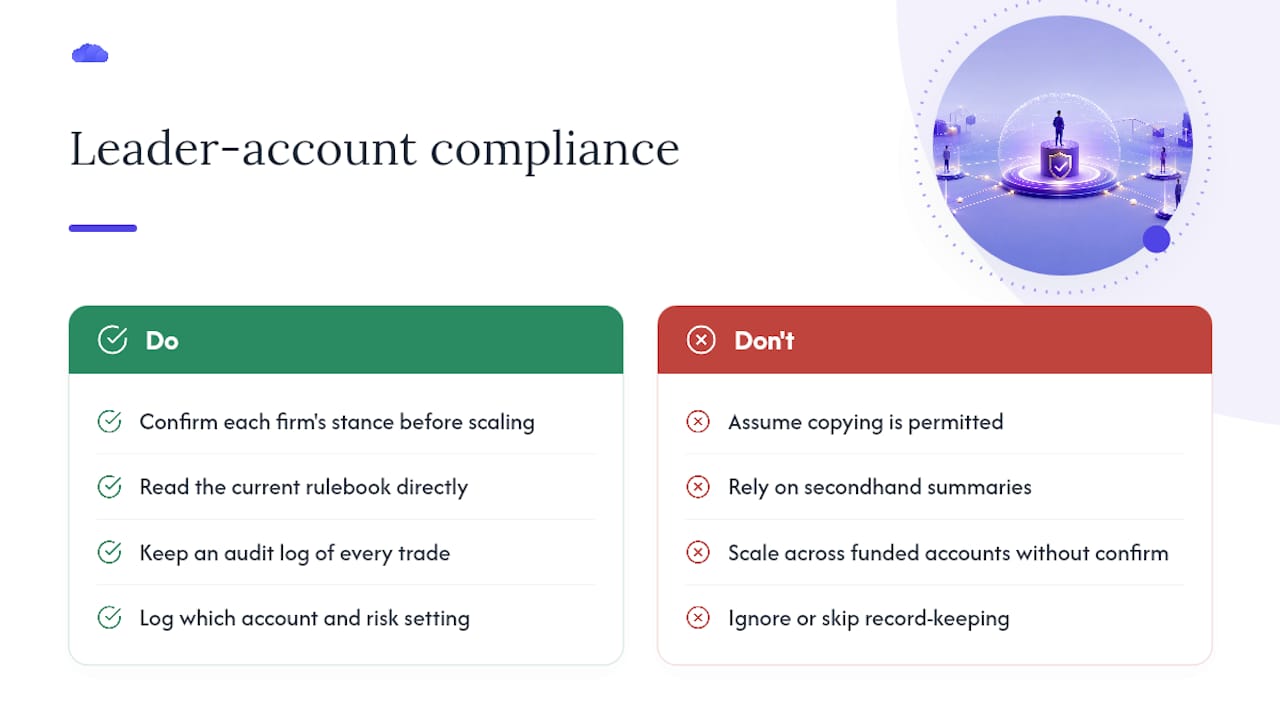
Copy trading a personal or evaluation account into multiple funded accounts sits in a gray zone that most prop firms address through their own rulebooks rather than through securities regulation, since these are proprietary firm accounts, not customer brokerage accounts subject to investment-adviser registration.
That doesn't mean compliance is optional. Every prop firm sets its own policy on whether copying between accounts under the same trader's control is permitted, and those policies vary by firm and can change without much notice. Trade copying guidance for funded accounts is explicit on this point: confirm each firm's stance on account mirroring before scaling a setup across multiple funded evaluations, since a violation can trigger disqualification even when the trading itself was profitable.
Firms including Apex Trader Funding, Tradeify, Lucid Trading, MyFundedFutures, Alpha Futures, and TakeProfit Trader each publish their own rules on multiple-account management, consistency requirements, and what counts as prohibited coordination between accounts. Read the current version of each firm's rulebook directly rather than relying on secondhand summaries, since these terms get revised.
Keep records. An audit log showing exactly when each trade fired, which account it mirrored to, and what risk setting was active at the time is your best defense if a firm ever questions how an account was managed. It also happens to be the same documentation that helps you diagnose your own mistakes, which makes it worth keeping even if no firm ever asks.
Compliance here is less about a single regulatory body and more about discipline: read the rules, follow them precisely, and document your process well enough that you could explain any single trade six months later.
How Often Should You Review Leader Account Risk Controls?
Risk controls decay if you never look at them again. A limit that made sense when your leader account held $50,000 stops making sense once it grows to $120,000, and a multiplier calculated in January is often stale by March.
Build review into your calendar, not your memory. A weekly check should cover current account balances against your multiplier table, whether any follower is approaching its drawdown limit, and whether your Tradovate loss and profit triggers still reflect your actual risk tolerance rather than the settings you configured months ago.
A monthly check should go deeper: review the audit log for any rogue-trade flags, reconcile every recorded exit against your trade journal, and confirm that no follower account changed prop firms or rule sets without your multiplier table catching up. Firms occasionally revise drawdown structures, switching a follower from trailing to static drawdown, for example, and that single change can flip an account from safely inside its multiplier to dangerously oversized overnight.
Watch for drift signals specifically:
Growing balance spreads between leader and followers signal it's time to recalculate multipliers before the next significant trade, not after. Increasing frequency of near-miss alerts, meaning trades that almost tripped a daily loss limit, suggest your personal risk tolerance has crept looser than your stated rules. And any gap between what your audit log shows and what actually landed in a follower account needs same-day investigation, not a shrug.
The traders who keep funded accounts long-term treat this review cadence as fixed infrastructure, not an occasional chore squeezed in when something already went wrong.
What Can Past Copy Trading Failures Teach You?
The most common failure pattern in leader/follower setups isn't exotic. It's an exit that didn't sync. A leader closes a losing trade, the follower's mirror lags by a few seconds during a fast market, and the follower account eats a materially worse price on the same position the leader already escaped. Multiply that gap across several follower accounts running simultaneously, and one bad tick can turn into several blown evaluations in the time it takes to notice a chat alert.
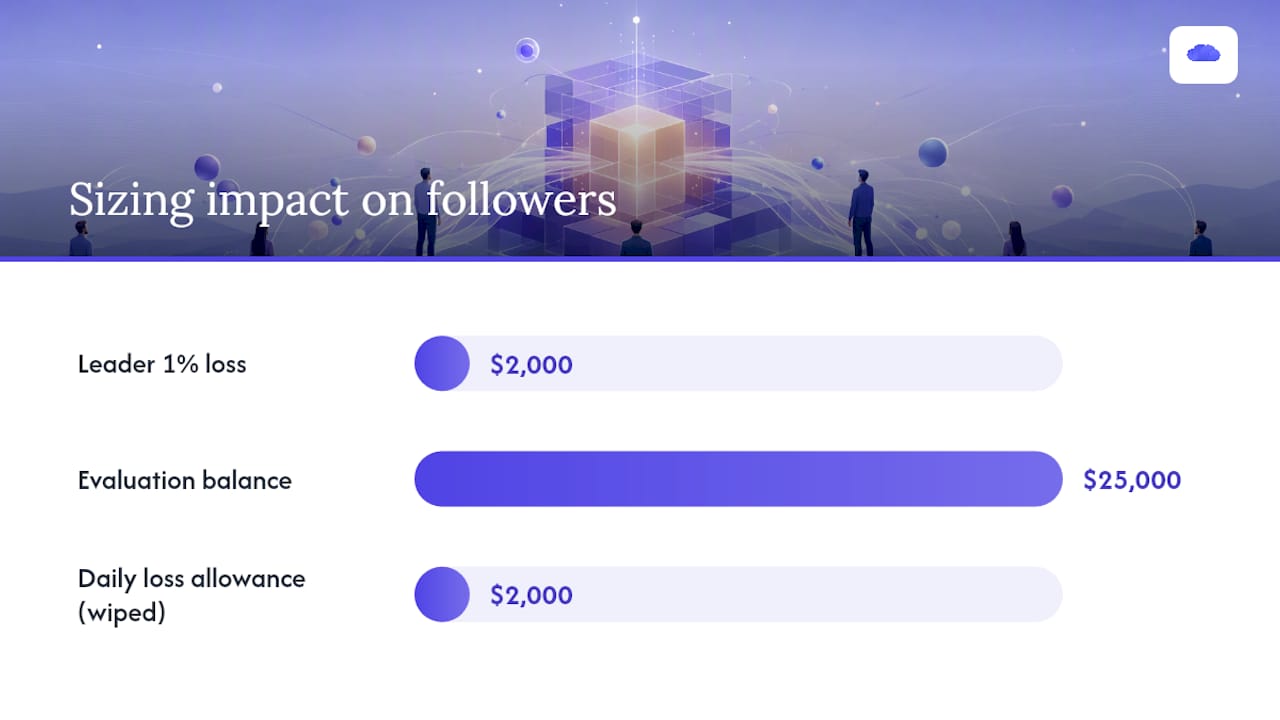
A second recurring failure involves sizing that ignored the strictest follower. A trader running a $200,000 leader account alongside a $25,000 evaluation account applies leader-scale risk without adjusting the multiplier, and a single trade that costs the leader a routine 1% wipes out the smaller account's entire daily loss allowance in one fill. The lesson isn't complicated: a leader trade sized for one account can breach the rules of another whenever the accounts sit at different scales or under different drawdown rules.
A third pattern shows up around broker-enforced locks. A trader hits a daily loss trigger, assumes support can flip the account back on, and discovers the lock holds until the next session regardless of how the request is phrased. The account sits dark for hours, during which the trader has no way to manage open exposure on any mirrored follower still carrying a position from before the lock.
Each of these failures traces back to a control that existed but wasn't tested under real conditions before it mattered. Demo testing, staged rollouts, and routine multiplier reviews aren't administrative overhead. They're the difference between catching these failure patterns in a log file and catching them in a funded account balance.
A Practical Take on Leader Account Risk Controls
Most guidance on this topic treats risk controls as a checklist you configure once and forget; however, implementing daily loss limit trading: set and enforce your cap is essential for effective risk management. That's backwards. The accounts that survive long-term treat controls as a living system that gets reviewed as often as the trading strategy itself, because balances shift, firm rules change, and a multiplier calculated in one market condition rarely holds up in another.
The overlooked piece is exit sync, not entry sync. Traders obsess over whether a copier fires the right trade at the right size, but the accounts that actually blow up usually got the entry right and the exit wrong. A leader that fits Tradovate's daily loss triggers, layers rogue-trade detection on top, and mirrors through server-side execution with a WebSocket connection built to sync in under 100 milliseconds, the kind of stack TradeDupe provides for Tradovate-based accounts, closes that gap by design rather than by hope. That combination of OAuth-based Tradovate connection, per-account toggles, and broker-enforced limit support maps directly onto every control this guide has walked through. Readers who want to verify the technical specifics can review TradeDupe's documentation and security pages directly before connecting a live account.
> — Andres
Put These Leader Account Risk Controls to Work With TradeDupe
TradeDupe is built specifically for Tradovate prop traders running a leader account into multiple funded followers rather than as a generic multi-broker bridge that happens to support Tradovate. It connects through Tradovate's official OAuth flow, so your password is never stored and nothing runs locally on your PC or VPS, and every fill mirrors over a live WebSocket connection typically within 100 milliseconds.
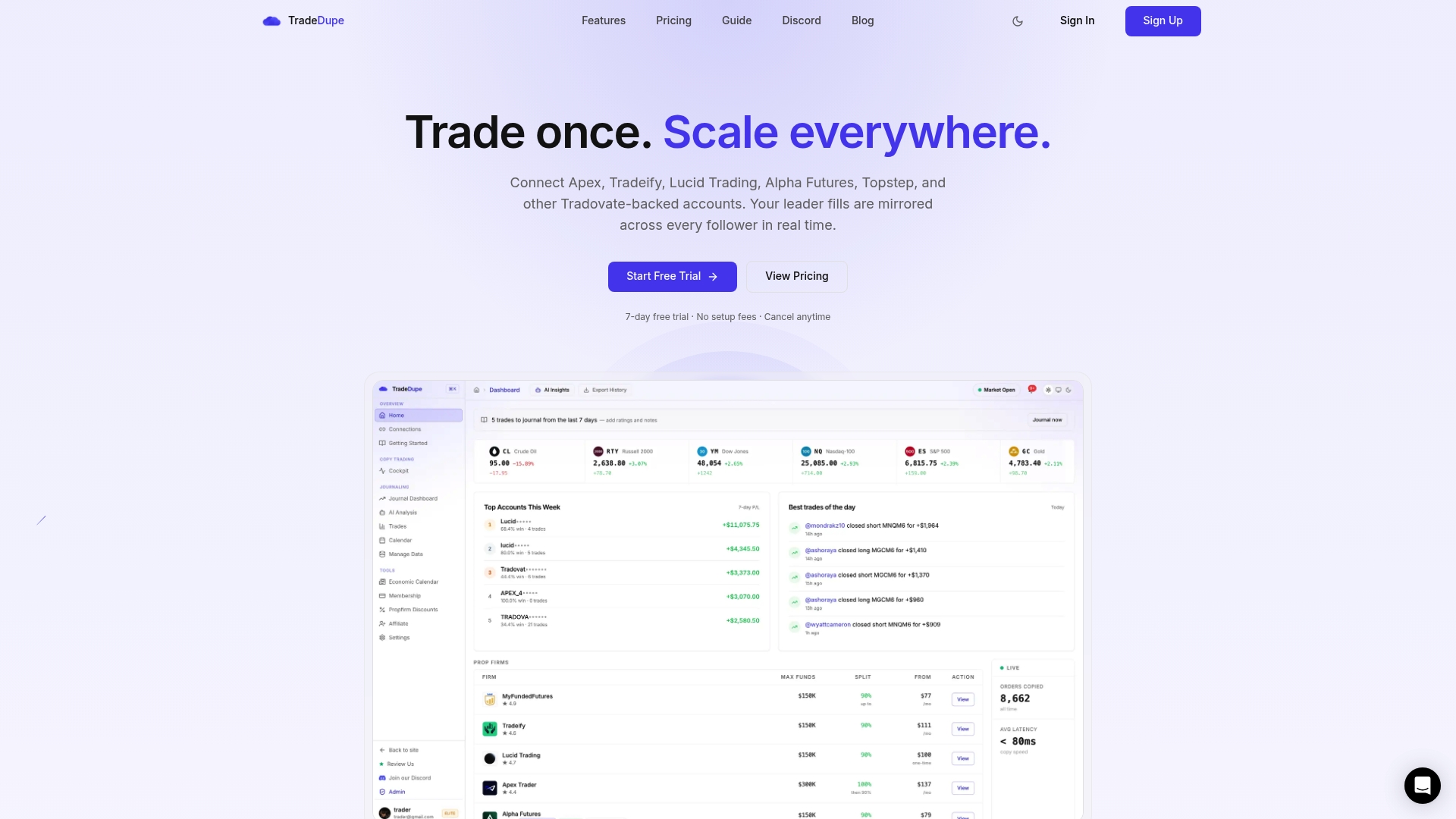
The safeguards covered in this guide come built in: rogue-trade detection catches follower fills the copier didn't originate, per-account toggles let you isolate any account instantly, and daily loss limits stay enforced by Tradovate itself rather than by a third-party layer that can lag or fail. It works across Apex Trader Funding, Tradeify, Lucid Trading, MyFundedFutures, Alpha Futures, and TakeProfit Trader accounts.
Plans start at $20/month billed yearly, scaling up through the Pro and Elite tiers as your connection and account counts grow, and every tier includes a 7-day free trial with one-click cancellation. Walk through the getting-started guide to have your leader account mirroring to your first follower in about ten minutes.
Sources
Review Tradovate's risk settings documentation, prop trading risk guidance, and TradeDupe's copy trading overview for deeper technical detail.
- Risk Settings - Tradovate
- Prop Trading Risk Management: Rules & Limits
- Ultimate Guide to Trade Copying for Funded Accounts | Damn Prop Firms
FAQ
What Is the Most Important Leader Account Risk Control?
Sizing the leader trade to your strictest follower's drawdown allowance matters most, since a trade that fits one account can breach another. Daily loss limits and rogue-trade detection matter too, but sizing failures cause the fastest account losses.
Does Tradovate Guarantee My Loss Limit Won't Be Exceeded?
No. Tradovate's risk settings auto-close positions and cancel orders once a limit triggers, but liquidation happens at market price, and slippage in fast conditions can produce a loss larger than the configured limit. Set personal buffers with that slippage risk in mind.
How Fast Does a Copier Need to Sync Exits?
Sub-100 millisecond sync, the speed TradeDupe's WebSocket connection targets, meaningfully reduces the window where a follower account holds risk the leader has already exited. Slower sync widens that mismatch window, particularly during fast market moves.
Can I Test a Leader/Follower Setup Before Going Live?
Yes, and you should. Run demo tests covering partial fills, stop modifications, and reconnection handling, then log at least 50 to 100 test trades before scaling from one follower to a full rollout.
Does TradeDupe Cost Extra Per Follower Account?
No. TradeDupe prices by plan tier rather than per account: the Standard plan runs $20 per month billed yearly for 2 connections with 10 accounts each, with Pro and Elite tiers scaling connection and account limits from there.
Recommended
- 4 Metrics Prop Desks Need for Leader Follower Analytics on Tradovate
- 5 Layer Prop Desk Risk Controls for Operators: Sizing to Risk Engine
- Protect Prop Desk Capital With 34ms Tradovate Selective Copy Trading
- Order Throttle Limits for Tradovate Copy Trading: Pace Fan Out to Avoid Outages
For educational purposes only. Not financial advice. Futures trading involves substantial risk of loss and is not suitable for every investor.