

Avoid $720/yr Roll Drag with Futures Contract Mapping for Quants
TradeDupe
10 min read
Practical guidance on rolling futures: liquidity-based roll timing, cumulative roll adjustments, an operational checklist, and a $720/year roll drag...
Futures contract mapping is the set of rules and executions that keep exposure continuous by rolling from expiring to deferred contracts. The practice we recommend combines liquidity-driven roll timing with explicit cumulative roll adjustments in backtests, because together they prevent the two most common failure points: slippage at the roll and distorted historical returns from naive data splicing.
*
> TL;DR: > > - Proper contract mapping prevents significant roll yield distortions, especially in markets with persistent contango or backwardation, by applying explicit cumulative adjustments. > - Selecting a roll method should depend on liquidity; fixed schedules work for front-month liquidity, while rule-based or spread execution can reduce slippage in less liquid markets. > - Backtest accuracy relies on consistent, rule-based roll dates and cumulative price difference adjustments, with sensitivity testing recommended to confirm robustness. > - Tools like funding-rate-based synthetic proxies avoid physical rolls but are not interchangeable with exchange futures for regulated hedging; verify specifications before implementation. > - Live execution risks include symbol mismatch and improperly timed spreads, which can cause operational errors; handling these requires precise symbol mapping and macro-aware scheduling.
*
Table of Contents
- What Contract Mapping Is and Why Modelers Need It
- Core Mapping Methods You Can Execute
- How Roll Yield Shapes Your Returns
- Building Backtests That Splice Contracts Correctly
- A Practical Checklist for Production Mapping
- Operational Notes for Multi-Account Execution
- Three Rules of Thumb I Give Every Modeler
- TradeDupe: Built for the Operational Side of Mapping
- FAQ
- Sources
What Contract Mapping Is and Why Modelers Need It
Contract mapping, often called rolling, is the process of closing an expiring futures position and opening an equivalent position in a deferred contract to maintain continuous exposure. Exchange-traded futures expire by design, but a trading model or a long-term portfolio strategy needs a seamless price series, so quants construct a continuous series that approximates holding "the market" rather than any single expiring instrument.

That approximation is where the trouble starts. A continuous series is a modeling convenience, not an exchange reality, and the two diverge at every roll date. Futures contracts are standardized, exchange-traded agreements, and most positions are offset before delivery rather than settled physically, which is exactly why rolling exists as a mechanical, repeatable process rather than an occasional event.
The main pitfalls cluster around four issues: ignoring roll yield entirely, rolling into a thin, illiquid deferred contract, misreading settlement rules that differ by product, and failing to apply corporate-action-style adjustments when a series splices across contract months. Each of these can quietly bend a backtest's results without ever triggering an obvious error.
Core Mapping Methods You Can Execute
Four approaches dominate practical mapping, and the right one depends on the liquidity profile of the market and how much model risk you are willing to carry.
- Nearest-month fixed schedule: roll on a set calendar rule, such as five business days before expiration; simple to automate and effective when volume stays concentrated in the front month.
- Calendar spread execution: enter a single spread order that simultaneously sells the expiring contract and buys the deferred one, which tightens the fill and reduces the slippage of working two separate legs.
- Optimum-roll or rule-based selection: choose the contract expected to deliver the best yield over the holding horizon rather than defaulting to the front month.
- Perpetual or synthetic proxies: use funding-rate-based instruments that never expire, substituting a periodic funding payment for a physical roll.
The nearest-month approach is the workhorse for markets like crude oil or equity index futures, where front-month liquidity dominates. Calendar spreads are the standard execution mechanism for the roll itself, letting traders avoid delivery risk while capturing a tighter combined fill than legging in and out separately.
Rule-based selection, of the kind used in methodologies such as Citi's CUBES framework, attempts to pick the contract with the best expected yield instead of mechanically defaulting to the front month. That can reduce negative roll in some periods, but it introduces real model risk when the curve evolves differently than the model predicted, so a rule-based roll can underperform a plain fixed schedule.
Perpetual or synthetic instruments sidestep the roll mechanically through a funding rate, but they are not interchangeable with exchange-deliverable futures for regulated hedging purposes, given the differences in margining and settlement behavior.
How Roll Yield Shapes Your Returns
Roll yield is the return (or cost) generated purely by the act of rolling, separate from any change in the spot price, and curve shape determines its sign. When a market is in contango, the deferred contract trades above the expiring one, so rolling forward means selling low and buying high, producing a negative roll. In backwardation, the deferred contract trades below the expiring one, and the roll generates a positive return.
The effect compounds. A single month of negative roll looks trivial, but repeated monthly negative rolls across a sustained contango period can erode a long-only commodity position's return well beyond what spot-price movement alone would suggest, a dynamic documented in CME Group's analysis of futures return decomposition.
Worked example (illustrative): say the front-month contract trades at $75.00 and the deferred contract trades at $75.60, a $0.60 contango spread. Rolling 100 contracts at that spread costs 100 × $0.60 = $60.00 in nominal roll loss for that month, before any transaction costs. Run that same $0.60 monthly contango for twelve consecutive months and the cumulative roll drag reaches $720.00 per 100-contract position, entirely independent of where spot price ends up.

Index methodologies matter here too. A fixed-schedule index rolls on the same calendar day every month regardless of curve shape, while a rule-based index attempts to time the roll around the curve, which changes the realized roll yield an investor actually experiences even when both track the same underlying commodity.
Building Backtests That Splice Contracts Correctly
Naive concatenation, simply pasting the front-month price series end to end at each expiration, creates artificial price jumps at every roll date and can meaningfully inflate or deflate backtested returns depending on which direction the gap happened to run. The fix is a cumulative roll adjustment: a running total of the price differences recorded at each historical roll date, applied backward to the earlier segments of the series so the whole history reads as one continuous, gap-free line.
- Pick the roll date using a consistent, pre-defined rule rather than discretion.
- At that date, record the price difference between the expiring and deferred contracts.
- Add that difference to a running cumulative adjustment total.
- Apply the cumulative adjustment to every price point before that roll date.
- Repeat for each subsequent roll across the full historical window.
Roll-date rules generally fall into three camps: an open-interest or volume threshold (roll once the deferred month captures a defined share of activity), a fixed percentage-shift rule, or a simple fixed business-day window before expiration. CME Group's educational materials recommend monitoring open interest and volume migration between the lead and deferred months specifically to avoid rolling into a contract that cannot absorb the order without slippage.
Once the series is spliced, sensitivity testing matters more than most quants expect: performance can be more sensitive to the roll-date threshold than to the trading signal's own parameters, so a parameter sweep over roll rules, followed by out-of-sample validation, belongs in every serious backtest.

Pro Tip: Run your backtest twice with two different roll-date rules before trusting the result; if performance swings more than your signal's own parameter sensitivity, the roll rule is driving your edge, not your model.
A Practical Checklist for Production Mapping
Before any mapping logic goes live, verify the contract's actual specifications rather than assuming they match a related product.
- Confirm tick size and contract multiplier against the exchange's own spec page.
- Confirm settlement type: physical delivery versus cash settlement changes roll urgency.
- List all currently listed expiry months and their last trade and settlement dates.
- Check the open-interest and volume liquidity profile across the lead and deferred months.
- Write down the rollover execution plan in advance, including order type and timing.
- Set a slippage budget for the roll so execution cost is measured, not assumed.
Gold futures, for example, trade at 100 troy ounces per contract with a minimum tick of $0.10 per ounce, while the Micro Gold and 1-Ounce Gold variants carry entirely different multipliers, so a mapping script built for one will misprice the other if the contract code is not checked explicitly. Vendor data feeds deserve the same scrutiny: confirm contract code conventions, expiry codes, multiplier, tick value, and settlement method before trusting any third-party feed.
Operational Notes for Multi-Account Execution
Mapping errors do not stay theoretical once they hit live execution across multiple accounts. A symbol mapping mismatch, where one broker's contract code does not line up with another's, can cause a follower account to receive the wrong instrument entirely or miss the mirrored fill altogether; our own symbol-mapping guide walks through several high-risk symbols where this commonly breaks. Calendar-spread execution windows also matter for mirrored trades, since fill timing across many follower accounts can widen if the roll order is worked as two legs instead of one spread. Pairing a clean roll-date rule with our economic calendar helps keep macro-sensitive rolls, like rate futures around FOMC dates, away from thin liquidity windows.
Three Rules of Thumb I Give Every Modeler
Roll timing should follow liquidity, not the calendar: wait for open interest to actually migrate before forcing a roll. Model roll yield explicitly and let it compound across periods instead of treating it as noise. Finally, build instrument-specific adjustments for micro contracts and corporate-action-style splits rather than reusing one roll rule across every product you trade.
> — Andres
TradeDupe: Built for the Operational Side of Mapping
Getting the roll rule right is only half the job once positions are mirrored across several prop firm accounts. We built TradeDupe's copy trading around that exact gap: real-time WebSocket mirroring of every leader fill to your enabled follower accounts, typically within 100ms, with rogue-trade detection and per-account toggles that catch a mismatched roll before it propagates across your whole book.
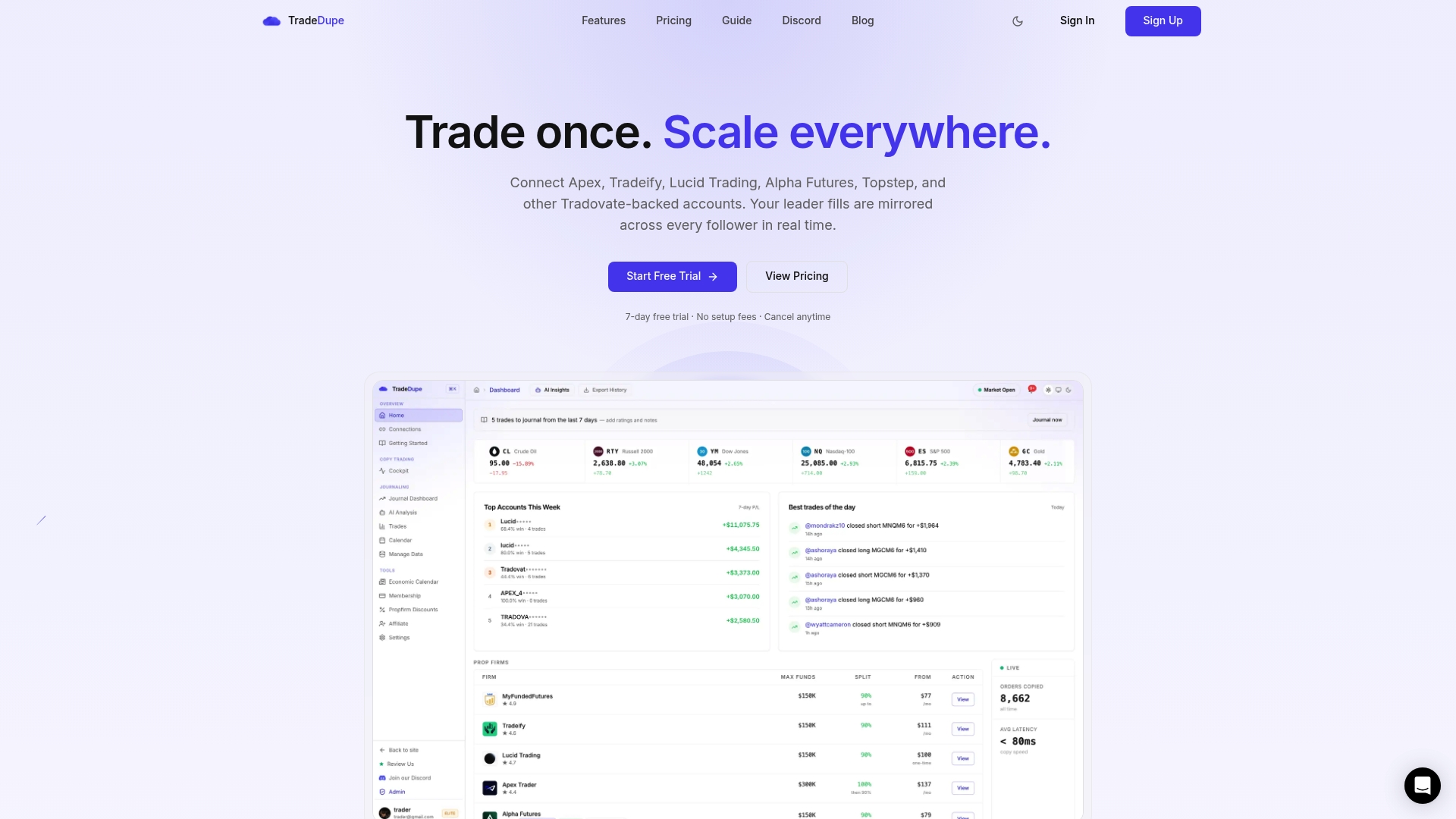
Our symbol-mapping documentation, built-in economic calendar, and position-size calculator exist specifically so a roll executed correctly on one account stays correct everywhere it gets mirrored. Plans start at a low monthly rate billed yearly, and every plan includes a 7-day free trial with one-click cancellation. Check current plan details and start the trial today.
FAQ
What are the four main types of futures contracts?
Futures contracts are generally grouped into commodity futures (energy, metals, agriculture), financial futures (interest rates, currencies), equity index futures, and newer categories like cryptocurrency futures. Each group shares the same mechanical structure: a standardized, exchange-traded agreement that is typically offset before delivery rather than settled physically.
How much is one tick of GC worth?
Gold futures (GC) carry a minimum tick of $0.10 per troy ounce, and since the contract covers 100 troy ounces, one tick is worth $10.00 per contract. Smaller variants like Micro Gold carry different multipliers, so this value does not transfer directly across product sizes.
Can you provide a list of futures contracts?
Rather than a fixed list, the most reliable approach is checking an exchange's own product slate, since available contracts and their specifications change over time. The CME Group product pages organize every listed contract by asset class with current specs for each.
How does a futures contract work?
A futures contract is a standardized agreement to buy or sell an asset at a set price on a future date, cleared through a clearinghouse that stands between both parties to manage counterparty risk. Most traders exit their position before expiration rather than take or make physical delivery, and margin typically runs 2% to 10% of the contract's notional value.
Sources
- Basics of Futures Trading | CFTC
- Understanding futures expiration & contract roll | CME Group
- Citi CUBES methodology / SEC filing
Recommended
- Futures Symbol Mapping for Copy Trading Ops: Test 5 High Risk Symbols
- Avoid Size Creep: Copy Trading Allocation for Futures (3 Spreadsheet Examples)
- Futures Position Size Calculator
- Bracket Orders in Futures: How Automated Exits Work
For educational purposes only. Not financial advice. Futures trading involves substantial risk of loss and is not suitable for every investor.