
Is Copy Trading Allowed at Prop Firms? 2026 Rules
TradeDupe
12 min read
Is copy trading allowed at prop firms? See what Apex, Tradeify, MyFundedFutures and others say about copying your own accounts, and how to verify before you link.
Mostly yes, with one condition that matters more than any other: you may copy trades between accounts you own and control, but you may not copy another trader, follow a signal group, or let someone else copy you. Beyond that line, each firm adds its own details on account types, sizes, correlated positions and which copier tools it tolerates, and those details change. This guide walks through what the firms say today, where traders get caught, and how to confirm the rule for your exact account before you link anything.
TL;DR
- Copying your own trades across your own accounts is allowed at most futures prop firms. Copying someone else, or being copied by others, is treated as a serious breach almost everywhere.
- Firms differ on the fine print: same program, same size, hedging, correlated markets, and whether third-party copiers are supported or used "at your own risk."
- Penalties can include removed profits, denied payouts and closed accounts, so confirm the rule on the firm's own help page, not on a review or a vendor's compatibility list.
- Test your copier in simulation first, then keep a dated screenshot of the rule you relied on.
Table of Contents
- Why firms allow it at all
- What the rules usually say
- Your own accounts versus other people's trades
- Same firm versus different firms
- Evaluation, funded and live stages
- The mistakes that get accounts flagged
- How firms find violations and what follows
- How to check a firm's rule before you copy
- Choosing how to copy
- Our perspective
- Where TradeDupe fits
- FAQ
- Sources
Why firms allow it at all
A prop firm sells you an evaluation, and often several. Holding five or ten accounts is normal, and placing the same order by hand ten times is slow and error-prone. Slippage between the first and last fill, a missed exit on one account, or a fat-fingered size can end an evaluation that was otherwise going fine.
So most futures firms accept that a trader will mirror their own decisions across their own accounts. What they object to is a different thing: many people trading one strategy, or one person effectively trading accounts that belong to others. That is where the phrase "copy trading" turns from a convenience into a rule violation. If you want a plain definition of the practice first, our copy trading explainer for futures covers it.
What the rules usually say
Read enough rule pages and the same structure repeats:
- Ownership. All accounts must be in your name, verified under your identity.
- Your own decisions. The orders being copied must come from your own analysis, not from a signal provider, a mentor or a group chat.
- No group trading. Several traders pooling or mirroring one strategy is prohibited.
- Tool conditions. Some firms name supported tools, others say third-party copiers are used at your own risk.
- Risk behavior. Hedging between accounts, opposite positions and abusive use of copying to game the rules are separate violations.
The table below summarizes what the firms in our audience say publicly. Treat it as a map, then read the linked page yourself.
| Firm | What its published rule says | Watch for |
|---|---|---|
| Apex Trader Funding | Its prohibited activities page forbids trade copying with other traders. | Copying with anyone else is grounds for closure and forfeiture. Confirm the current rule for your own multiple accounts. |
| Tradeify | Its help article allows group trading only between accounts you own and manage, and says third-party copiers are at your own risk. | Tradovate's group trading has quantity and bracket-order limits. |
| MyFundedFutures | Its copy trading page says copying is allowed across account types, but you assume responsibility for the consequences. | You must check that your activity complies with the applicable terms. |
| Top One Futures | Its policy allows copying between accounts of the same program and size. | Same-direction trades on highly correlated assets across different types or sizes are prohibited. |
| FundedNext Futures | Its policy prohibits copy and group trading in general, but lets you copy your own trades between accounts you own, including at other firms. | All accounts must belong to the same verified individual. |
| BrightFunded Futures | Its rule page allows copying between your own accounts. | Copying other traders and group trading are hard breaches, and bots must be yours and inaccessible to others. |
Lucid Trading, Alpha Futures and TakeProfit Trader also publish their own rules. We are not summarizing them here because we could not verify the current wording line by line, so open each firm's help center for the exact program you hold. Our page on which futures prop firms allow copy trading is kept up to date as firms change their wording.
Your own accounts versus other people's trades
This is the distinction every firm draws, and it is worth stating bluntly.
Allowed in most rule sets: you place a trade on a leader account and your own follower accounts take the same trade. You are the single decision-maker, and every account is in your name.
Not allowed in most rule sets:
- Subscribing to a signal service or a mentor's feed and mirroring it onto funded accounts.
- Sharing your leader account with friends so their accounts follow yours.
- Running a bot you do not own or that other people can access.
- Managing accounts that belong to someone else.
The reason is straightforward from the firm's side. A firm evaluates one trader's skill and risk. If ten accounts are driven by one source, or one person's account is driven by another, the evaluation no longer measures what it was sold to measure.
Same firm versus different firms
Copying inside one firm is usually the simplest case, but it can carry conditions. Top One Futures, for example, allows it between accounts of the identical program and the same size, and prohibits same-direction trades on highly correlated assets across accounts of different types or sizes. If you hold a $50K evaluation and a $150K funded account at the same firm and mirror one into the other, a rule like that is exactly what you could trip.
Copying across firms is also accepted by some. FundedNext Futures allows copying between your own accounts and accounts at other prop firms, provided all accounts are owned by you and verified under the same name. Others are silent or stricter, so the safe default is to assume nothing: read the page for each firm in the chain, because your leader account follows its firm's rules and every follower follows its own.

One point from a third-party checklist is worth keeping in mind: a platform integration listed by a firm does not by itself prove the firm permits copying. The ownership, hedging, account stage, account capacity and position-size rules still apply.
Evaluation, funded and live stages
Rules can change as an account moves up. A firm may be relaxed on evaluation accounts and stricter after you pass, or may limit how many funded accounts you can hold at a time. Topstep, for instance, states in its live funded account rules that a trader may have one active Live Funded Account, which is the kind of cap that changes how many followers you can run at that stage. We do not list Topstep as a supported platform for our tool, but it shows why stage-by-stage reading matters.
MyFundedFutures says copying is allowed across all account types, yet places responsibility on you. That is typical phrasing: permission, plus a reminder that if the account breaks another rule through copying, the copier is not an excuse. Our article Does MyFundedFutures allow copy trading? goes through that wording in detail.

The mistakes that get accounts flagged
Most copy trading problems are not about the copier. They come from behavior around it.
- Mixed account sizes with correlated trades. Same-direction ES and MES, or NQ and MNQ, across different sizes can fall under a correlated-asset restriction.
- Hedging across accounts. Going long on one account and short on another can look like gaming the rules. Topstep, for one, monitors hedging in real time and advises trading each account independently. Check whether your firm has a similar position.
- Following a leader that isn't yours. If a mentor's signal or a friend's account drives your orders, you are in group-trading territory.
- Unnoticed follower trades. A follower account that takes an order your copier never sent, whether from a stray manual click or another tool, makes your account history inconsistent with your stated method.
- Consistency and payout surprises. Copying amplifies a single large day across every account at once. If your firm has consistency rules, all of your accounts hit the same threshold together. Our consistency rules comparison shows how the firms differ.
- Skipping the test. Top One Futures advises testing and verifying copier settings in a simulated environment before active trading. Quantity ratios, direction reversal and partial fills are easy to get wrong and expensive to find out live.
How firms find violations and what follows
Firms do not need to know what software you run to see a problem. They see order timing, size, instruments and direction across accounts, along with identity and IP data. Ten accounts opening the same trade within milliseconds is exactly what your own copier should produce, so that alone is not a violation if the accounts are yours. Identical behavior across accounts with different owners is what draws attention.
The consequences depend on the firm and the severity. Top One Futures says it may remove profits, deny related payout requests, or terminate accounts in serious or repeated cases. Apex says violations of its account and resource sharing rules result in account closure and forfeiture of funds. Either way, the loss usually lands on exactly the accounts that were about to pay you.
How to check a firm's rule before you copy
A review site or a copier vendor's compatibility list is not a rule. The firm's own page is. A reliable routine looks like this:
- Find the current rule page for the exact program and account stage you hold, plus your agreement and any dashboard notice.
- Search it for copy trading, trade copiers, multiple accounts, hedging, automation and account sharing. This approach follows a rule-checking guide for prop traders.
- Verify the specifics: ownership, account limits, platform, stage transitions and live restrictions.
- Save the page date and a screenshot. If a rule is reworded later, you have proof of what applied when you acted.
- Ask support in writing when anything is ambiguous, and keep the reply. If you are unsure, confirm with the firm before you copy.
For a deeper walk through how wording turns into practice, see how prop firm rules affect trade copying.
Choosing how to copy
There are broadly three routes for Tradovate-based accounts:
- Tradovate's built-in group trading. Free and accepted by several firms, but it has limits. Tradeify's help article notes that order quantity must be a multiple of the group total and that bracket orders are not supported in group trading, which is a real constraint if you rely on them.
- Platform add-ons on a desktop. These can work, but they depend on your PC or a VPS staying online.
- A cloud-based copier connected to your accounts, running off your machine.
Our prop firm trade copier guide compares what matters here: rules, setup and failure modes.
Our perspective
We built TradeDupe for one narrow group: retail traders holding several prop accounts on Tradovate. That focus shapes how we think about the rules question.
First, permission is only half the problem. A firm can allow copying and you can still lose an account because a follower took an order you did not intend. That is why we built rogue-trade detection, which flags follower trades the copier did not place, along with per-account copy toggles so you can pause one account without touching the rest.
Second, risk limits should not depend on software you control. We set daily loss limits and profit targets directly on Tradovate so the broker enforces them, rather than relying on a script that could be offline.
Third, we think the safest setup is the plainest one: your own accounts, your own leader, your own decisions, a rule page you have read and a screenshot to prove it. Our tool does not change what a firm permits. It only makes permitted copying faster and cleaner.
> — Andres
Where TradeDupe fits
If you hold several Tradovate-based accounts at Apex, Tradeify, Lucid, MyFundedFutures, Alpha Futures or TakeProfit Trader, TradeDupe mirrors each fill on your leader account to your enabled followers, typically under 100ms. You connect through Tradovate's official OAuth flow, so we never store your password, and nothing runs on your PC or VPS.
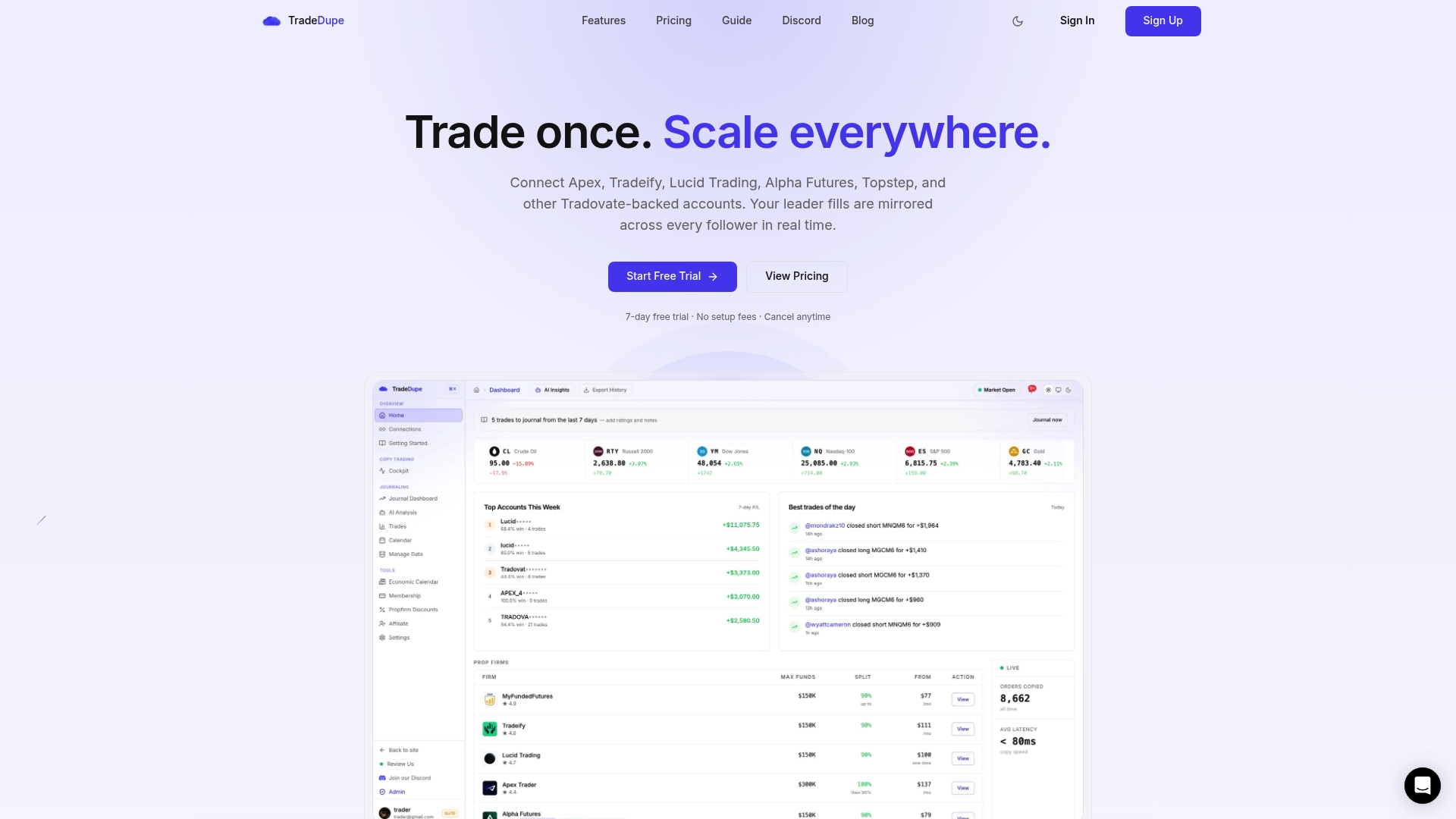
Plans start at $20/month billed yearly (Standard is $30/month if you pay monthly), and every plan includes a 7-day free trial with one-click cancellation. You can compare tiers on the pricing section and run the trial on a simulated account first, as the firms themselves recommend.
FAQ
Is copy trading allowed at prop firms?
Usually yes, if you copy between accounts that you own and control. Copying another trader, a signal service or a group is prohibited at most futures firms. Rules for account types, sizes and tools vary, so read your firm's current page.
Can I copy trades between different prop firms?
Some firms say yes. FundedNext Futures, for example, allows it when all accounts are owned by the same verified individual. Others may be stricter or silent, so check each firm involved and ask support in writing if the wording is unclear.
Can I use a third-party copier?
Often, but conditions differ. Tradeify says third-party copiers are used at your own risk and that it will not support errors they cause. MyFundedFutures lists preferred tools and also accepts external solutions. Confirm which tools your firm tolerates.
What happens if I break a copy trading rule?
The outcome depends on the firm and the severity. Top One Futures may remove profits, deny payout requests or terminate accounts in serious or repeated cases. Apex states that sharing violations lead to closure and forfeiture of funds.
Should I test a copier before using it live?
Yes. Top One Futures advises verifying copier settings in a simulated environment first. Check quantity ratios, exits, partial fills and any hedging risk before real accounts depend on it.
Sources
- Prohibited Activities, Apex Trader Funding
- Tradovate Order Entry & Copy Trading, Tradeify Help Center
- Copy Trading at MyFundedFutures, Help Center
- Copy Trading Policy, Top One Futures Help Center
- Copy & group trading policy, FundedNext Futures
- Copy trading, bots and EAs: what is allowed? BrightFunded Futures
- Live Funded Account Rules, Topstep
- Understanding Hedging, Topstep Help Center
- How to Check Copy-Trading Rules Before Linking Prop Firm Accounts
Recommended
- How Prop Firm Rules Affect Trade Copying in 2026
- Best Trade Copier for Prop Firms \(2026\): Rules + Setup
- Which Futures Prop Firms Allow Copy Trading? \(October 2026\)
- 34ms Copy Trading for U.S. Tradovate Prop Desks: Audit Logs & Controls
For educational purposes only. Not financial advice. Futures trading involves substantial risk of loss and is not suitable for every investor.