
Lucid Flex Payout Rules (2026): Caps, Minimums, Eligibility
TradeDupe
11 min read
LucidFlex payout rules for 2026: the 5-day profit requirement, $2,000 cap on 50K, 90/10 split, no funded consistency rule, timing and how to request.
A LucidFlex funded account pays you 90% of what you withdraw, and each request is limited to 50% of your cycle profit, up to a cap that depends on account size ($2,000 on a 50K). To qualify, you need at least five winning days at the minimum daily profit and positive net profit for the cycle. There is no consistency percentage on the funded account. Below are the numbers for every account size, a worked example, the request process, and what changes if you run several Lucid accounts from one Tradovate login.
Rules in this article were checked against Lucid Trading's Help Center in November 2026. Prop firms change terms often, so confirm anything that affects a withdrawal on Lucid's Help Center before you request.
TL;DR
- Eligibility: five separate days at the minimum daily profit ($150 on 50K) plus positive net cycle profit, and a minimum request of $500.
- Cap: 50% of profit per request, up to $1,000 (25K), $2,000 (50K), $2,500 (100K) or $3,000 (150K). The cap does not grow with later payouts.
- Split: 90% to you, 10% to Lucid Trading.
- Consistency: none on funded LucidFlex accounts. The evaluation has its own consistency check.
- After payout 5: the account moves to Live, at Lucid's discretion on timing.
Table of Contents
- The core LucidFlex payout rules
- A worked example on a 50K account
- Does LucidFlex have a consistency rule?
- LucidFlex vs LucidPro payouts
- How to request a LucidFlex payout
- What happens after five payouts
- Recent changes to keep in mind
- Running several Lucid accounts: what changes for payouts
- Taxes on LucidFlex payouts
- How TradeDupe fits
- Our view
- FAQ
- Sources
The core LucidFlex payout rules
Lucid's official LucidFlex Payouts article (28 July 2026) sets out the structure. Four conditions decide whether a request is available.
- Five qualifying days. Within the payout cycle you must earn at least the minimum daily profit on five separate days. The thresholds are $100 on 25K, $150 on 50K, $200 on 100K and $250 on 150K, per Lucid's LucidFlex Payouts article. Days do not need to be consecutive.
- Positive net profit. The cycle must show positive net profit, even $1.
- Minimum request. The smallest request is $500.
- Maximum request. 50% of your profit, up to the account cap.
After each approved payout, the qualifying-day count resets. You earn five new days before the next request.
The split is 90% to you and 10% to Lucid, confirmed in Lucid's general FAQ.
Caps by account size
| Account | Min. daily profit (5 days needed) | Max per request |
|---|---|---|
| 25K | $100 | $1,000 |
| 50K | $150 | $2,000 |
| 100K | $200 | $2,500 |
| 150K | $250 | $3,000 |
These figures come from the same LucidFlex Payouts article. Two details matter. First, the cap stays flat across payouts. Second, after five payouts the account moves to Live.
A worked example on a 50K account
Say you pass the evaluation and fund a 50K LucidFlex account. Here is how the first cycle can run.
- You trade for two weeks and hit $150 or more on five different days.
- Your cycle profit is $4,300.
- Because a request is limited to 50% of profit, the maximum is $2,150, but the 50K cap is $2,000. So you request $2,000.
- At the 90/10 split, you receive $1,800 and Lucid keeps $200.
The 50% rule has a practical consequence. To request the full $2,000 cap you need $4,000 of profit in the cycle. BestProps' analysis works through it: if you request the cap every time, each later cycle must add about one cap of new profit, so five full payouts on a 50K take roughly $12,000 of total trading profit.
If profit is smaller, you can still request. At $1,000 of cycle profit you could ask for $500, the minimum. Many traders request smaller amounts early to keep the account's balance cushion intact. That is a risk-management choice, not a rule.

Does LucidFlex have a consistency rule?
Not on the funded account. Lucid's LucidFlex Funded Account page states that funded accounts have no Consistency Percentage, no payout buffer, an optional Daily Loss Limit, a 90/10 split and end-of-day trailing drawdown.
The evaluation is different. According to Capital Critic, LucidFlex and LucidDaily evaluations now default to a 40% consistency rule, meaning your largest winning day can be at most 40% of total evaluation profit. A 50% version is offered as a paid checkout add-on. Funded accounts remain free of it. Check the checkout page for the version you are buying.

If you hold accounts at several firms, the contrast is useful. Some firms apply a consistency percentage to funded payouts, and the math differs from firm to firm. Our prop firm consistency rules comparison lays out each firm's formula, and the list of prop firms with no consistency rule shows where LucidFlex sits.
LucidFlex vs LucidPro payouts
The two plans pay differently, so check which one each of your accounts is on.
| LucidFlex | LucidPro | |
|---|---|---|
| Qualifying rule | 5 days at minimum daily profit, plus positive net profit | Minimum cycle profit goal |
| Funded consistency | None | 40% |
| Buffer | None | Balance must be above the buffer ($52,100 on 50K) |
| Cap on 50K | 50% of profit, up to $2,000 | $2,000 first payout, $2,500 after |
The comparison follows Lucid's FAQ and Evalsaver's breakdown. Flex favors steady, repeatable green days. Pro favors larger swings, but you must stay above the buffer and stay under the consistency limit.
How to request a LucidFlex payout
The process, per Lucid's FAQ:
- Wait for end-of-day accounting. Eligibility updates after the session closes, so a qualifying fifth day appears the next morning rather than mid-session.
- Open Dashboard → Payouts and submit the request.
- Complete KYC (identity verification) if prompted.
- Select your payout method.
There is no fixed payout window. Once approved, the amount is deducted from the account within a few minutes and sent to your payment method within two business days, per the LucidFlex Payouts article. Marketing copy may describe faster arrivals; plan around the official two-business-day figure.
Mistakes that cost traders a payout
- Counting a day that fell short. A $149 day on a 50K does not count. Track each day against the threshold, not just cycle profit.
- Forgetting the reset. The five-day count restarts after every approved payout.
- Ignoring commissions. Lucid charges per-side commissions by contract, for example $1.75 on ES and NQ and $0.50 on MES and MNQ. The Flex article does not say whether the minimum daily profit is measured before or after commissions, so confirm with Lucid support and leave a margin above the threshold.
- Assuming the cap rises. It does not. The 50K limit is $2,000 on payout one and payout five.
What happens after five payouts
On the current rules, the account moves to Live after five payouts. Accounts bought or reset on or before 27 February 2026 sit under legacy live terms, which allow a sixth payout and use a different move-to-live formula, according to BestProps. If you hold an older account, read the legacy Live article before planning your withdrawals.
Timing of the transition is not automatic. PropTradingVibes points out that five payouts are not a guaranteed appointment, because Lucid's risk team keeps discretion over every live transition. Treat the fifth payout as the trigger for a review, not a promised date.
Recent changes to keep in mind
Lucid's terms moved several times in the past year. PropFirmTrading documents that in October 2026 Lucid introduced intraday payouts for accounts with the Daily Loss Limit turned on, after which LucidPro and LucidFlex stop trading for the day, along with the 40% evaluation consistency default. The same review notes that in November 2025 LucidPro funded consistency was set at 40% and new and reset accounts lost the 100% split on the first $10,000.
The lesson is practical: a rule you read in a video from last spring may be out of date. Use the Help Center as the final word and note the date on any article you rely on.
Running several Lucid accounts: what changes for payouts
The rules above apply per account. If you hold three 50K LucidFlex accounts, each needs its own five qualifying days, its own positive cycle, and its own request. That is where copying one leader account to several followers changes the picture.
When the same fills land on every account, the accounts tend to qualify on the same days. A $150 day on the leader is a day above the threshold on each follower if the sizes match, so your payout cycles line up. That is convenient for planning cash flow, but it also means one bad day hits every account at once. Differences in fills or commissions can leave one follower a few dollars short on a threshold day, so check each account's daily number rather than assuming they match.
Two cautions before you copy:
- Check the firm's copy trading policy. Whether and how a firm allows copying across its own accounts is a firm rule. Read the current policy in Lucid's Help Center and confirm with Lucid support if anything is unclear. Our overview of which prop firms allow copy trading is a starting point, not a substitute for the firm's current text.
- Mind the per-account math. Cap, minimum and split all apply to each account separately, so your total monthly withdrawal scales with how many accounts qualify, not with the leader alone.
If you also hold Apex accounts, their payout logic is different. The Lucid vs Apex comparison shows the two side by side, and you can model your own numbers with the prop firm profit calculator.
Taxes on LucidFlex payouts
A payout is income, even when no tax is withheld. TraderTax reports that Lucid Trading does not issue 1099 forms and does not withhold taxes, yet payouts are still taxable and are typically reported as self-employment income on Schedule C, with federal income tax plus 15.3% self-employment tax. The same source notes the 1099-NEC reporting threshold rose from $600 to $2,000 starting tax year 2026 under the July 2025 OBBBA law.
Keep a record of every request, amount and payout date. For how your situation is taxed, talk to a CPA or enrolled agent who works with traders.
How TradeDupe fits
If you run several Tradovate-based prop accounts, you can mirror a leader account to your follower accounts with TradeDupe. You connect through Tradovate's official OAuth flow, so your password is never stored. Every fill on the leader is copied to the follower accounts you enable, and you can toggle each account on or off. Daily loss limits and profit targets are set directly on Tradovate, so the broker enforces them. Plans start at $20/month billed yearly, and every plan includes a 7-day free trial with one-click cancellation.
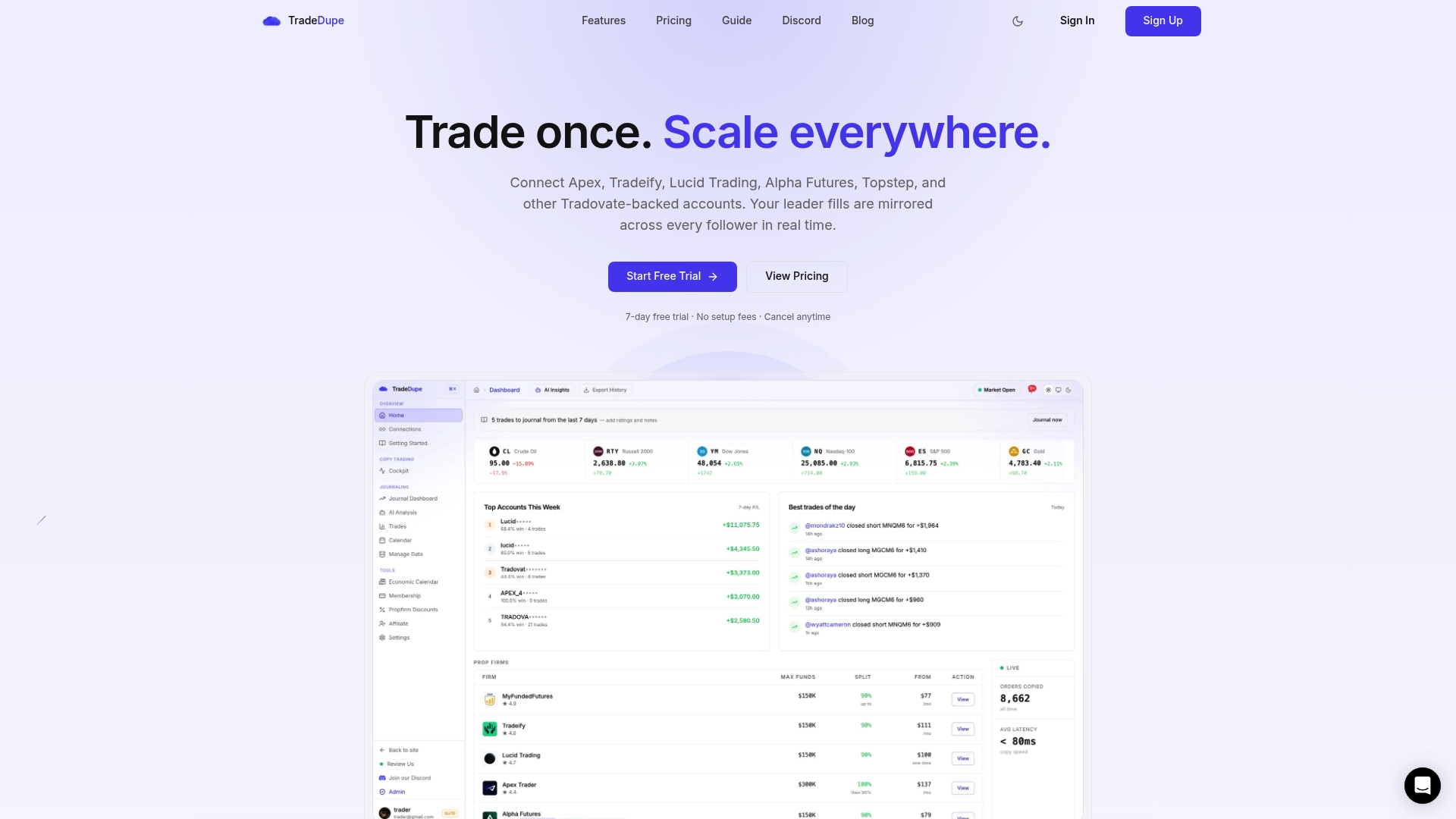
With the trial you can set up a leader and a follower and watch how fills line up before the next payout cycle. For plan details see TradeDupe.
Our view
> Most payout problems we see discussed among prop traders come from small gaps, not big ones: a $148 day, a forgotten reset, a follower that drifted from the leader. > > LucidFlex rewards repeatable days. With no consistency rule on funded accounts, the work is keeping every account above its daily threshold, five times per cycle. > > That is why we built TradeDupe around Tradovate prop traders. Rogue-trade detection flags follower trades the copier did not place, and per-account toggles let you pause one account without touching the rest. You keep your attention on the leader chart while the cycle math runs on every account. > > Andres
FAQ
What is the max payout on a 50K LucidFlex account?
The limit is 50% of profit up to $2,000 per request. The cap does not increase on later payouts, and after five payouts the account moves to Live, per Lucid's LucidFlex Payouts article.
Does LucidFlex have a consistency rule?
Funded LucidFlex accounts have no consistency rule and no payout buffer. The evaluation does carry a consistency check, so read the rules for the version you purchase.
How long does a LucidFlex payout take?
Once approved, funds leave the account within a few minutes and reach your payment method within two business days. There is no fixed payout window, so you can request whenever eligibility shows.
What is the profit split?
Funded payouts are 90% to you and 10% to Lucid Trading. Some older accounts sit on different live terms, so check your account's date against the Help Center.
Sources
- LucidFlex Payouts, Lucid Trading Help Center
- LucidFlex Funded Account, Lucid Trading Help Center
- Futures Trading & Prop Firm FAQ, Lucid Trading
- Lucid Flex Payout Rules, Max Payouts & Eval Rules, BestProps
- Lucid Trading Payout Rules: Flex, Pro and Daily Plans, Evalsaver
- Lucid Trading On-Demand Payouts, Capital Critic
- Lucid Trading Review 2026, PropFirmTrading
- LucidLive Transition, PropTradingVibes
- Lucid Trading Taxes, TraderTax
Recommended
- Tradeify Payout Rules: Eligibility, Caps and Timing \(2026\)
- Lucid Trading vs Apex Trader Funding: Prop Firm Comparison \(2026\)
- Tradeify vs Lucid Trading: Prop Firm Comparison \(2026\)
- Apex 3.0 Payout Rules Changed, So Check the 30% Cap First
For educational purposes only. Not financial advice. Futures trading involves substantial risk of loss and is not suitable for every investor.