
Lucid Prop Firm Guide 2026: Rules, Costs, Payouts
TradeDupe
11 min read
Lucid Trading explained for multi-account futures traders: account types, 2026 pricing, drawdown and consistency rules, payouts, and how to copy across accounts.
Lucid Trading is a US-based futures prop firm that sells one-time-fee simulated accounts: evaluations that lead to a simulated funded account, or a direct-to-funded account that skips the evaluation. There is no monthly subscription. If you plan to hold several Lucid accounts on Tradovate, the rules that matter most are the drawdown, the consistency percentage, the 4:45 PM EST close, the no-hedging rule and the payout caps. This guide covers each one, using Lucid's own help center pages (checked November 2026) wherever the firm states the rule. Where a detail can change, confirm it with Lucid before you buy.
TL;DR
- Lucid offers four account families, LucidPro, LucidFlex, LucidDaily and LucidDirect, all bought with a one-time fee and no monthly billing.
- Every current funded plan pays a 90/10 split, with a $500 minimum payout request, according to a November 2026 review of Lucid's terms.
- Lucid's FAQ states that automated strategies and trade copiers are permitted, but hedging is banned, including across accounts, and you are responsible for software errors.
- Sim positions must be flat by 4:45 PM EST, so a copier setup has to be checked against that cutoff on every account.
- If you run several Lucid accounts on Tradovate, one leader account can mirror to the rest, so you place each trade once.
Table of Contents
- What Lucid Trading is and how the accounts work
- What Lucid costs in 2026
- LucidFlex rules: targets, loss limits and consistency
- LucidPro rules: loss limits, no scaling and payout caps
- Trading rules that catch multi-account traders
- How payouts work
- What traders report about Lucid
- Copying trades across several Lucid accounts
- Perspective
- Run your Lucid accounts from one chart
- FAQ
- Sources
What Lucid Trading is and how the accounts work
Lucid describes its offering as simulated futures evaluations that can lead to a sim funded account, or a direct-to-funded account that begins payouts immediately. Successful traders may later move to a live brokerage account. Fees are one-time, with no monthly subscription and no funded activation fee.
An independent review lists the operator as Lucid Trading Group LLC, a Delaware company. It was established in March 2025, so its track record is short compared with older firms. Another professional review says traders can hold up to five funded accounts per household, on more than ten platforms. Check Lucid's help center for the current account limits before you plan a multi-account setup.
The four families differ in how you get funded and how you are paid:
- LucidPro: an evaluation, then a funded account with a max loss limit and an optional daily loss limit.
- LucidFlex: an evaluation with a profit target, a consistency rule and a minimum number of trading days.
- LucidDaily: a funded account built around daily payouts above a buffer.
- LucidDirect: the direct-to-funded account, with the highest fee and no evaluation.
What Lucid costs in 2026
The list prices below were read from Lucid's homepage in early November 2026 by BestProps. They are one-time fees across the $25K to $150K sizes. Promotions change often, so treat these as a reference point, not a quote.
| Account | $25K | $50K | $100K | $150K |
|---|---|---|---|---|
| LucidPro | $108 | $172 | $272 | $365 |
| LucidFlex | $65 | $115 | $215 | $323 |
| LucidDirect | $329 | $515 | $700 | $836 |
LucidDaily runs from $72 to $286 depending on the drawdown type. The same review reports a site-wide VAULT code for 30% off, for example $75.60 for a $25K LucidPro with the daily loss limit on. Codes expire, so check the checkout page.
Lucid's fee page says LucidPro Evaluation and LucidDirect have a one-time fee with no automatic rebilling, and that upgrading a LucidPro Evaluation to LucidPro Funded carries no activation fee. A reset is a paid purchase that returns the account to its original balance and risk parameters.
For a multi-account trader, this changes the budget math. Five $50K LucidFlex evaluations at the listed price is a different outlay from five monthly-fee evaluations, because you stop paying once you pass. Your real running cost is resets, so the discipline of your rules matters more than the sticker price.
LucidFlex rules: targets, loss limits and consistency
Per Lucid's LucidFlex help article (dated October 19, 2026), the evaluation has these requirements:
| Size | Profit target | Max loss limit | Max size |
|---|---|---|---|
| $25K | $1,250 | $1,000 | 2 minis or 20 micros |
| $50K | $3,000 | $2,000 | Check the article |
| $100K | $6,000 | $3,000 | Check the article |
| $150K | $9,000 | $4,500 | 10 minis or 100 micros |
Sizes run from 2 to 10 minis, or 20 to 100 micros, across the range. Consistency is 40%, or 50% with a paid add-on. The consistency rule caps how much of your total profit any one day can represent, so a single outsized day cannot carry the evaluation.
The minimum is three trading days at 40%, or two days with the 50% add-on. Lucid says activation happens in real time, within 5 to 30 minutes of hitting the target.
On payouts, LucidFlex requires five profitable days at the required daily minimum plus positive net profit. Each request is capped at 50% of profit, according to the BestProps review. The details are in our LucidFlex payout rules breakdown.

LucidPro rules: loss limits, no scaling and payout caps
Lucid's LucidPro funded account page (August 26, 2026) lists max loss limits of $1,000 to $4,500 by size. It also lists an optional fixed daily loss limit of $600 to $2,700, or a scaling daily loss limit of 60% of peak end-of-day balance. Contract sizes run from 2 to 10 minis (20 to 100 micros), there is no scaling plan, and no simulated payout caps apply.

The daily loss limit is optional, so decide on it per account. A tighter daily limit forces you to stop on a bad morning. If that is the habit you are trying to build, a drawdown recovery plan with risk gates gives you a structure for deciding when to cut size or stop.
Payout eligibility for LucidPro needs a per-cycle profit goal ($250 to $1,000 by size), 40% consistency and a buffer. Per-request caps run from $1,000 to $3,500, per the same review. Our LucidPro payout rules page walks through the caps, buffer and consistency math.
Trading rules that catch multi-account traders
Lucid's general FAQ states the following for LucidPro, LucidFlex and LucidDirect:
- Close by 4:45 PM EST. Positions must be closed by 4:45 PM EST Monday to Friday. Trading resumes at 6:00 PM EST Sunday to Thursday. Overnight holding is not permitted on sim accounts.
- News trading is allowed. LucidDaily is the exception: the BestProps review says it requires you to be flat around high-impact USD news.
- Hedging is prohibited. That includes hedging across accounts and across correlated instruments. With many accounts, it matters most if you run different strategies on different accounts. One account long and another short on the same or a correlated market is the pattern to avoid.
- Microscalping is flagged. It is flagged when more than 50% of profit comes from trades held 5 seconds or less. High-frequency trading is prohibited.
- Automation and copiers are permitted. You are responsible for software errors.
That last point is the one multi-account traders care about. A copier is allowed, but the same order hitting every account amplifies a mistake. A wrong size on the leader is a wrong size on every follower, and each account has its own max loss limit.
How payouts work
The BestProps review (November 2026) reports that every current funded plan pays a 90/10 split, meaning 90% goes to you. LucidPro accounts bought or reset before November 28, 2025 at 3 PM EST keep 100% of the first $10,000. The minimum request is $500 on every plan and requests are final.
Lucid disburses within two business days. Plaid transfers typically take 5 to 15 minutes, and WorkMarket by ADP can be as early as the next business day. Crypto is available for international traders. LucidDaily pays daily above the buffer with no per-request cap.
Since October 18 to 19, 2026, the same review says DLL-on LucidPro and LucidFlex accounts, and LucidDirect accounts of $50K and up, can request on demand during the session. Trading pauses until end of day after an intraday request.
On the live path, Lucid's terms have changed. The same review notes that from February 28, 2026, eligible LucidFlex accounts move to live after up to five payouts, with live accounts starting at $0 plus a one-time Live Bonus. Confirm the current conditions in Lucid's help center before counting on a live account.
What traders report about Lucid
Independent reporting is mixed in tone, so read it as a rule-awareness exercise. Trader Review found that on October 7, 2026 Lucid held a 4.4 TrustScore from 6,449 Trustpilot reviews, with 86% five-star. It also reports that payouts are often approved within minutes, and that Plaid deposits to US banks commonly arrive the same day.
The same analysis says the newest one- and two-star reviews most often involved a closed or banned account. Identity checks and contested rules were also common themes. Whatever the cause in any single case, the practical lesson is to follow the written rules on every account, keep your identity documents consistent, and keep your own records of trades and payouts.
Copying trades across several Lucid accounts
Lucid's rules allow copiers, and the platform context for Lucid accounts is Tradovate. That makes a copy setup straightforward if you hold several accounts. Our guide to copy trading Lucid accounts shows the setup on Tradovate. The practical checklist is:
- Pick one leader. Trade only the leader. Never place manual orders on a follower while the copy is on, because it creates a mismatch.
- Match sizes to each account's limit. A $25K account allows fewer contracts than a $150K account. Check each account's max size before you enable it.
- Plan around 4:45 PM EST. Flatten the leader early enough that every follower closes before the cutoff.
- Avoid opposing positions. Because hedging across accounts is prohibited, do not put followers on the opposite side of the leader.
- Set loss limits at the account level. Use each account's daily loss limit, where you have chosen one, as a backstop.
- Separate firms with care. Each firm has its own rules. Our multi-firm copy trading overview lists which allow copiers, and the consistency rules comparison helps when your accounts sit at different firms.
Perspective
> Most blown multi-account setups come from the same cause: a single bad entry multiplied by ten. The copier is rarely the problem. The problem is that a trader scaled the number of accounts before they scaled their process. > > Lucid's rule set rewards that process. Flat by 4:45 PM EST, no hedging across accounts, a consistency percentage that punishes one giant day. All of it pushes you toward the same trade, taken the same way, repeatedly. That is exactly what copying from one leader account does well. > > We built TradeDupe only for Tradovate prop firm traders, which is why it connects through Tradovate's official OAuth flow and never stores your password. Daily loss limits and profit targets are set directly on Tradovate, so the broker enforces them. Rogue-trade detection flags follower trades the copier did not place, which is the kind of mismatch that gets noticed on a multi-account day. > > Andres
Run your Lucid accounts from one chart
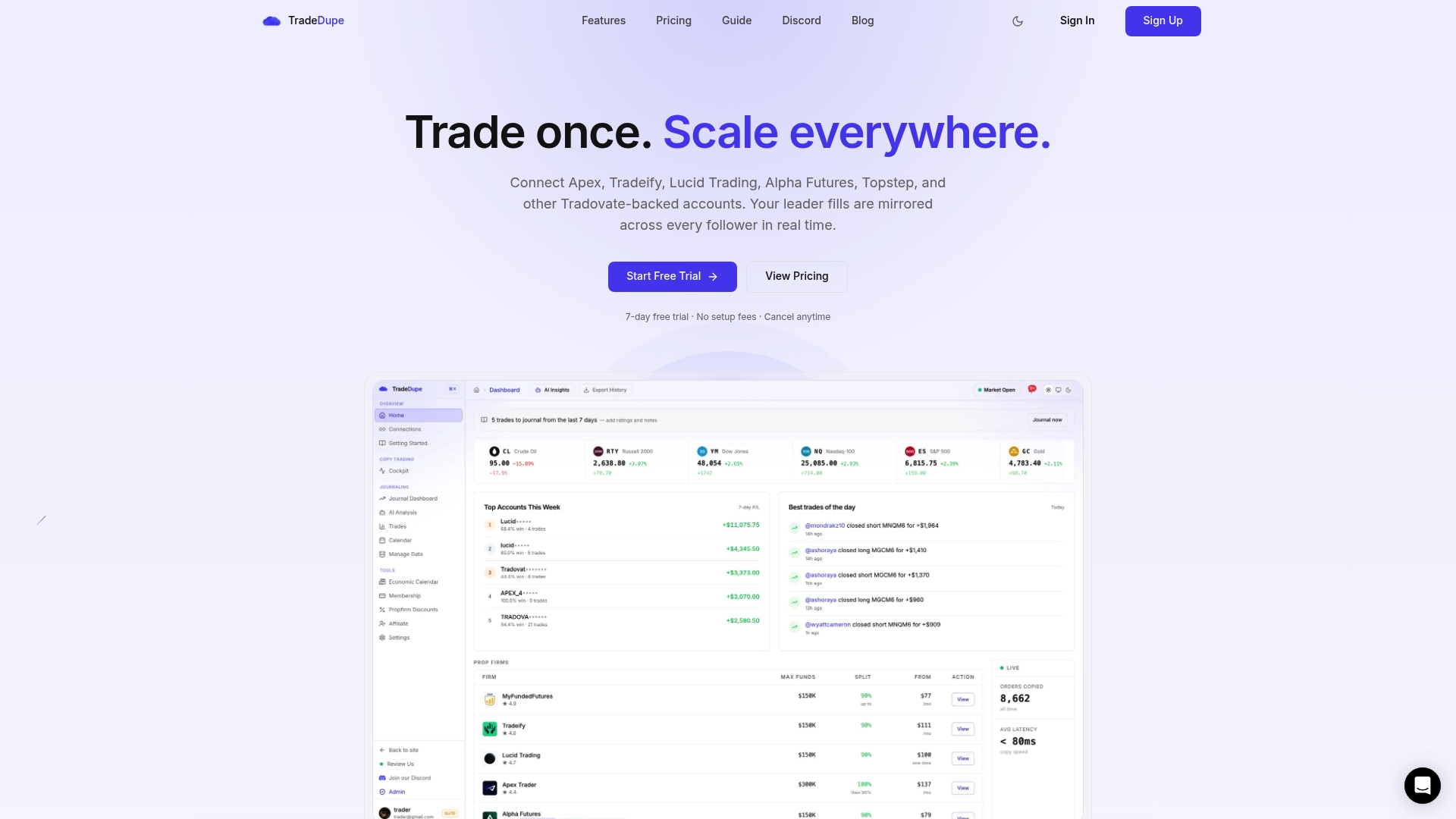
If you hold several Lucid accounts, TradeDupe mirrors every fill on your leader account to your enabled follower accounts in real time. You connect through Tradovate's official OAuth, so nothing runs on your PC or VPS, and you can toggle copying per account. It also works with Apex, Tradeify, MyFundedFutures and TakeProfit Trader accounts on Tradovate.
Plans start at $20/month billed yearly, which is the Standard plan at $240 per year. Pro is $540 per year and Elite is $1,080 per year, and every plan includes a 7-day free trial with one-click cancellation. See the futures trade copier page for how the setup works.
FAQ
Is Lucid Trading a good prop firm?
Lucid sells one-time-fee accounts with no monthly subscription and a 90/10 split on funded plans. Independent review data shows a 4.4 TrustScore from 6,449 Trustpilot reviews as of October 7, 2026. Judge it against your own needs: contract limits, the 4:45 PM EST close, and payout caps.
Does Lucid Trading allow trade copiers?
Yes. Lucid's FAQ states that automated strategies and trade copiers are permitted. You remain responsible for software errors, and hedging across accounts is still prohibited.
Who owns Lucid Trading?
It is operated by Lucid Trading Group LLC, a Delaware company. According to BestProps, Lucid does not publish the company's owners.
Does Lucid Trading actually pay out?
Independent reporting says payouts are often approved within minutes, with Plaid deposits commonly arriving the same day. Lucid states that it disburses within two business days. Confirm the eligibility rules for your account type before you request.
Sources
- Lucid Trading homepage
- Lucid Trading general FAQ
- Lucid help center: LucidFlex Evaluation Account
- Lucid help center: LucidPro Funded Account
- Lucid help center: Simulated Account Fees
- BestProps: Lucid Trading review
- BestProps: What Is Lucid Trading?
- PropFirmly: Lucid Trading review
- Trader Review: Lucid Trading
Recommended
- Lucid Flex Payout Rules \(2026\): Caps, Minimums, Eligibility
- Lucid Pro Payout Rules \(2026\): Caps, Buffer, Consistency
- Lucid Trading Alternatives \(2026\): Apex, Topstep & Alpha Futures Compared
- Prop Firm Consistency Rules Compared \(October 2026\): Apex, Lucid, Tradeify, MFFU, Topstep & More
For educational purposes only. Not financial advice. Futures trading involves substantial risk of loss and is not suitable for every investor.