
Why Multi-Account Traders Need Sync Monitoring
TradeDupe
10 min read
Discover why multi-account traders must use sync monitoring to prevent portfolio-wide losses from unmanaged copy trading. Learn essential tips!
Yes: sync monitoring is essential for multi-account traders, because unmanaged copy trading turns isolated mistakes into correlated, portfolio-wide losses. A single rogue trade or a stalled follower account can breach a daily loss limit on five accounts in the time it takes to notice. TradeDupe runs trade mirroring at a median latency of 34ms, but latency alone doesn't protect you. What protects you is watching the sync in real time, the same way the CFTC expects firms to maintain oversight and recordkeeping over their trading operations.
Enable these before your next session:
- Turn on the real-time dashboard's aggregate "All Accounts" view.
- Set a portfolio-level stop percentage across every connected account.
- Confirm audit logs are capturing every copied trade, not just leader-side fills.
Run this checklist in under five minutes: verify aggregate equity view is live, confirm your portfolio stop threshold is set, and spot-check that today's audit log matches your leader account's trade history.
Key Takeaways
Multi-account traders need sync monitoring because unmanaged copy trading turns a single execution error into correlated losses across every connected account.
| Point | Details |
|---|---|
| Portfolio-level stops beat speed alone | A fast sync without a kill switch still fails catastrophically when latency drift goes unnoticed. |
| Track parity, not just uptime | Trade-parity below 98% for more than a few minutes should trigger an automatic investigation. |
| Fix root validation errors first | One recurring validation error often explains most downstream sync failures. |
| Keep the daily check under five minutes | A monitoring routine that takes longer than five minutes per account group is too complex to sustain. |
| TradeDupe covers the core requirements | Median 34ms latency, rogue-trade detection, auto-recovery, and per-account toggles across Apex, Tradeify, Lucid Trading, and Alpha Futures. |
Table of Contents
- Why Multi-Account Traders Need Sync Monitoring in the First Place
- What to Monitor: The Core Metrics and KPIs
- Essential Monitoring Capabilities to Look For
- Building an Incident Response Playbook for Sync Failures
- How TradeDupe Handles the Monitoring Problem
- What Most Risk Teams Get Wrong About Multi-Account Monitoring
- Getting Started With Real-Time Sync Monitoring
- Frequently Asked Questions
- Sources
Why Multi-Account Traders Need Sync Monitoring in the First Place
Unmanaged syncs fail in predictable ways, and each failure mode gets more expensive as you add accounts. Rogue trades happen when a follower account executes something the leader never sent, often from a stale connection or a misconfigured toggle. Latency divergence creates a gap between when the leader fills and when followers catch up, which matters enormously during fast-moving futures sessions. Missed or partial fills leave some accounts with a position and others without one, breaking the parity your risk model assumes. Permission mismatches are quieter but just as dangerous. A follower account with the wrong contract size or an unrevoked API key can multiply a small leader error tenfold.
These aren't abstract concerns. A trader running multiple funded accounts through a leader position that goes wrong by even a small margin can see their losses multiply significantly when replicated unchecked across every follower. Prop firms structure their rules around exactly this kind of cascading exposure. Daily loss limits and max drawdown conditions don't care whether the loss came from one bad trade or ten identical bad trades. Scaling to ten or more accounts without a portfolio-level stop rule is one of the fastest ways to fail an evaluation you'd otherwise have passed.
Unmonitored syncs also create problems that show up later, not just in the moment:
- Profitability erosion: silent partial fills quietly change your realized risk-reward ratio.
- Auditability gaps: without logs, you can't reconstruct what happened when a prop firm asks.
- Compliance exposure: recordkeeping expectations assume you can show what executed, when, and where.
What to Monitor: The Core Metrics and KPIs
A monitoring system is only as good as what it measures. Here's the checklist that matters most for portfolio-level risk:
- Sync latency (ms): time from leader execution to follower execution. TradeDupe's median sits at 34ms, a useful baseline for judging your own setup.
- Trade-parity percentage: the share of follower trades that match the leader's size, direction, and timing.
- Missed-execution count: trades the leader sent that one or more followers never received.
- Run status: whether the sync session is running, completed, completed with errors, or failed.
- Error and warning counts: distinct from missed executions, these flag configuration or connectivity issues before they cause a missed trade.
- Per-account drawdown buffer: how much room each account has left against its rule before a breach.
- Aggregate portfolio drawdown: the combined exposure across every connected account, viewed as one number.
- Daily loss used: tracked per account and rolled up, since most prop firm rules reset this daily.
Each metric maps directly to a way you can fail an evaluation or blow a funded account. Trade-parity dropping significantly for even a short time usually means a follower is drifting out of sync, and that drift compounds with every subsequent trade.
Pro Tip: Set an automatic investigation trigger as soon as trade-parity drops noticeably for more than a couple of minutes. Waiting for a human to notice the gap is how a small desync becomes a rule violation.
The point of tracking these numbers isn't reporting. It's giving you the data to make a fast decision: stop the sync, quarantine one account, or roll back a bad fill before it compounds.
Essential Monitoring Capabilities to Look For
Metrics only help if the platform acts on them. A serious monitoring system needs a specific set of capabilities, not just a status page.
Must-have capabilities:
- Real-time dashboard with both per-account and aggregate "All Accounts" scope.
- Rogue-trade detection that flags unexpected executions before they multiply across followers is detailed in Trade Execution Best Practices That Drive Profitability.
- A portfolio-level kill switch or auto-recovery routine that can pause every follower at once.
- Per-account toggles so you can pull one account out of the sync without touching the rest.
- An immutable audit trail covering every copied trade, timestamp, and configuration change.
Should-have capabilities:
- Alerts across email, SMS, and webhook, not just an in-app notification.
- Historical run views covering at least 14 prior sync sessions, so you can spot patterns rather than one-off glitches.
Nice-to-have capabilities:
- Independent feed verification alongside your primary broker connection, so you're not relying on a single data source to confirm what actually executed.
Server-side execution matters here more than most traders realize. A desktop-based expert advisor dies the moment your machine loses connection or restarts for an update, taking every follower account with it. Server-side systems keep syncing even when your laptop is closed, which is precisely why Tradovate copy trading built for real-time sync has become the standard architecture for serious multi-account desks. Read-only investor credentials on follower accounts also let you verify what happened independently of the platform doing the mirroring, an extra layer worth having when real money is on the line.
Building an Incident Response Playbook for Sync Failures
Detection without a response plan just tells you something is wrong. The playbook that works follows five steps, in order:
- Detect — alerts and dashboard status flag the anomaly the moment it happens, not at end of day.
- Triage — check trade-parity and latency first, since most downstream errors trace back to one root validation issue.
- Contain — quarantine the affected account with a per-account toggle, or trip the portfolio kill switch if the issue is systemic.
- Recover — run auto-recovery or a manual rollback to restore parity between leader and followers.
- Reconcile — pull the audit log and confirm every trade matches, closing the loop before the next session opens.
Testing prevents most incidents from reaching step one. Run new configurations in a staging environment first, and use canary testing on evaluation accounts before pushing a change live to funded accounts. Pre-market connectivity checks catch a dropped API key before the open, not after your first trade fails to replicate. A daily end-of-day reconciliation and a weekly full audit keep small drifts from becoming systemic ones.
Pro Tip: When multiple errors appear at once, fix the validation error with the most instances first. One root cause usually explains several downstream symptoms, and clearing it often resolves the rest automatically.
How TradeDupe Handles the Monitoring Problem
TradeDupe was built around typical failure modes in trade mirroring and mirrors trades from a leader account to unlimited follower accounts with low median latency, using server-side execution so the sync keeps running independent of your desktop.
Core capabilities include:
- Rogue-trade detection that flags executions the leader never sent.
- Auto-recovery that restores parity after a missed fill or connectivity gap.
- Per-account toggles for pulling one account out without stopping the rest.
- Immutable audit logs covering every copied trade.
- AI-powered trade analysis layered on top of the raw sync data.
TradeDupe supports Apex, Tradeify, Lucid Trading, and Alpha Futures with pre-configured rule templates, so daily loss and drawdown thresholds match what each prop firm actually enforces rather than a generic default. Pricing runs on tiered monthly or annual subscriptions scaled to broker connections and account count, with a free trial for desks that want to test the sync before committing. For desks running many funded accounts, that combination of low latency and firm-specific rule templates can be the difference between passing evaluations and facing violations.
What Most Risk Teams Get Wrong About Multi-Account Monitoring
The instinct among traders scaling past three or four accounts is to treat monitoring as a dashboard problem: get more screens, watch more numbers, react faster. That instinct is backwards. The traders who avoid blowups treat multi-account trading as portfolio management first and execution second, which means the kill switch matters more than the alert, and the alert matters more than the dashboard.
Conventional advice tends to overweight sync speed and underweight parity verification. A 34-millisecond sync that silently drifts out of parity for ninety seconds is more dangerous than a slower sync that flags the drift immediately, because speed without verification just means you fail faster and with less warning. The five-minute daily check routine gets dismissed by traders who assume more time watching screens equals more safety. In practice, a system that requires more than five minutes of manual review per account group is usually too complex to trust under pressure, and complexity is where operational risk actually hides.
Prioritize the kill switch and the audit trail before you prioritize speed. Everything else is refinement.
Getting Started With Real-Time Sync Monitoring
TradeDupe exists for exactly the reader who just read the sections above: a prop trader or risk manager running multiple Tradovate accounts who needs the sync verified, not just fast. The platform combines a median 34ms mirroring latency with rogue-trade detection, auto-recovery, and per-account toggles, so the safeguards described in this article aren't a manual process you build yourself. They're already running in the dashboard.
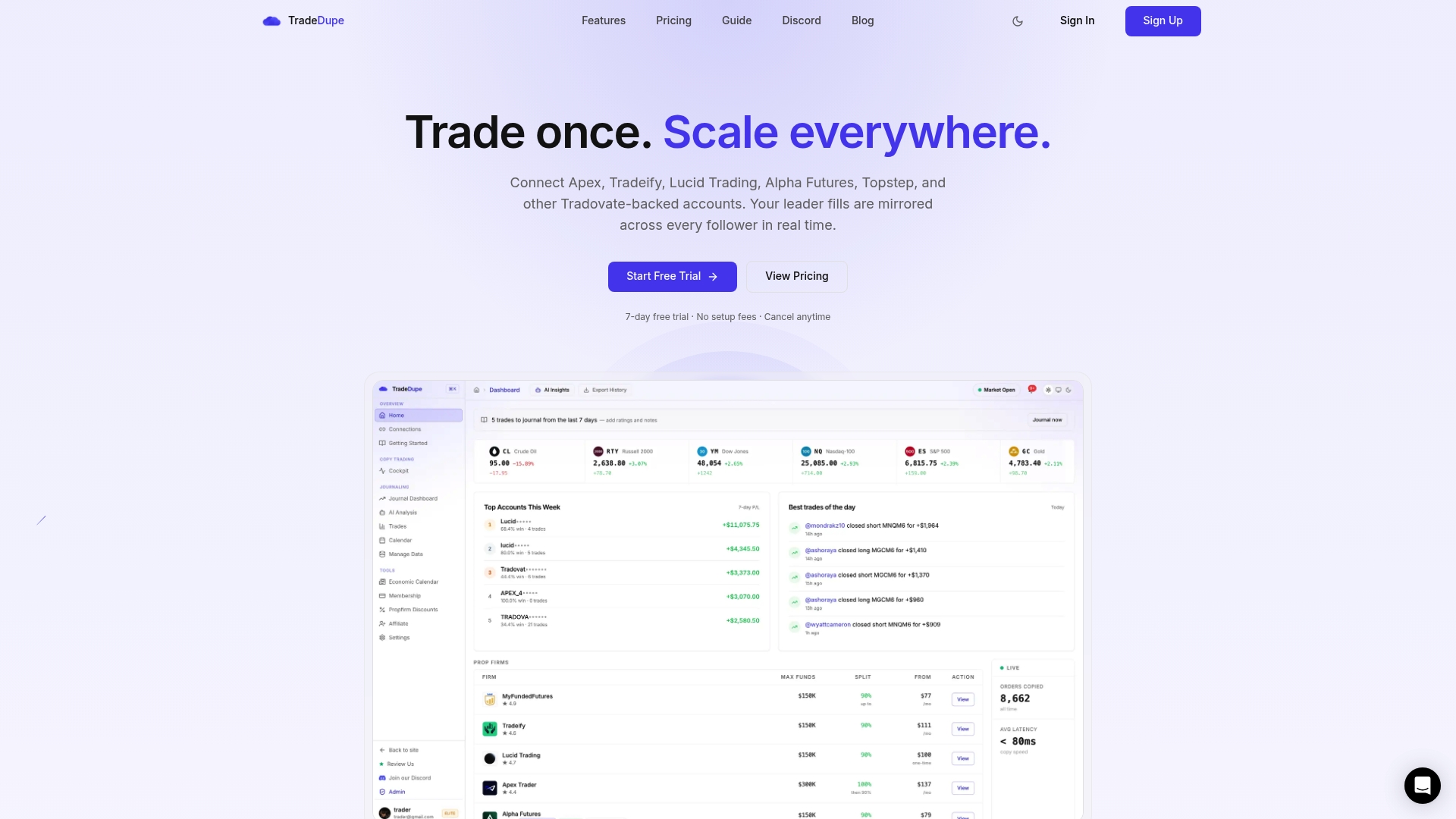
If you're managing accounts across Apex, Tradeify, Lucid Trading, or Alpha Futures, TradeDupe's pre-configured rule templates map directly to each firm's daily loss and drawdown structure, which means less setup work and fewer manual thresholds to maintain. Subscription tiers scale with your account count, so a two-account desk and a twenty-account prop shop aren't paying for the same feature set. Start with the 10-minute setup guide to connect your leader account and first follower, then confirm your audit trail is capturing every trade before your next live session.
Frequently Asked Questions
Why do multi-account traders need sync monitoring instead of just checking accounts manually? Manual checks can't catch a desync in real time. By the time you notice a missed fill across five accounts, the drawdown damage across all of them may already be done. Automated sync monitoring flags the issue in seconds, not at the next time you happen to look.
What's the biggest risk of running multiple synced accounts without monitoring? Correlated loss. A single rogue trade or latency gap replicates across every follower account simultaneously, which can breach daily loss limits on accounts that would have been fine individually.
How often should a multi-account trading desk review sync performance? Daily, at minimum, with a routine built around a morning connectivity check, real-time compliance during the session, and an end-of-day aggregate review. If that routine takes more than five minutes per account group, the setup is more complex than it needs to be.
Does sync monitoring help with prop firm compliance? Yes. Daily loss and max drawdown rules are enforced at the account level, and an audit trail showing exactly what executed and when gives you the records to demonstrate compliance if a prop firm asks.
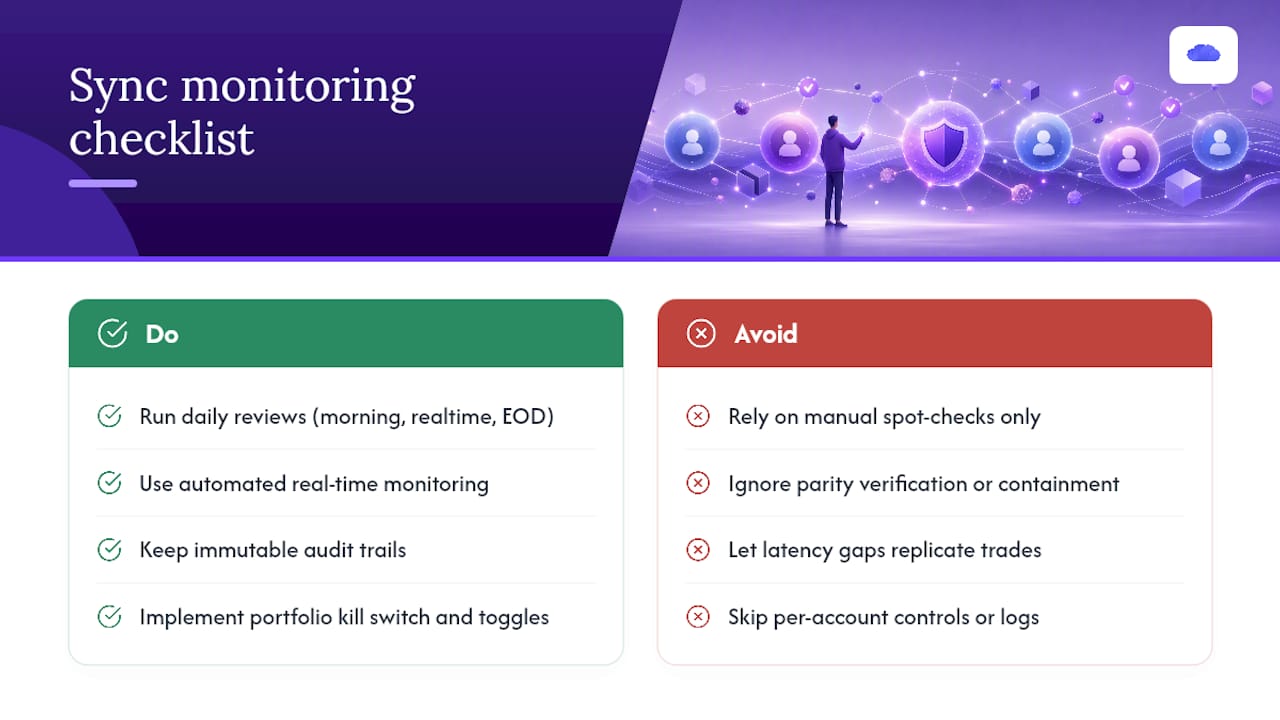
What should I look for when evaluating a sync monitoring platform? Prioritize a real-time dashboard with an aggregate view, rogue-trade detection, a portfolio-level kill switch, per-account toggles, and immutable audit logs. Latency matters, but parity verification and containment controls matter more.
Sources
- School Data Sync — data health and monitoring
- Managing Multiple Funded Accounts: The Portfolio Approach to Prop Firm Trading - NexusFi Academy
- The Multi-Account Strategy: 1, 5, or 20 Accounts? — PropScorer Academy