Prop Desk AI Trade Tagging: 3 Categories, 85% Threshold, TradeDupe Fit
TradeDupe
7 min read
Practical playbook for prop desks and multi-account traders to implement AI trade tagging: taxonomy, 85% auto-apply threshold, governance, and TradeDupe...
AI trade tagging automatically labels each trade you place, by setup, emotion, and outcome, so you can analyze strategy performance and trading behavior across every account you run. It draws on your fill data, order timestamps, and candle context to classify trades the way a disciplined journaler would, minus the hours of manual review. That matters most for prop desks and multi-account operators who need consistent labels applied retroactively across thousands of trades, not just the ones logged this week.
*
> TL;DR: > > - Accurate data normalization and real-time broker sync are essential to ensure AI tags are reliable and applicable retroactively across all trade history. > - Using high-confidence thresholds and maintaining a review queue helps prevent incorrect tags from corrupting your audit trail and analysis outcomes. > - Keeping a small, controlled taxonomy with strict governance prevents confusion and ensures consistent, searchable tags for cross-account comparison. > - Evaluating tagging tools requires checking for multi-leg strategy recognition, explainability, bulk actions, and easy report slicing, not just classification accuracy. > - TradeMirroring systems enhance tagging reliability by ensuring trade data consistency across multiple accounts, supporting trustworthy performance analysis.
*
Table of Contents
- What AI Trade Tagging Is and How It Works
- Where Tagging Actually Pays Off in Trading Analysis
- Building a Reliable AI Tagging Workflow
- Tag Taxonomy and Governance That Actually Scale
- What to Look For When Evaluating a Tagging Tool
- How TradeDupe Fits Into a Tagged, Audited Workflow
- Further Technical Reading
- The Real Value of AI Trade Tagging, and Where People Overinvest
- Sources
What AI Trade Tagging Is and How It Works
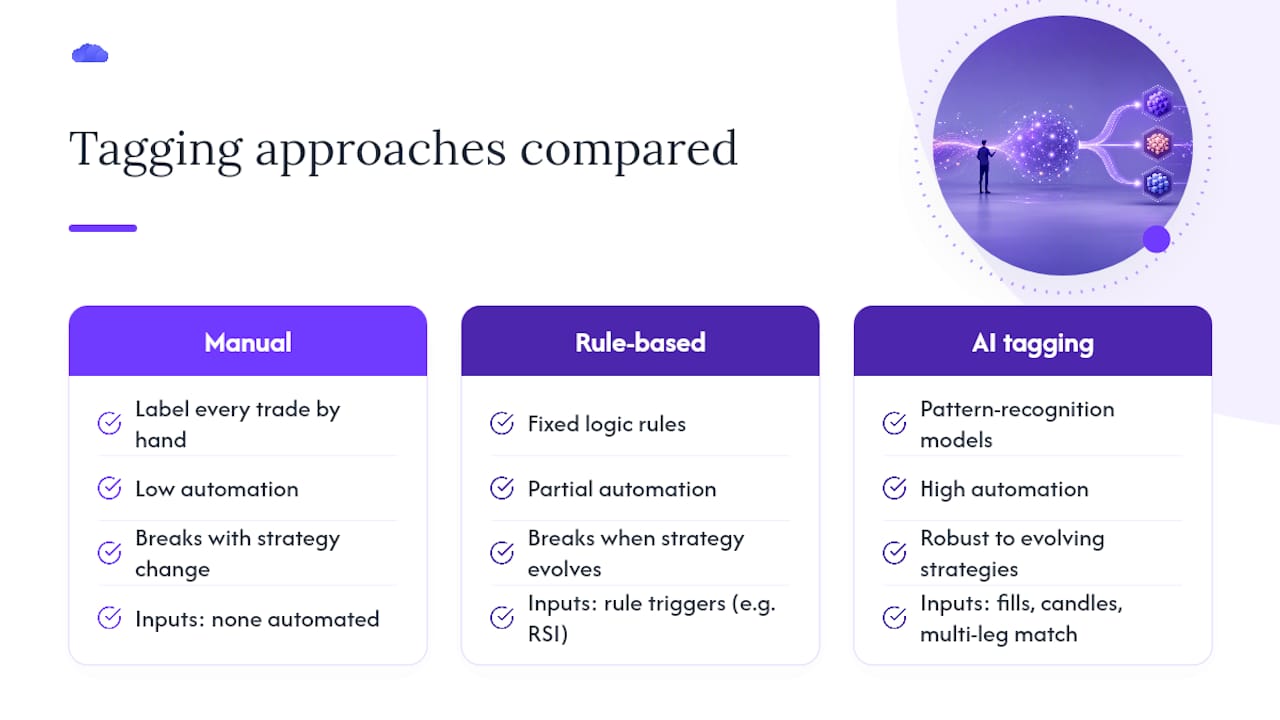
Manual tagging asks you to label every trade by hand after the close. Rule-based tagging automates part of that with fixed logic, like "if RSI crossed 70, tag overbought," but it breaks the moment a strategy evolves. AI trade tagging is different: it uses pattern recognition and classification models trained on your trade history to detect setups, then applies labels without a rigid rulebook.
The system needs a specific set of inputs to work well: order fills with precise timestamps, candle data for market context at entry and exit, and multi-leg matching logic for anything beyond a single-instrument trade. Feed it clean data, and the model extracts features like time-to-fill, distance from prior structure, and holding duration, then runs classification against known setup patterns.
A well-built system does not just spit out a tag. It returns a confidence score, a short human-readable rationale explaining why the trade got that label, and it applies the same logic retroactively to your entire imported history. One common architecture pairs deterministic classification, which produces auditable evidence, with an optional layer of AI-generated explanation on top, as described in the trading-data-analysis-agent repository. That separation matters: the deterministic layer stays the source of truth, while the AI layer just makes it readable.
Where Tagging Actually Pays Off in Trading Analysis
Tags are only useful once you slice performance by them.
Behavioral metrics benefit just as much. Tagging systems that normalize subjective inputs like confidence and stress into categorical labels let you quantify hesitation, missed entries, and FOMO chases over time, rather than relying on memory, according to Process Trader's breakdown of tagging as a behavioral signal.
On the operational side, consistent tags create an audit trail that prop firms actually respect during evaluations. Cross-account comparisons become trivial once every account uses the same tag taxonomy: you can pull up two follower accounts running the same leader strategy and see immediately where execution diverged, whether that is slippage, timing lag, or a rogue manual override.
Building a Reliable AI Tagging Workflow
Getting AI tagging right is less about the model and more about the plumbing underneath it. Work through these steps in order.
- Normalize your data first. Standardize candle data to one timezone and interval, and make sure fills carry order-level metadata (order type, account ID, multi-leg group).
- Prioritize broker sync over manual import. A live broker connection catches fills in real time; CSV import should be the fallback for historical backfill, not your primary pipeline.
- Link trades to replay context. Attach the underlying chart snapshot or candle window to each trade so tags carry visible justification, not just a label.
- Set a confidence threshold. Anything above roughly 85% confidence can auto-apply; anything below routes to a review queue instead of committing silently.
- Build a review queue with bulk actions. You want bulk approve for high-confidence batches and bulk reject for anything flagged as conflicted, mirroring the triage patterns used in open-source trading agent frameworks.
- Log every change. Every tag edit, approval, or rejection needs a timestamp and a user ID, full stop, for audit purposes later.
Pro Tip: Preview suggested tags before they save, rather than after. A one-click apply or replace mode, the pattern Process Trader recommends for tagging UX, stops noisy labels from ever hitting your journal in the first place.
Tag Taxonomy and Governance That Actually Scale
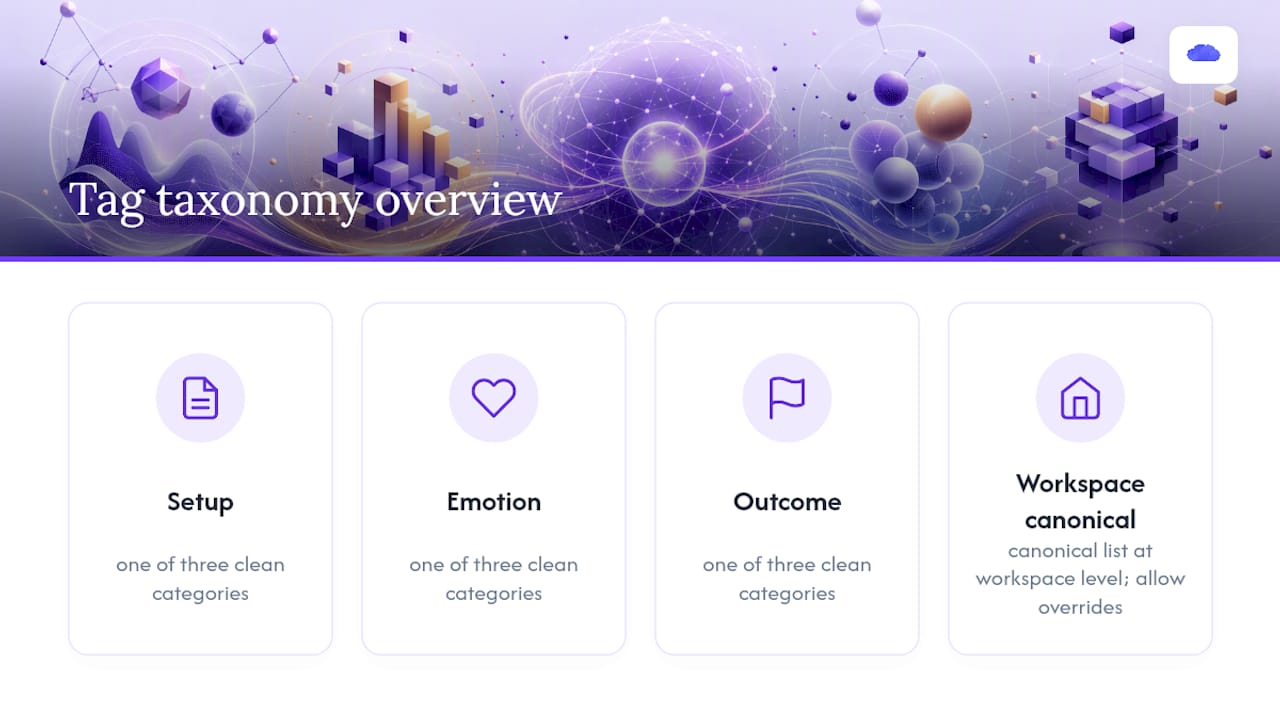
A tagging system falls apart fast without discipline on naming. Keep the vocabulary small and controlled: three clean categories, setup, emotion, and outcome, beat fifty overlapping tags that nobody remembers the difference between six months later. Use consistent kebab-case naming (`liquidity-sweep`, `revenge-trade`, `partial-fill`) so tags stay searchable and machine-parseable.
Governance is where most teams skip a step. Decide upfront who can create a new tag, whether that requires desk-lead approval, and how a retired tag gets archived instead of silently deleted, which breaks historical reports. Keep a change log of every taxonomy edit.
Multi-account operators need one more layer: a canonical tag list at the workspace level, with room for account-specific overrides when a follower account runs a genuinely different strategy than its leader. Without that split, you either force every account into an ill-fitting shared taxonomy or lose the ability to compare accounts at all.
What to Look For When Evaluating a Tagging Tool
Not every AI tagging feature delivers equal value. Before you commit a workflow to a platform, check for:
- Multi-leg strategy recognition with a confidence score attached to each detected leg, not just the overall trade.
- Retroactive tagging on import, so your entire trade history becomes analyzable the day you connect the platform, not just trades going forward.
- Explainability, meaning a short, readable rationale per tag and a visible audit trail, the kind of evidence-graph transparency VerumTrade's approach to decision traces demonstrates.
- Bulk actions for approving or rejecting large batches of suggested tags at once.
- Search, filters, and export that let you slice reports by tag and feed results into backtesting or compliance reporting without a manual export step.
How TradeDupe Fits Into a Tagged, Audited Workflow
Tagging only matters if the underlying trade data is trustworthy across every account it touches. TradeDupe's real-time mirroring architecture keeps follower accounts synced to a single leader, which means tags applied to one account's setups map cleanly onto every account replicating that trade.
That consistency shows up in a few practical ways:
- Per-account toggle controls let you isolate which accounts feed into your tagged performance reports.
- Rogue-trade detection and auto-recovery reduce the noisy, unexplainable trades that make tagging systems less reliable in the first place.
- Dashboards support the audit trail work prop desks need during evaluations.
- TradeDupe complements tagging by surfacing patterns across the performance metrics that matter to a multi-account desk.
Further Technical Reading
For engineers building or evaluating tagging pipelines, the trading-data-analysis-agent repository covers deterministic classification with auditable artifacts, while VerumTrade documents evidence-graph reasoning traces worth studying before you trust a black-box tag.
The Real Value of AI Trade Tagging, and Where People Overinvest
Most of the enthusiasm around AI trade tagging focuses on the model, whether it "gets" your setups right. That is the wrong obsession. The bigger risk sits in the plumbing: dirty timestamp data, inconsistent multi-leg matching, and a tag taxonomy that sprawls until nobody trusts the reports it feeds. A mediocre model on clean, well-governed data will outperform a sophisticated one fed garbage inputs every time.
The conventional advice to "just turn on AI tagging and let it run" also skips the most important control: a review queue. Confidence scores exist precisely because no model gets every trade right, and blindly auto-applying every tag defeats the audit trail you built the system to create.
If you run more than one account, prioritize governance before features. Decide who owns your tag taxonomy and how retroactive tagging applies to historical data before you evaluate any platform's classification accuracy. The desks that get real value from tagging are the ones treating it as an operational discipline, not a novelty feature bolted onto a journal.
> — Andres
Sources
- trading-data-analysis-agent
- Smarter tags, smarter trading: Why tagging matters more than you think – Process Trader