

Protect Multi Account Funds with AI Trading Analytics for Tradovate
TradeDupe
15 min read
Tradovate traders running multiple funded accounts: learn how to evaluate AI trading analytics, validate models with CPCV and GT-Score, and apply per...
AI trading analytics refers to software that parses charts and market data to produce entry, stop, and target levels alongside a confidence score, letting you test a trading idea before risking capital. The output is genuinely useful for spotting setups faster, but it is a decision aid, not a guarantee. Every signal still needs validation against historical data and a clear exit rule before it touches a funded account.
*
> TL;DR: > > - Before paying, require an explainable signal and downloadable, timestamped trade logs; reject vendors that promise guaranteed wins or hide losing trades. > - Use purged cross validation and Monte Carlo trials, then include transaction costs and realistic fills; a flawless historical backtest can reflect overfitting. > - Judge performance with drawdown, Sharpe ratio, and average win versus loss size, since a 70% directional accuracy rate can still lose money. > - Paper trade first, validate over a longer historical window, then deploy on one account with loss limits enforced by the broker before expanding. > - Stop using a signal when live results diverge from backtests for more than a handful of trades, since market conditions may have shifted.
*
Table of Contents
- What AI trading analytics actually does: core capabilities and outputs
- Key features and evaluation criteria: a checklist to separate credible analytics from hype
- How to validate AI models and backtests so you avoid overfitting
- Regulatory guidance and fraud risks: what the CFTC and SEC warn about
- How to integrate AI analytics into a trading workflow for multiple funded accounts
- TradeDupe example: how an AI-enabled analytics and copy-trading workflow looks in practice
- Types of AI models used in trading analytics
- Performance evaluation metrics for AI trading systems
- Challenges and limitations of AI trading analytics
- Future trends and innovations in AI trading analytics
- Author perspective: concise verdict and next steps for traders managing multiple accounts
- How TradeDupe supports Tradovate traders running multiple accounts
- FAQ
- Sources
What AI trading analytics actually does: core capabilities and outputs
Most AI trading analytics products sit between your chart and your execution platform. They read price data, apply pattern-recognition models, and hand you a structured read instead of a raw chart.
The core building blocks look similar across vendors:
- Automated chart parsing: pattern detection, support and resistance mapping, and a directional bias based on recent price structure.
- Signal outputs: a suggested entry, stop loss, take profit, and a confidence score that reflects how strongly the model backs the call.
- Data inputs: open, high, low, close, and volume (OHLCV) feeds, broker data streams, uploaded chart screenshots, or direct API connections.
- Integration points: indicator overlays inside your existing platform, push or Discord alerts, and exportable strategy logic for backtesting.
The practical value is speed. A model can scan dozens of instruments and flag the handful worth your attention, which matters if you are managing several funded accounts and cannot watch every chart tick by tick. The risk is treating the output as a finished trade plan rather than a starting point that still needs your own filter for market context, news, and account-specific rules.
Key features and evaluation criteria: a checklist to separate credible analytics from hype
Before you trust any AI analytics product with real decisions, run it through a short checklist. Vendors vary wildly in how much proof they give you, and the gap between marketing copy and reproducible results is where most disappointment happens.
- Explainability: does the tool show why it generated a signal, or just a number? A confidence score with no supporting logic is closer to a guess than an analysis.
- Backtest reproducibility: can you download the trade log and rerun the test yourself? If the only proof is a chart screenshot, treat it as marketing.
- Operational controls: look for per-account toggles, selectable execution modes, and automatic detection of trades that were not actually placed by you, often called rogue-trade detection.
- Latency and enforcement: mirroring or alert delivery speed matters if you trade fast setups. TradeDupe, for example, cites typical mirroring latency under 100ms, which is a feature to compare other tools against rather than a universal benchmark.
- Red flags: guaranteed win rates, vague "proprietary algorithm" language with no methodology, and an unwillingness to show losing trades.
Our AI Trade Analysis for Tradovate Copy Trading guide walks through the specific questions worth asking a vendor before you commit.
Pro Tip: Ask any AI analytics vendor for a downloadable, timestamped trade log before you pay for a subscription. If they can't produce one, assume the backtest numbers are cherry-picked.
How to validate AI models and backtests so you avoid overfitting
A backtest that looks flawless in-sample is often just a model that memorized the past. This is overfitting, and it is the single biggest reason AI trading strategies fail the moment they meet live markets. The model learns noise specific to the historical window rather than a pattern that persists.
A few practices reduce that risk substantially:
- Use combinatorial purged cross-validation (CPCV) or other advanced cross-validation methods instead of a single train-test split, since standard walk-forward testing can still leak information across time.
- Run Monte Carlo trials that reshuffle trade sequences to see how sensitive results are to order and timing.
- Account for transaction costs, slippage, and realistic fill assumptions, since a strategy that only works with perfect fills will not survive live execution.
- Consider a composite objective function rather than optimizing for raw profit alone, since profit-only optimization tends to produce fragile, overfit parameter sets.
CPCV-based validation has been shown to lower the probability of backtest overfitting and improve deflated Sharpe ratio statistics compared with standard out-of-sample testing methods, according to research comparing cross-validation techniques for financial time series. Research into composite objective functions like the GT-Score found that embedding consistency and downside-risk terms into the scoring function, rather than optimizing for profit alone, improved out-of-sample generalization by up to 98% compared with baseline objective functions across tests on 50 S&P 500 stocks. That is a meaningful signal that how you score a strategy during testing matters as much as the strategy itself.
Regulatory guidance and fraud risks: what the CFTC and SEC warn about
Regulators have been explicit that AI hype has outpaced AI reliability in trading, and that gap has become a recruiting ground for fraud. The CFTC's customer advisory on AI trading bots states plainly that AI technology cannot predict market changes, and that fraudsters exploit AI hype to market trading programs that never deliver on their claims. One fraudulent scheme cited in that advisory led to losses of a very large amount of bitcoins, worth roughly a billion dollars at the time.
The SEC has pursued its own enforcement track. A 2024 SEC press release details charges against firms for misrepresenting the extent and sophistication of their AI-driven investment processes, a practice regulators now refer to as "AI washing."
A few verification steps protect you:
- Check how long the vendor's domain and company have actually existed before trusting performance claims.
- Ask for a reproducible, timestamped backtest rather than a static equity curve.
- Request any third-party audit or verification of claimed results.
- Weigh the vendor's incentive structure: a tool that profits from your trade volume has a different motive than one that profits from a flat subscription.
Operational risks matter too. Model drift, where a strategy that worked for months quietly stops working as market conditions shift, and basic cybersecurity around how your account credentials are handled both deserve the same scrutiny as the headline performance numbers.
How to integrate AI analytics into a trading workflow for multiple funded accounts
If you run several funded or evaluation accounts, the sequence matters more than the tool itself.
- Capture the signal from your AI analytics tool, including its confidence score and underlying logic.
- Paper trade it for a defined stretch before risking any account.
- Backtest it against a longer historical window using the validation methods above.
- Deploy small on a single account first, not across every funded account at once.
- Tag and journal every trade by signal source so you can review performance by strategy later.
Keep per-account loss limits and daily targets enforced at the broker level, not just inside your own tracking spreadsheet, and size each position according to the specific account's rules rather than a blanket number. Our Prop Firm Profit Calculator helps estimate payout impact as you scale a signal across accounts. Stop using any AI signal the moment its live results diverge meaningfully from its backtested behavior for more than a handful of trades; that divergence usually means the market regime shifted.
Pro Tip: Journal every AI-generated trade with the confidence score attached. After 30 to 50 trades, you'll know whether high-confidence signals actually outperform low-confidence ones for that specific tool.
TradeDupe example: how an AI-enabled analytics and copy-trading workflow looks in practice
For traders juggling several Tradovate-based funded accounts, the practical question is less "does AI work" and more "how do I apply it without blowing up four accounts at once." We offer AI trade analysis and tagging on top of real-time trade mirroring, which gives a concrete look at how this fits together operationally.
- AI trade tagging and anomaly detection: methods like Hawkes processes, CUSUM, and Bayesian online change-point detection (BOCPD) flag unusual trade patterns in near real time; our anomaly detection explainer covers the mechanics.
- Per-account safeguards: copy toggles let you enable or disable mirroring per account, and rogue-trade detection flags fills that do not match the leader account.
- Broker-enforced limits: daily loss limits and profit targets are set directly on Tradovate, so the broker enforces them rather than relying on a third-party app.
- Connection security: accounts connect through Tradovate's official OAuth flow, so passwords are never stored, and mirrored fills typically reach follower accounts in under 100ms.
Confirm any prop-firm-specific consistency or copy-trading rules with your firm directly before enabling mirrored execution across accounts.
Types of AI models used in trading analytics
Not every "AI trading tool" uses the same underlying model, and the type shapes what it can realistically do for you.
Machine learning (ML) models, including random forests and gradient-boosted trees, are the workhorses behind most retail-facing analytics. They are trained on historical price and volume data to classify setups or predict short-term direction, and they tend to be more interpretable than deeper architectures, which matters when you want to understand why a signal fired.
Deep learning models, including recurrent neural networks and transformer-based architectures, handle more complex pattern recognition across longer sequences of data. They can pick up subtler relationships in price action but are harder to explain and more prone to overfitting on limited financial datasets, since markets generate far less usable training data than fields like image recognition.
Reinforcement learning (RL) takes a different approach entirely: instead of predicting a price move, an RL model learns a trading policy by simulating trades and adjusting based on a reward signal like profit or risk-adjusted return. RL is popular in research but far less common in retail-facing products, partly because it requires careful reward design to avoid learning strategies that look good in simulation and fail in live markets.
For a retail trader evaluating a tool, the practical takeaway is simpler than the technical distinction: ask what type of model powers the signal, and whether the vendor can explain its logic in plain terms. A model you cannot interrogate is a model you cannot troubleshoot when it starts underperforming.

Performance evaluation metrics for AI trading systems
Raw win rate tells you almost nothing about whether an AI trading system is actually good. A handful of metrics give a fuller picture.
The Sharpe ratio measures return relative to volatility, which matters because a strategy with a high win rate but occasional large losses can still be worse than a steadier, lower-win-rate approach. Maximum drawdown tracks the largest peak-to-trough decline the strategy experienced, which is often more relevant to you as a funded trader than Sharpe ratio alone, since most prop firms enforce hard drawdown limits that end an account regardless of long-term profitability.
Accuracy, meaning the percentage of correct directional calls, is the metric most AI vendors lead with because it is the easiest to market, but it is also the easiest to game: a model that is accurate 70% of the time on small moves and wrong 30% of the time on large moves can still lose money overall. Pair accuracy with the average size of winning versus losing trades before drawing any conclusion.
Other useful metrics include the deflated Sharpe ratio, which adjusts for the number of strategy variations tested before finding the winning one, and consistency metrics that track performance stability across different market segments rather than one blended average. A strategy that performs well only in trending markets and poorly in chop will show a respectable blended Sharpe ratio while hiding a serious weakness.
When you evaluate any AI trading analytics claim, ask for drawdown and Sharpe figures alongside the headline accuracy number, not instead of it.

Challenges and limitations of AI trading analytics
AI trading analytics carries real, persistent limitations that no amount of model sophistication fully removes.
Data bias is the first. Models trained predominantly on recent bull-market data, for instance, can learn patterns that simply do not hold in a sustained downtrend or a high-volatility regime. The training window shapes what the model believes is normal.
Model interpretability is the second. Deep learning models in particular can produce a confidence score with no accessible explanation for why it was generated, which leaves you unable to judge whether a signal reflects genuine pattern recognition or a statistical artifact. This is why explainability belongs on any evaluation checklist rather than being treated as a nice-to-have.
Market regime changes are the third and arguably the hardest to solve. Markets shift between trending, ranging, and high-volatility states, and a model tuned on one regime can degrade quickly when conditions change, a phenomenon sometimes called model drift. No backtest, however rigorous, can fully anticipate a regime the training data never contained.
None of this means AI analytics tools are useless. It means their output should be treated as one input among several, filtered through your own read of current market conditions and the specific rules of the account you are trading.
Future trends and innovations in AI trading analytics
The direction of travel in this space is toward tools that explain themselves and adapt faster, both of which address the limitations above.
Explainable AI (XAI) techniques aim to make model outputs interpretable, showing which features or price patterns actually drove a given signal rather than presenting a confidence score as a black box. Regulators have flagged explainability as a governance priority, which gives vendors a practical incentive to build it in rather than treat it as optional.
Real-time adaptive models are also gaining traction, where a system continuously retrains or recalibrates against incoming data instead of running on a model trained once and left static for months. This directly targets the model drift problem, though it introduces its own validation challenge: a model that is always changing is harder to backtest in any traditional sense.
Expect more emphasis on composite validation metrics as well, following the direction of research like the GT-Score, where the scoring function used to select a strategy already penalizes overfitting rather than relying on a separate validation step after the fact. For a retail trader, the practical effect of these trends should be fewer black-box tools and more vendors willing to show their reasoning, which makes the evaluation checklist in this guide more enforceable over time rather than less.
Author perspective: concise verdict and next steps for traders managing multiple accounts
AI trading analytics is a genuine augmentation to how you read charts and plan trades, not a replacement for your own judgment or risk discipline. Validate every signal with proper cross-validation, keep risk controls enforced at the broker level, and size live deployment small before trusting an AI-generated signal across several funded accounts at once.
> — Andres
How TradeDupe supports Tradovate traders running multiple accounts
Running several prop firm accounts on Tradovate means repeating the same trade decision across every account, which is exactly where real-time mirroring earns its keep. We built TradeDupe around that specific job: connect your Tradovate accounts, designate a leader, and every fill mirrors to your enabled follower accounts over a live connection, typically within 100ms. Certain plans add AI trade analysis and tagging on top of that mirroring, while per-account toggles and trade detection features help manage risk across multiple accounts.
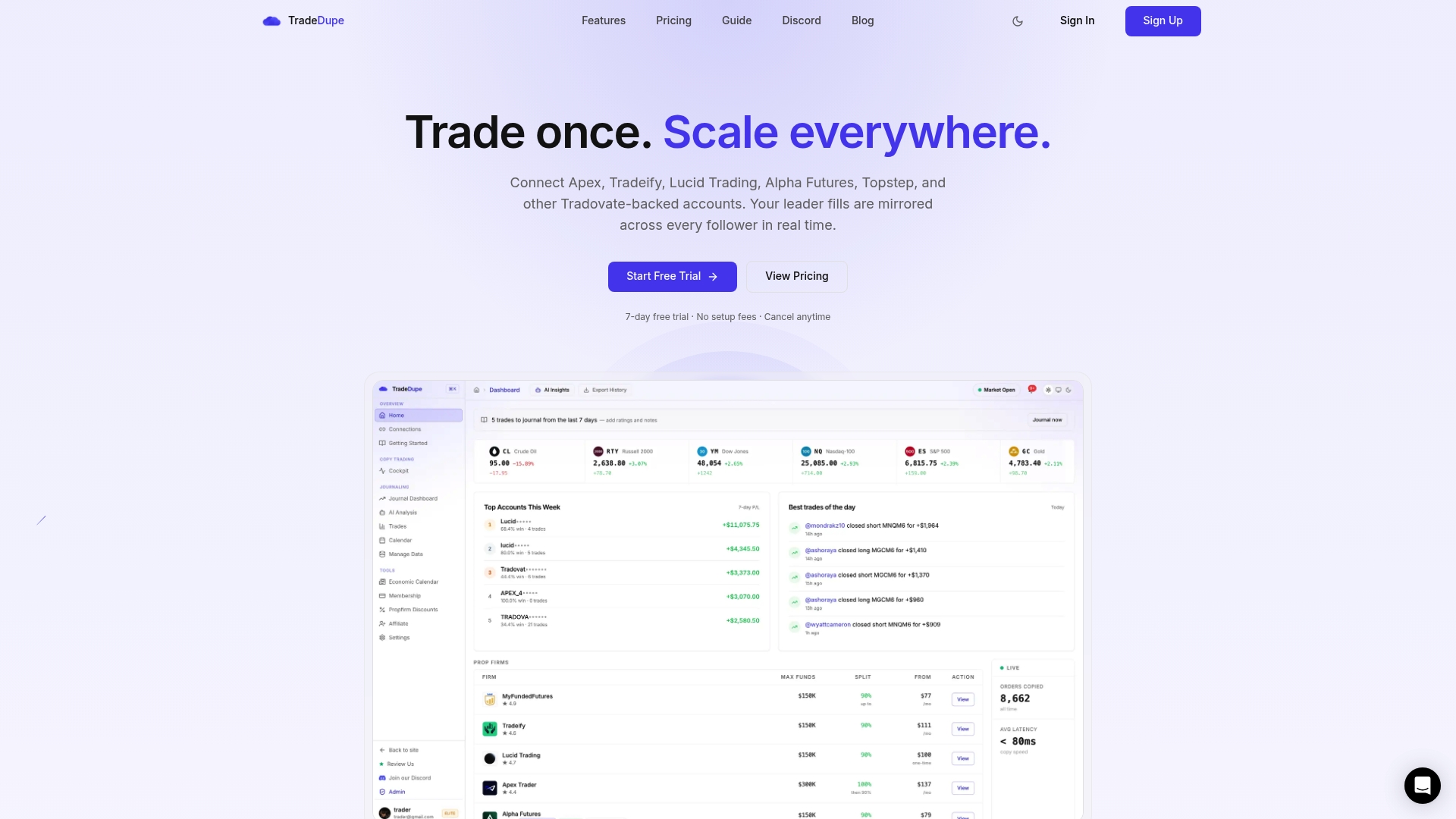
If you are managing Apex, Tradeify, Lucid, MyFundedFutures, Alpha Futures, or TakeProfit Trader accounts on Tradovate and want to see how the mirroring and analytics work together, our copy trading page walks through the setup, and every plan starts with a 7-day free trial you can cancel with one click.
This article is general information, not a substitute for advice from a qualified financial advisor. Consult a qualified financial professional about your own circumstances before acting on anything here.
FAQ
What is the best AI analysis for trading?
There is no single "best" tool; the right AI analysis product depends on whether you need chart pattern detection, signal generation, or trade tagging across multiple accounts. Evaluate any candidate against explainability, reproducible backtests, and operational safeguards like per-account execution controls before trusting it with live capital.
Does AI trading actually work?
AI trading tools can identify patterns and generate testable trade ideas faster than manual chart review, but regulators caution that AI cannot reliably predict market moves and has been used to market fraudulent programs. Treat any AI output as an input to validate, not a guaranteed result.
Can ChatGPT build a trading bot?
ChatGPT and similar large language models can help write the code for a trading bot, including backtesting scripts and broker API integrations, but they do not generate validated trading edge on their own. Any resulting strategy still needs rigorous out-of-sample testing, such as combinatorial purged cross-validation, before it touches real money.
Is there a free AI trading analyzer available?
Some AI chart analysis and backtesting tools offer free tiers or trials, though features like confidence scoring, trade tagging, and multi-account safeguards are typically reserved for paid plans. TradeDupe's AI trade analysis is included in the Pro and Elite plans, and every plan includes a 7-day free trial.
Sources
- Customer Advisory: AI Won’t Turn Trading Bots into Money Machines | CFTC
- SEC press release on AI washing enforcement
- The GT-Score: A Robust Objective Function for Reducing Overfitting in Data-Driven Trading Strategies
Recommended
- Protect Prop Desk Capital With 34ms Tradovate Selective Copy Trading
- The Best Risk Manager Dashboard for Tradovate Multi-Account Trading
- Tradovate Copy Trading: Pro Setups for Multi-Account Traders
For educational purposes only. Not financial advice. Futures trading involves substantial risk of loss and is not suitable for every investor.