
Copy Trading Terms Explained for Futures Traders (2026)
TradeDupe
12 min read
Plain definitions of copy trading terms for futures traders with several prop firm accounts: leader, follower, slippage, drawdown, mirroring, and the myths.
Copy trading means orders placed on one account are automatically reproduced on other accounts. For a futures trader with several prop firm accounts on Tradovate, that usually means you trade one leader account and your other accounts, the followers, take the same trades. This glossary defines every term you will meet, in the way it applies to your accounts, and clears up the myths that cause rule violations and blown evaluations.
TL;DR
- Copy trading reproduces one account's orders on others. Social trading is the wider community layer, and mirror trading usually means following a predefined, algorithmic strategy.
- In your setup, the leader is the account you trade by hand and each follower is another account you own. Every account keeps its own fills, drawdown and rules.
- Identical instructions do not guarantee identical results. Slippage, latency and account size make divergence normal.
- A copier does not make an account compliant. Each prop firm sets its own copy rules, so confirm them with the firm before you copy.
- Copying automates execution. It does not remove market risk, and past performance does not predict future results.
Table of Contents
- The three umbrella terms: copy, social and mirror trading
- The roles: leader, follower and copier
- Execution terms: fill, slippage and latency
- Sizing terms: multiplier, contract cap and allocation
- Risk terms: ROI, drawdown and the rules that bite
- Compliance terms: own-account copying and the CTA question
- Safeguard terms: rogue trades, toggles and execution modes
- Copy trading myths, corrected
- Our perspective
- Run it on Tradovate with TradeDupe
- FAQ
- Sources
The three umbrella terms: copy, social and mirror trading
These three phrases get used as synonyms, and that is the first source of confusion.
Copy trading is the act of automatically reproducing a selected trader's positions on another account. FXEmpire's guide describes it as automated, semi-automated or manual replication of individual traders. The follower delegates entries, exits and timing but keeps their own broker, account size and fills.
Social trading is the broader ecosystem: feeds, rankings, discussion and shared ideas. It does not necessarily automate execution. You can read a social trading feed all day and never copy a single order.
Mirror trading generally refers to automatically following a predefined, often algorithmic strategy rather than a person's discretionary live decisions. Some retail sites use it as another word for copy trading, so read the context. In futures prop trading, people often say mirroring when they mean one of their own accounts replicating another, which is the use case this glossary focuses on.
For a longer explanation of the concept on futures accounts, see our page on what copy trading means for futures trading.
The roles: leader, follower and copier
Leader (also called master, source or lead account) is the account whose fills are the signal. In a typical retail copy trading marketplace the leader is a stranger. In your prop firm setup it is simply the account you choose to trade manually.
Follower (also called slave or copy account) is any account that receives the leader's orders. You can usually enable or pause each follower individually.
Copier (trade copier, or copy engine) is the software that watches the leader and sends matching orders to the followers. If you want the longer definition, our entry on the trade copier covers it.
A useful distinction for prop traders:
| Setup | Who is the leader? | Who owns the followers? | Typical prop firm treatment |
|---|---|---|---|
| Own-account copying | You | You | Often permitted under conditions |
| Copying another trader | Someone else | You | Almost always banned |
| Following a paid signal service | A provider | You | Almost always banned |
The last two rows are the ones that end accounts. According to BestProps' rule comparison, Apex permits copying among a trader's own Performance Accounts under stated conditions but prohibits copying with other traders, and Tradeify requires personally owned and managed accounts with same-direction copying. Rules change, so check each firm's current terms before you turn a copier on. Our page on which futures prop firms allow copy trading tracks the picture across firms.
Execution terms: fill, slippage and latency
This is where copied accounts quietly drift apart.
Fill is the confirmation that your order executed, with a price and quantity. A copier reacts to the leader's fill, then each follower order gets its own fill. A market order on the leader and a market order on a follower are two separate events at the exchange.
Slippage is the difference between the price you expected and the price you got. In copy trading it can occur when the follower's order reaches the market after the leader's order and receives a different price, as Coin Bureau explains. On a fast-moving contract like ES or NQ, a one-tick difference on every entry adds up across ten accounts. We break this down in our post on copy trading slippage across Tradovate prop accounts.
Latency is the delay between the leader's fill and the follower's order being sent. Our platform mirrors fills over live WebSocket streams, typically under 100ms. Latency is only one piece of slippage, because the follower order still has to be matched against whatever liquidity is available at that moment.
Partial fill happens when only part of your order quantity executes at first. A copier has to decide whether followers mirror the partial quantity or wait for the full fill.
Rejected order is an order the broker or exchange refuses, for example because it would breach a risk limit. A follower can be rejected while the leader is filled, which leaves the two accounts in different positions.
Reconciliation is the check that compares leader and follower positions and corrects any follower that has drifted. Good copiers do this continuously, but you should still glance at your positions on Tradovate after any disconnect.

Sizing terms: multiplier, contract cap and allocation
Allocation is how the leader's size translates to each follower. You might send 1:1, or scale a larger funded account up relative to a smaller evaluation.
Multiplier (or ratio) is the factor applied to the leader's quantity. A 2x multiplier turns a 3-contract leader trade into 6 contracts on that follower.
Contract cap (position limit) is the maximum number of contracts a follower may hold, whether set in your copier or by the firm. Prop firms publish their own limits for each account size, and they differ by firm and plan, so confirm the numbers with the firm rather than assuming they match across accounts.
Proportional sizing scales trades relative to account size. It scales the risk, but it does not shrink it: as one educational glossary notes, a 40% drawdown copied proportionally is still a 40% drawdown.
Before you copy, write down for every account the maximum contracts per instrument, the dollar risk of a single copied event, your maximum simultaneous positions, and the daily loss and total drawdown rules. A short spreadsheet is enough. Accounts of different sizes and different firms rarely share the same numbers.
Risk terms: ROI, drawdown and the rules that bite
ROI (return on investment) is percentage return over a measurement period. Maximum drawdown is the largest measured decline from a peak to a later trough. Coin Bureau warns that ROI without drawdown can make an aggressive strategy look safer than it was, and that historical maximum drawdown is only the worst decline in the dataset, not the worst loss that can happen.
Prop firm accounts add their own vocabulary. The exact definitions vary by firm, so treat the following as the general concepts and read each firm's rulebook for the mechanics:
- Daily loss limit: a cap on how much the account can lose in a day. With our platform you set daily loss limits and profit targets directly on Tradovate, so the broker enforces them.
- Trailing drawdown: a loss threshold that moves as the account's equity peak rises. Firms define when it trails and when it locks, so check yours.
- Profit target: the gain required to pass an evaluation.
- Consistency rule: a firm requirement limiting how much of your profit may come from a single day or trade. Not every firm uses one, and the thresholds differ.
- Buffer: the cushion between your balance and your drawdown line.
The key point is that these are enforced at the account level, not the strategy level. Finimize puts it this way: the strategy may be identical but the account states are not, so a trade that is compliant on the leader can violate a rule on a follower with a thinner buffer or a different daily P&L. Our post on how prop firm rules affect trade copying walks through examples.
Compliance terms: own-account copying and the CTA question
Own-account copying means every account in the group belongs to you and is managed by you. This is the only kind most futures prop firms tolerate, and even then conditions apply: which account types may participate, ownership requirements, and account caps. Our guide to whether copy trading is allowed at prop firms summarizes how firms differ, and our post on copy trading at Tradeify covers one firm in detail.
Signal copying means following someone else's trades or a paid service. This is where firm bans are strictest.
CTA (Commodity Trading Advisor) is a regulatory term, not a trading style. The NFA says a CTA is an individual or organization that, for compensation or profit, advises others on buying or selling futures contracts, options, retail off-exchange forex contracts or swaps, and that registration is required unless an exemption or exclusion applies. You do not need to worry about this when you copy between your own accounts. It matters when someone trades or advises on other people's accounts for pay. If you ever plan to do that, speak to a securities or commodities attorney or the NFA first.
Safeguard terms: rogue trades, toggles and execution modes
These words describe the controls that keep a copier from becoming a liability.
Rogue trade is a trade on a follower that the copier did not place, for example a manual click on the wrong account. Our platform includes rogue-trade detection to catch follower trades the copier did not place. Because follower accounts are live and tradable, this matters more than most traders expect.
Per-account toggle is a switch that enables or pauses copying for one follower. Use it when an account is near its drawdown line, is waiting on a payout, or has hit a daily target.
Execution mode controls how the copier behaves, such as which orders are mirrored. Learn what each option does before going live.
Auto-recovery is how the copier re-establishes its connection and position sync after a disconnect.
OAuth is the login method where you authorize an app through the broker's own sign-in page. Our platform connects through Tradovate's official OAuth flow, so passwords are never stored.
Before going live, test entries, reductions, exits and reconnect behavior in a simulation environment. Pause copying and check your Tradovate positions any time a follower diverges. A pre-copy checklist should also cover news windows, weekend policy, bracket order behavior and what happens after a rejected or unprotected order.
Copy trading myths, corrected
Myth: copied accounts share one risk limit. Each account keeps its own orders, fills and risk limits. One account's remaining drawdown does not automatically apply to the group, so you must watch every account.
Myth: the same signal means the same result. Different fills, costs and sizes mean divergence is the default, not a malfunction. Two accounts copying the same trader can produce different returns because of entry price, slippage and available margin.
Myth: a copier makes every account compliant. It only sends orders. Each firm decides whether copying is allowed, for which account types and under what limits.
Myth: copying removes market risk. It automates execution. Losses are still losses, and past returns do not reliably predict future results.
Myth: latency does not matter. It matters most in fast markets and on tight-target strategies, but it is not the only factor. Order type, liquidity and size all shape your fill.
Myth: any copier works at any firm. Firm rules, supported platforms and connection methods differ. A tool built for Tradovate accounts will not necessarily suit accounts on other platforms.
Our perspective
> Most glossaries on this topic are written for people copying strangers. That is not your situation. You hold several evaluation or funded accounts, you trade one of them, and you want the others to follow without logging into six screens. > > That changes which terms matter. Fill, slippage, rogue trade, daily loss limit and per-account toggle matter more than ROI rankings or follower leaderboards. The risk is not picking the wrong leader. The risk is an account state you forgot about. > > We built TradeDupe only for Tradovate prop firm traders for that reason. Connections go through Tradovate's official OAuth, nothing runs on your PC or VPS, and daily loss limits and profit targets are set on Tradovate so the broker enforces them. We think flat plans beat per-account fees, because the more accounts you hold, the more a per-account bill punishes you. > > Whatever tool you use, the rule is the same: read each firm's current copy rules, size every account on purpose, and keep a hand on the toggle. > > Andres
Run it on Tradovate with TradeDupe
If you hold several Tradovate-based accounts at firms like Apex, Tradeify, Lucid Trading, MyFundedFutures, Alpha Futures or TakeProfit Trader, our futures trade copier mirrors each fill from your leader to the followers you enable, typically under 100ms. Standard is $20 per month billed yearly ($30 monthly), Pro is $45 per month billed yearly ($60 monthly), and Elite is $90 per month billed yearly ($120 monthly). Every plan includes a 7-day free trial with one-click cancellation.
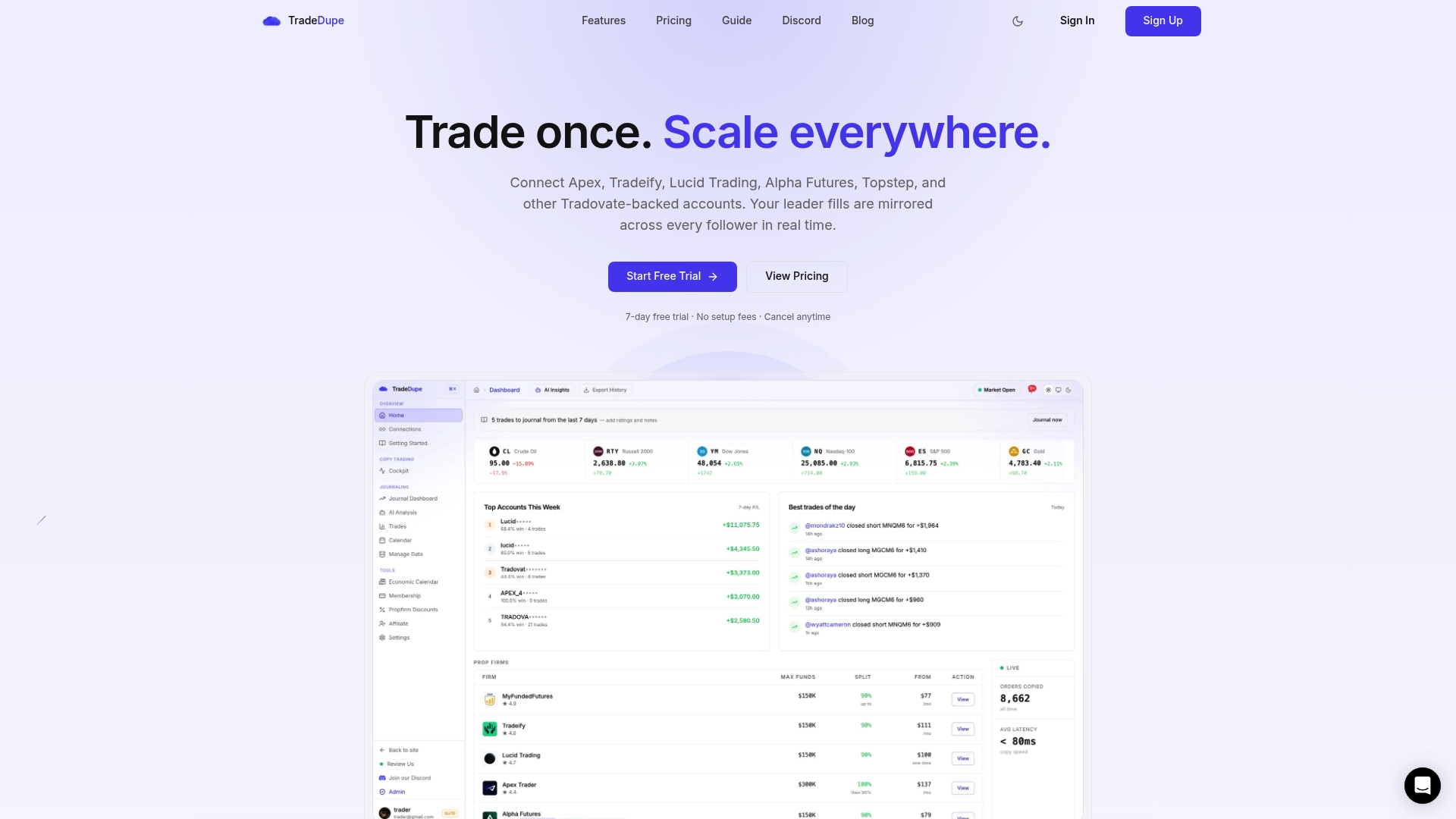
Standard covers 2 connections with 10 accounts each, Pro covers 4 connections with 20 accounts each, and Elite has unlimited connections. Confirm each firm's copy rules first, then start the trial at tradedupe.com.
FAQ
What is the difference between copy trading and a trade copier?
Copy trading is the practice of reproducing one account's orders on others. A trade copier is the software that performs it. When you copy between your own prop firm accounts, you are using a trade copier for copy trading.
Is mirroring the same as copy trading?
Often, yes, in everyday prop firm talk. Strictly, mirror trading refers to following a predefined, algorithmic strategy, while copy trading follows a person's decisions. In your case, both words usually mean one of your accounts replicating another.
Why do my follower accounts show different fills than my leader?
Each account sends its own order and gets filled at the price available at that moment. Latency, order type, liquidity and size all affect it. Small differences are normal, and slippage is the term for them.
Does every prop firm allow copy trading?
No. Firms differ on whether copying is allowed, which account types can take part, ownership requirements and account caps. Copying someone else's account or a signal service is almost always banned. Confirm the current rules with each firm before you copy.
Sources
- Copy and Social Trading, Ultimate Guide (FXEmpire)
- What Is Copy Trading? How It Works, Risks and Costs (Coin Bureau)
- Prop Firm Trade Copier Rules by Account Type (BestProps)
- How Copy Trading Works Inside Proprietary Trading Firms (Finimize)
- Who Has to Register (NFA)
Recommended
- Copy Trading: What It Means for Futures Trading
- Which Futures Prop Firms Allow Copy Trading? \(October 2026\)
- Best Futures Trading Strategy for Copy Trading \(2026\): Order Flow vs ICT Concepts
- 3 Safeguards Prop Firm Traders Need for Futures Copy Trading Security
For educational purposes only. Not financial advice. Futures trading involves substantial risk of loss and is not suitable for every investor.