
Multi Broker Copy Trading: What Prop Desks Should Demand
TradeDupe
13 min read
Discover the essential requirements for effective multi broker copy trading and how to choose a reliable platform for prop desks.
The professional standard for multi broker copy trading is a server-side, low-latency platform with per-account risk controls and full audit logs, not a client-side script bolted onto a VPS. For prop desks running Tradovate accounts, TradeDupe is the practical option built specifically around that standard.
Two things separate a reliable system from a liability:
- Server-side execution removes the client-side lag and single-point-of-failure risk that comes with running copiers on a personal machine or shared VPS.
- Per-account controls — toggles, position limits, and rogue-trade detection — let you shut down one follower account without touching the rest of the fleet.
Before signing with any vendor, request their median latency figure and time-to-fill data under load. If they can't produce numbers, treat that silence as your answer.
Key Takeaways
Reliable multi broker copy trading depends on server-side execution, measured latency data, and per-account risk controls working together, not any single feature in isolation.
| Point | Details |
|---|---|
| Verify latency in writing | Request median latency and time-to-fill figures from any vendor before piloting, not after signing. |
| Require per-account isolation | Confirm toggles and risk limits let you pause one follower account without disrupting the rest. |
| Insist on audit logs | Every copied trade needs a timestamped record for reconciliation and prop-firm compliance. |
| Pilot before scaling | Run a low-size live test measuring slippage and fill rates before increasing capital allocation. |
| Consider TradeDupe for Tradovate desks | TradeDupe offers server-side mirroring with 34ms median latency and native support for major prop-firm account models. |
Table of Contents
- What Multi Broker Copy Trading Requires From Your Platforms
- How Does Multi Broker Copy Trading Actually Work?
- Key Features To Evaluate Before You Commit
- What Goes Wrong With Copy Trading Across Multiple Brokers
- How To Roll Out a Multi Broker Copy Trading Pilot
- TradeDupe's Approach To The Multi Broker Checklist
- How Support Quality Varies Across Copy Trading Platforms
- Does It Work With Your Existing Trading Stack?
- The Gap Between Copier Marketing And Copier Reality
- Get Started With Server-Side Copy Trading Built For Tradovate
- Sources
What Multi Broker Copy Trading Requires From Your Platforms
Multi broker copy trading only works if the underlying platforms and brokers actually talk to each other cleanly. Most professional setups need to support Tradovate, NinjaTrader, Rithmic, TradingView, and sometimes MT4/MT5 or cTrader, depending on whether the desk trades futures, equities, FX, or crypto. Futures-focused prop firms lean heavily on Tradovate and Rithmic connectivity; FX and equities desks often need MT4/MT5 or broker-specific APIs instead.
The connection type matters as much as the platform list. Copy trading is commonly built on direct mirroring between a master account and follower accounts, and how that mirroring happens changes everything downstream, as IG's overview of copy trading lays out. Three connection types dominate the market:
- API connections offer the tightest integration and lowest latency, but require the vendor to maintain direct relationships with each broker.
- FIX protocol links are common in institutional setups and generally reliable, though implementation quality varies widely between vendors.
- Bridge or terminal-based connections are easier to set up but introduce an extra hop that can add measurable delay.
Before committing to any solution, verify symbol mapping across every account, confirm the exact instruments available on each broker, and confirm whether execution is direct market access or a synthetic fill. A mismatch in any of these three areas can silently distort your copied trades without throwing an obvious error.
How Does Multi Broker Copy Trading Actually Work?
The mechanics come down to one decision: does execution happen server-side or client-side? Server-side systems process the leader's order on a remote server and push instructions to follower accounts independently of any single computer staying online. Client-side systems depend on a local terminal or EA running continuously, which means a dropped connection on one machine can silently break the entire chain. For a prop desk running a dozen follower accounts, server-side architecture is the only version genuinely built for scale, an approach vendors like ConnectX Copy have built their infrastructure around.
Once a leader fill happens, a copier has to complete several steps almost instantly:
- Detect the fill on the leader account and confirm the exact instrument, size, and price.
- Translate the symbol to its equivalent contract or ticker on each follower's broker.
- Calculate proportional sizing based on each follower account's balance, risk allocation, or fixed lot rules.
- Route the order to each follower account, adjusting for contract multipliers where futures products differ across brokers.
- Confirm the fill and log it for reconciliation.
Latency creeps in at every one of those steps, and where it hurts depends on your strategy. A swing trader holding positions for hours barely notices 50 to 100 milliseconds of delay. A scalper working five-tick moves on the ES contract can have an entire trade invalidated by that same delay.
Pro Tip: If your strategy holds trades for under a minute, ask any vendor for their time-to-fill (TTF) data specifically under volatile market conditions, not just their quiet-market average. TTF under stress is where copiers actually fail.
Key Features To Evaluate Before You Commit
Choosing among multi broker trading solutions comes down to a specific checklist, not a general impression of "reliability." Feature lists on vendor pages tend to converge on the same core items, and for good reason: these are the features that actually prevent losses when something goes wrong.
Require these at minimum:
- Per-account risk limits that cap exposure independently on each follower account.
- Rogue-trade detection that flags orders inconsistent with the leader's activity or with an account's own risk parameters.
- Auto-recovery that reconnects and resyncs accounts automatically after a dropped connection, without manual intervention.
- Per-account toggles so you can pause or resume individual followers without disrupting the rest of the group.
- Audit logs with a full trade journal for every copied order.
- Symbol mapping and trade filters that let you exclude specific instruments or sessions from copying.
- Monitoring and alerting that notifies your team the moment a sync fails or a fill diverges from expectation.
Beyond features, ask for hard numbers. Request the vendor's median latency in milliseconds, their typical slippage under normal and volatile conditions, their uptime SLA, and how often reconciliation runs between leader and follower accounts. A vendor that only offers vague claims like "fast" or "reliable" without a measured figure hasn't done the work of measuring it themselves.
Commercial terms deserve equal scrutiny. Pricing models vary between per-connection fees and flat tiered plans, and the difference matters enormously once you're running more than a handful of accounts. Ask about onboarding timelines, and specifically whether the platform has direct support for the prop-firm account models your desk actually uses, including Apex, Tradeify, or similar programs. A platform that treats prop-firm accounts as an afterthought will show it during your first support ticket.
What Goes Wrong With Copy Trading Across Multiple Brokers
Execution risk sits at the top of the list. Partial fills, price slippage between the leader's execution and each follower's fill, and outright rejected orders all happen more often across multiple brokers than within a single account, simply because each broker's order book behaves differently. The fix isn't hoping it won't happen. It's requiring latency SLAs in writing and confirming that every fill generates an acknowledgment you can audit.
Strategy and correlation risk is subtler and easier to ignore until it costs money. Running multiple master strategies that are secretly correlated means a single bad market move can hit every follower account at once, defeating the entire point of diversification. Guides on copy trading consistently recommend size limits per master strategy and mechanical unfollow rules to catch this early, a discipline CopyTradeInsider's analysis of copy trading practices treats as a baseline requirement rather than an optional safeguard.
Broker and prop-firm conflicts round out the list. Before deploying any copier, confirm the exact contract specifications match across accounts, that automation itself is permitted under your prop firm's rules, and that position limits won't be silently breached by proportional sizing.
Here's the operational sequence worth locking in before you go live:
- Set automated stop rules tied to drawdown thresholds on each follower account.
- Apply per-account throttles that cap order frequency during volatile sessions.
- Require audit logs on every trade, matched against leader activity in real time.
- Run scheduled reconciliation, not just end-of-day checks, to catch divergence early.
Pro Tip: *Treat unfollow rules as code, not judgment calls.
How To Roll Out a Multi Broker Copy Trading Pilot
Every successful rollout starts small and measures everything. Begin with staging accounts that mirror your production setup but carry no real capital at risk, and confirm the connection holds under normal trading hours before touching a live account.
Once staging looks clean, move to a low-size live pilot:
- Connect one leader account to two or three follower accounts with minimal position sizing.
- Measure round-trip time from leader order acknowledgment to follower fill across every broker pair involved.
- Compare slippage and execution rates between brokers to spot any outlier connection.
- Verify the audit trail captures every trade with matching timestamps and sizes.
- Document results for at least two weeks before increasing size.
Scaling from there should be phased, not immediate. Increase capital allocation gradually, rebalance master-to-follower ratios on a fixed schedule rather than reactively, and rerun correlation checks every time you add a new master strategy to the mix.
Ongoing monitoring is what keeps a pilot from quietly degrading into a liability. At minimum, your dashboard needs to track:
- Real-time sync status across every leader and follower account.
- Fill confirmations matched against leader orders.
- Slippage trends over time, not just daily snapshots.
- Automated alerts the moment a follower account falls out of sync.
TradeDupe's Approach To The Multi Broker Checklist
TradeDupe was built around exactly the checklist professional desks need, applied specifically to Tradovate accounts. Its architecture runs server-side execution with a reported median latency of 34 milliseconds, which puts it well within the range that matters for most futures strategies, including short-duration setups where lag directly erodes edge.
The platform's proof points map directly onto the risk categories covered above:
- Rogue-trade detection flags orders on a follower account that don't match leader activity, catching desynchronization before it compounds.
- Auto-recovery reconnects and resyncs accounts automatically after a dropped connection, without requiring manual restarts.
- Per-account toggles let a desk pause a single follower instantly, isolating a problem account without disrupting the rest of the group.
- Analytics and a live dashboard give real-time visibility into sync status, leader/follower activity, and AI-assisted trade analysis.
TradeDupe supports major prop-firm account models including Apex, Tradeify, Lucid Trading, and Alpha Futures, which matters directly for desks running evaluation and funded accounts side by side. Teams evaluating a pilot can review the getting-started walkthrough to see exactly how account connection and setup work in practice.
How Support Quality Varies Across Copy Trading Platforms
Support quality separates platforms that survive a live incident from ones that turn a minor glitch into a lost trading day. When a follower account desyncs during market hours, the difference between a five-minute fix and a thirty-minute scramble usually comes down to whether the vendor has real trading-ops staff on call, not a generic ticketing queue.
Ask any vendor directly how they staff support during active market hours versus after close. A platform serving retail copy traders might treat a Saturday response time as acceptable; a prop desk running live capital during regular trading hours cannot. Response time commitments should be written into your agreement, not assumed from a sales call.
Documentation quality is a quieter but equally telling signal. Platforms built for professional users tend to publish detailed setup guides, audit-log explanations, and integration notes for specific prop-firm programs, rather than generic marketing pages. If a vendor's support content reads like it was written for hobbyist traders opening their first account, that's a reasonable proxy for how the underlying product was built.
Escalation paths matter most in the moment you need them least. Confirm whether there's a direct line to a technical team when a sync failure happens mid-session, and whether that access scales with your account tier or gets throttled the moment you're not paying for the top plan.
Does It Work With Your Existing Trading Stack?
Compatibility with your existing trading software determines whether a copier fits into your workflow or forces you to rebuild around it. Most professional desks already run charting platforms, risk dashboards, and order management tools alongside their execution layer, and a copy trading solution needs to sit next to those tools without conflict.
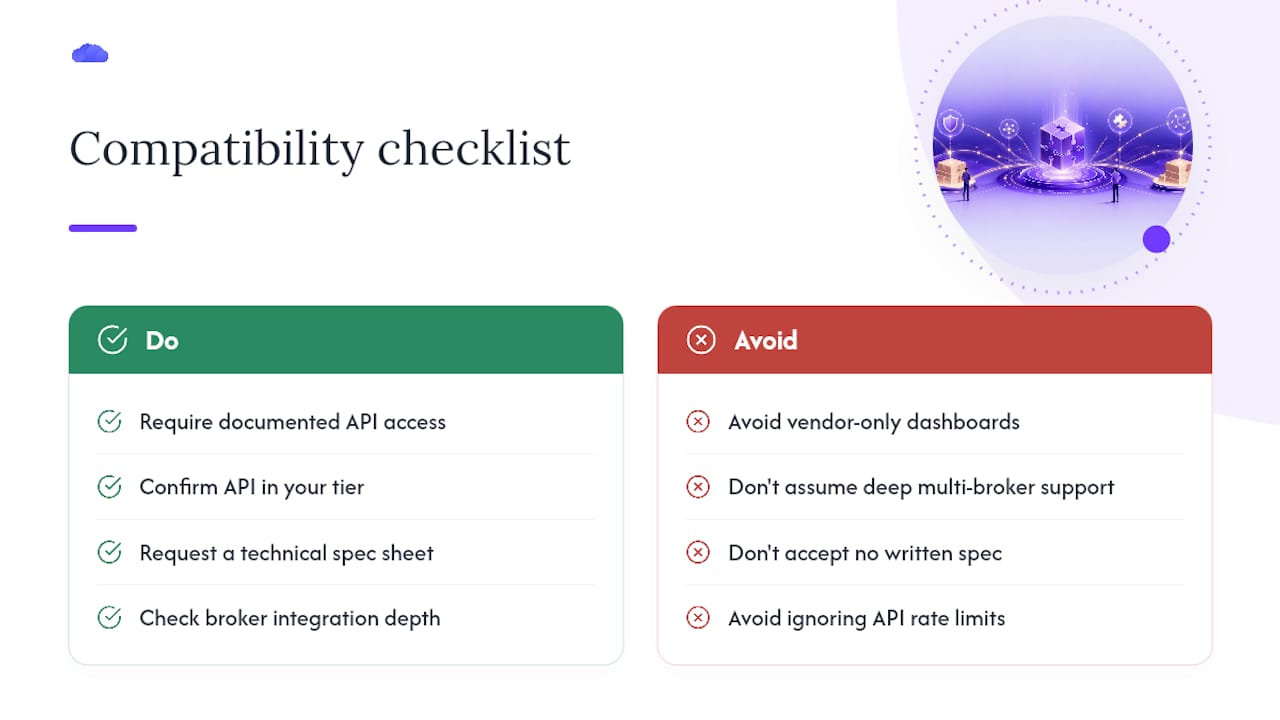
API access is the deciding factor here. A platform offering documented API endpoints lets your trading-ops team pull sync status, fill data, and account health into whatever internal monitoring system you already use, instead of forcing you to watch a separate vendor dashboard all day. Ask specifically whether API access is included at your subscription tier or reserved for enterprise plans, since that detail varies significantly between vendors.
Compatibility also extends to how a platform handles broker-specific quirks. Tradovate-native systems, for instance, can integrate more tightly with that platform's order types and account structure than a generalist multi-platform copier trying to support a dozen brokers at once. That tradeoff is worth naming plainly: broader platform support usually means shallower integration depth with any single one, while a focused integration tends to go deeper on reliability for that specific ecosystem.
Before committing, request a technical specification sheet covering supported order types, any rate limits on API calls, and how the platform handles broker-side maintenance windows or outages. A vendor unwilling to share that detail in writing is telling you something about how mature their integration actually is.
The Gap Between Copier Marketing And Copier Reality
Most vendor pages in this space read alike: fast, reliable, secure, built for professionals. None of that language is verifiable, and that's precisely the problem. The research on this topic keeps circling back to the same unglamorous conclusion: the platforms worth trusting are the ones willing to hand over a number, not an adjective.
Where conventional advice falls short is treating copy trading as a setup task instead of an ongoing operational discipline. A copier isn't something you configure once and forget. It's a live system that needs the same monitoring rigor as any other piece of trading infrastructure, with reconciliation, alerting, and mechanical unfollow rules built in from day one, not bolted on after the first bad sync.
If you take one thing from this into your next vendor conversation, make it this: ask for the median latency figure, ask how rogue trades get caught, and ask what happens automatically when a connection drops. A platform that answers all three without hesitation has actually built the thing it's selling.
> — Andres
Get Started With Server-Side Copy Trading Built For Tradovate
TradeDupe gives prop desks running Tradovate the one thing generic copiers can't: purpose-built infrastructure instead of a bolted-on integration. Where broader multi-platform tools spread their engineering across a dozen brokers, TradeDupe focuses entirely on Tradovate, which is how it maintains that 34ms median latency alongside rogue-trade detection and auto-recovery running in the background of every connected account.
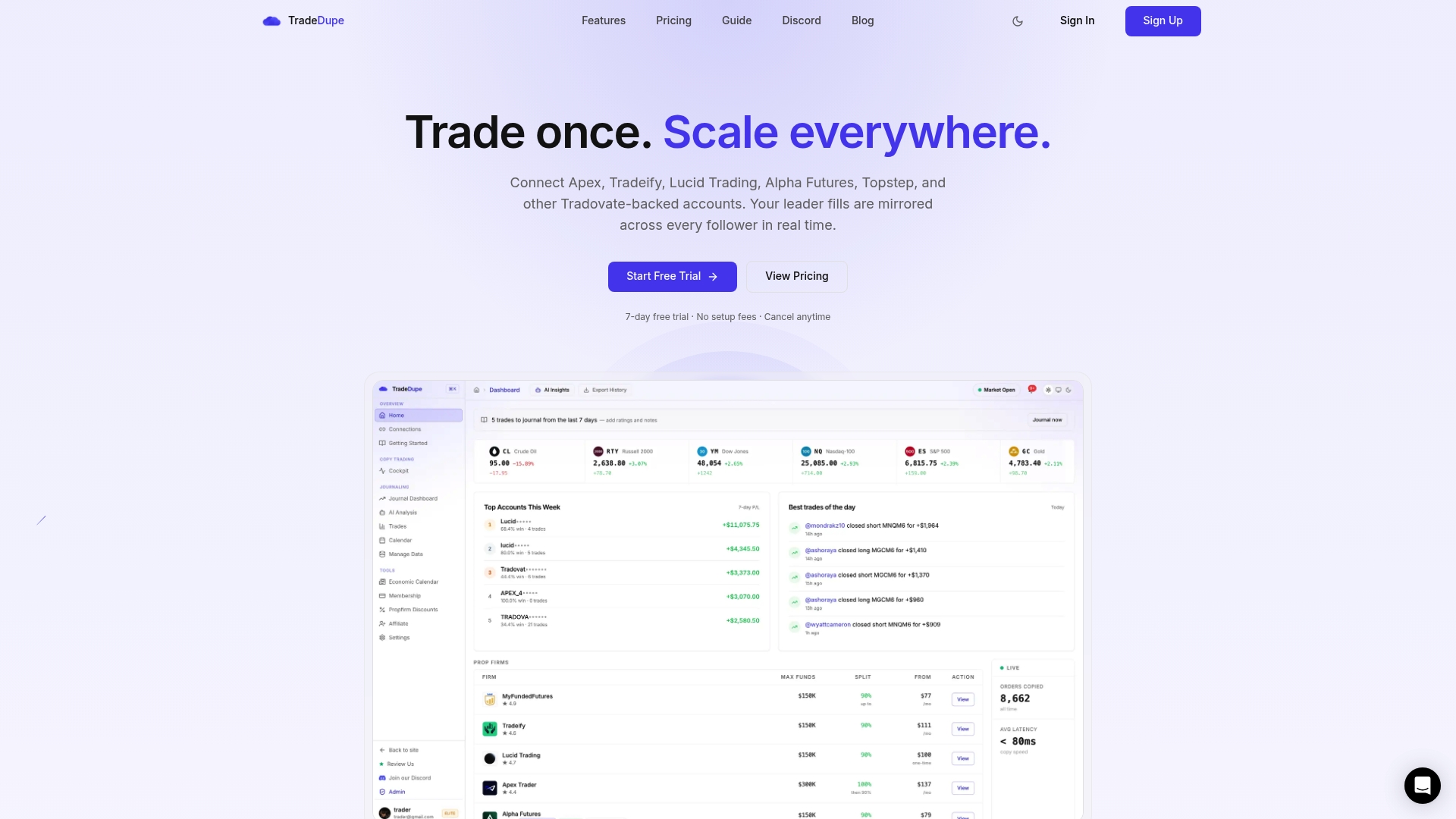
It suits desks managing evaluation and funded accounts side by side, with native support for Apex, Tradeify, Lucid Trading, and Alpha Futures baked into the account connection flow. Per-account toggles mean you can isolate one follower instantly without touching the rest of your fleet, and the built-in dashboard gives your trading-ops team the sync visibility this article just spent several sections arguing you should demand from any vendor.
If the checklist above matches what your desk actually needs, the next step is straightforward: walk through the 10-minute setup guide and connect a leader account to a small pilot group before scaling further.
Sources
- What is copy trading? Definition, Pros and Cons | IG
- ConnectX Copy — Cross-Platform Copy Trading | 6 Platforms
- Bybit Copy Trading Deep Guide 2026: Pick, Size, Monitor | CopyTradeInsider