

State Drift Kills: Order Routing Redundancy for Tradovate Prop Desks
TradeDupe
10 min read
Tradovate prop desks: comply with NFA and CME and stop orphaned or duplicate orders with idempotent order mapping and shared token state.
For Tradovate copy trading, implement a coordinated primary plus hot backup execution path with shared session state and proactive token renewal to avoid orphaned or duplicate orders. That means warm WebSocket connections on standby, a token store both systems can read, idempotent order mapping so retries never double fill, fan-out throttles that respect account limits, and monitoring that flags unacknowledged or duplicate orders within seconds rather than minutes.
*
> TL;DR: > > - Implement shared session state and proactive token renewal to prevent orphaned or duplicate orders during failover. > - Follow regulatory requirements by maintaining documented redundancy and pre- and post-execution controls reviewed annually. > - Use an active-standby architecture with synchronized WebSocket connections, idempotent order mapping, and sequence number continuity to ensure reliable failover. > - Monitor WebSocket latency, token expiration, unacknowledged orders, and duplicate flags continuously, with regular drills for failover testing. > - Prioritize correct order state synchronization and idempotent retry logic over minimal failover latency, as improper handling increases double fills and compliance risks.
*
Table of Contents
- Regulatory Obligations and Top Operational Risks
- Core Architecture and Protocol-Level Patterns for Reliable Failover
- Concrete Checklist for Implementation
- Runbook: Monitoring, Testing, and Incident Response
- Practical Lessons from TradeDupe's Operational Experience
- What Actually Matters in Order Routing Redundancy
- How TradeDupe Handles Redundancy for Prop Desks
- FAQ
- Sources
Regulatory Obligations and Top Operational Risks
Redundancy for automated order routing is not a performance feature you bolt on later. For firms using third-party execution tools, the NFA's interpretive notices under Compliance Rule 2-9 require written supervisory procedures, documented contingency plans, and pre- and post-execution controls, with annual reviews to confirm they still hold up. The regulator treats a redundant execution path as a core risk control, not an optional convenience, and the practical danger it is guarding against is simple: orphaned orders and accidental duplication when a primary and a backup path drift out of sync.
CME Group's own infrastructure adds a second layer of constraint. Cancel on Disconnect cancels resting orders automatically when a session drops ungracefully, and re-entering those orders is the trader's responsibility, not the exchange's. GTC and GTD orders historically needed manual re-entry after a disconnect, which is exactly the kind of gap a failover plan has to close.
Major failure modes to architect against:
- Orphaned orders left resting on the primary connection after a silent disconnect.
- Duplicate fills when a backup system resends an order the primary already placed.
- Stale orders that COD canceled but the backup system still believes are live.
- Authentication failures (401 errors) when an OAuth token expires mid-session during switchover.
NFA Interpretive Notice ¶9046 specifies disaster recovery, redundancy, and pre- and post-execution controls, plus annual reviews, as explicit requirements for firms relying on automated order routing, which makes redundancy a compliance line item as much as an engineering one.
Core Architecture and Protocol-Level Patterns for Reliable Failover
An active-standby pattern, not active-active, is the safer default for copy trading. Exchanges expect application messages on a single primary stream at a time, so running two systems that can both fire live orders invites exactly the duplication problem redundancy is meant to prevent. A primary system handles execution while a hot backup stays warm, synchronized, and ready to take over the instant the primary fails a health check.
Session state has to travel with the failover, not trail behind it. That starts with how you handle Tradovate's OAuth tokens: both systems need access to the same short-lived credentials, refreshed proactively before expiry rather than reactively after a 401 error. A shared, low-latency token store with a leader-election pattern for refresh avoids the race condition where primary and backup both try to renew the same token at once.
Build these patterns into the execution layer:
- Keep WebSocket connections warm on the backup system rather than opening them cold at failover time.
- Prefer event-driven streaming to polling REST calls on any path that touches live order placement.
- Respect exchange sequencing: maintain contiguous sequence numbers and reuse the same UUID across primary and backup sessions where the protocol allows it.
- Design order mapping to be idempotent, so a replayed message during switchover is recognized and skipped instead of executed twice.
Coordinated client processes that preserve sequence numbers and UUID continuity are part of how CME's fault-tolerance guidance expects failover to behave at the protocol level, and treating active-active as the default architecture tends to create more desync risk than it solves.
Pro Tip: Treat your backup connection as "ready," never "cold": a warm, authenticated, idle WebSocket session fails over in milliseconds, while a cold one has to authenticate, subscribe, and resync before it can place a single order.
Concrete Checklist for Implementation
Building this correctly means treating redundancy as five separate engineering problems that happen to share one architecture.
- Socket health: run keepalive pings on a fixed interval, define failure as a missed threshold rather than a single dropped packet, and automate promotion of the backup the moment that threshold is crossed.
- Token lifecycle: use a shared store for OAuth credentials issued through Tradovate's official OAuth flow, refresh proactively on a timer, and never store raw passwords on either system.
- Idempotency and order mapping: generate a stable idempotency key per leader order event and persist a leader-order-id to follower-order-id map so a retry during failover gets recognized and dropped instead of resent.
- Throttle and fan-out controls: enforce per-account and global rate limits so a burst of leader fills does not overload follower accounts during a fan-out event.
- Reconciliation hooks: compare drop-copy records against your own order log, automate re-entry rules for anything COD canceled, and log every decision for audit purposes.
Supporting infrastructure worth having in place before any of this goes live:
- A read-through cache for session tokens that both primary and backup processes can query without hitting Tradovate's API directly.
- Backpressure handling on the fan-out layer so a slow follower account does not stall mirroring for the rest.
- A dedicated audit log separate from the trading log, since regulators and clearing brokers often want the two kept apart.
A deeper breakdown of how duplicate orders happen in practice, and how to design around them, is covered in TradeDupe's guide to duplicate order prevention.
Runbook: Monitoring, Testing, and Incident Response
A redundancy architecture is only as good as the monitoring that watches it and the drills that prove it works under pressure. On-call teams need a short list of metrics that tell them something is wrong before a trader notices a missing fill.
Watch these continuously:
- WebSocket latency and the rate of missed keepalive responses.
- Token expiration events and any 401 errors on either the primary or backup path.
- Count of unacknowledged orders older than a defined threshold.
- Duplicate-order counts flagged by the idempotency layer.
When any of those cross an alert threshold, the response should be mechanical: fail over, pause fan-out until the backup confirms healthy, and escalate to the clearing or carrying broker if the issue touches live positions.
| Activity | Frequency | Purpose |
|---|---|---|
| Warm-failover drill | Weekly | Confirm backup promotion works under live conditions |
| Load test | Monthly | Validate throttle and fan-out behavior under volume |
| Independent review | Annual | Document controls for NFA supervisory requirements |
Evaluating any third-party execution dependency as part of this process is worth treating the same way firms assess overlap risk across providers in other parts of a portfolio, a discipline Evibe's overlap analysis applies to holdings and that applies equally well to redundant service providers.
Post-incident, capture a timeline, the specific orders affected, and the reconciliation steps taken, and notify supervisors per your written procedures. CME's November 2025 change to Globex disaster recovery now persists GTC and GTD orders across DR failover, which reduces how often re-entry logic actually fires, though other COD caveats around ungraceful disconnects still apply.
Practical Lessons from TradeDupe's Operational Experience
Building mirrored execution for prop desks surfaces the same desync symptoms repeatedly: a fill lands on the leader account but the follower order shows no acknowledgment, or a reconnect produces two fills where there should be one. The fix is almost always traceable to the order-id mapping, not the network itself. Checking fill logs against the leader-to-follower map, order by order, finds the break faster than restarting the connection and hoping.

TradeDupe's architecture keeps WebSocket connections warm specifically to avoid the cold-start latency that causes these symptoms, targeting mirrored fills within roughly 100 milliseconds of the leader's execution. Rogue-trade detection, per-account copy toggles, and daily loss limits enforced directly on Tradovate give the risk layer a check independent of the execution layer, which matters when an automated copier is the thing placing the orders.
What Actually Matters in Order Routing Redundancy

Most of the advice circulating about trading system redundancy treats it as a network engineering problem: more servers, more connections, more redundancy in the abstract. That framing misses the actual risk in copy trading, which is state drift, not downtime. A backup system that comes online instantly but does not know what the primary already did is more dangerous than no backup at all, because it will happily duplicate an order the primary already placed.
The priority order matters more than the architecture diagram. Get idempotent order mapping and shared token state working first, before worrying about shaving milliseconds off failover time. A slow, correct failover beats a fast one that double fills an account. Firms that skip the regulatory side, treating NFA documentation as paperwork rather than a design constraint, tend to discover the gap during an incident rather than before one.
> — Andres
How TradeDupe Handles Redundancy for Prop Desks
TradeDupe connects to Tradovate through its official OAuth flow, so credentials are never stored and nothing runs on a trader's PC or VPS waiting to fail. Order execution happens server-side with the kind of warm-connection, built-in safeguard design this guide describes, rogue-trade detection, per-account toggles, and daily loss limits enforced by Tradovate itself rather than by a script that might not catch a disconnect.
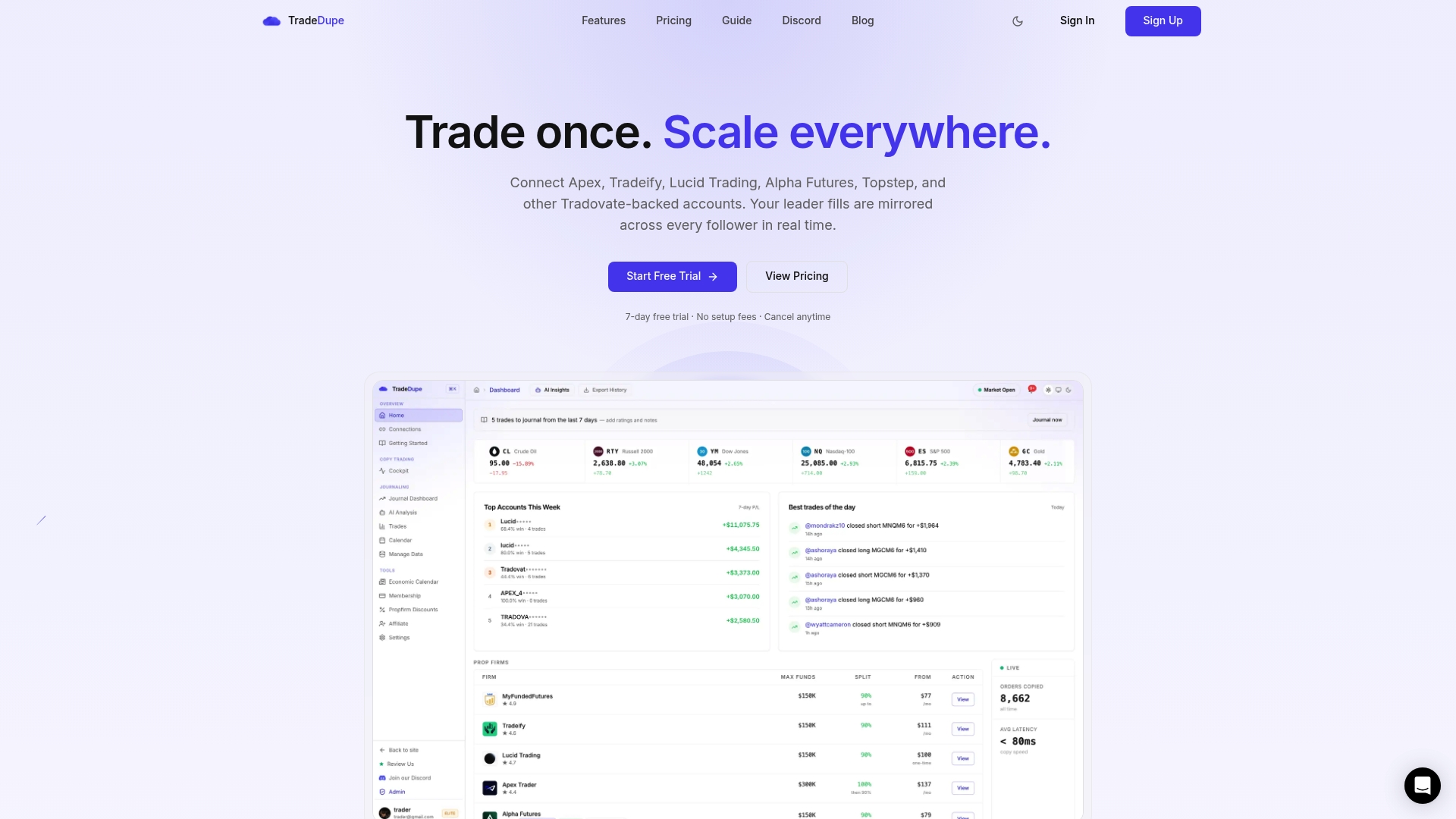
For a desk weighing in-house redundancy against a managed platform, the honest answer depends on engineering bandwidth: building the checklist above correctly takes real time, while a managed path gets you sub-100ms mirroring without maintaining it yourself. Plans start at a low monthly price billed yearly, and every plan includes a free trial with one-click cancellation. Get started with TradeDupe in about ten minutes.
FAQ
What does order routing redundancy mean for copy trading?
It means having a backup execution path, typically a hot standby system, ready to take over if the primary connection to Tradovate fails, without duplicating or losing orders in the process. The backup needs shared session state and synchronized order mapping to do this safely.
How does Cancel on Disconnect affect failover design?
CME's Cancel on Disconnect cancels resting orders automatically on an ungraceful session loss, and re-entering them is the trader's responsibility. A failover system needs explicit re-entry rules for anything COD cancels, though CME's November 2025 update now persists GTC and GTD orders across disaster recovery transitions specifically.
What NFA rules apply to automated order routing redundancy?
NFA Compliance Rule 2-9 and Interpretive Notice ¶9046 require written procedures covering disaster recovery, redundancy, and pre- and post-execution controls, reviewed annually. Firms using third-party copy trading tools remain responsible for these controls regardless of which vendor handles execution.
How do I prevent duplicate orders during a failover event?
Assign a stable idempotency key to every leader order event and maintain a persistent map between leader order IDs and follower order IDs. When the backup system comes online, it checks that map before sending anything, which stops a replayed or retried message from executing twice.
Does TradeDupe include built-in redundancy for Tradovate copy trading?
TradeDupe mirrors fills server-side with warm WebSocket connections and targets execution within roughly 100 milliseconds of the leader's fill. Rogue-trade detection and broker-enforced daily loss limits add a risk-control layer independent of the execution path itself.
Sources
- NFA compliance rules (interpretive notices) — Waystone compliance summary
- Cancel on Disconnect — CME Group documentation
- Tradovate API documentation
Recommended
- Duplicate Order Prevention for Tradovate Prop Desks
- Order Fill Mismatch: A Playbook for Tradovate Prop Desks
- Prevent Drift with 100ms Sync Monitoring for Tradovate Prop Accounts
- Trade Reconciliation Automation for Tradovate Prop Desks: 6 Essentials
For educational purposes only. Not financial advice. Futures trading involves substantial risk of loss and is not suitable for every investor.