

Five Minute Reconciliations: Multi Account P&L Attribution for Prop Desks
TradeDupe
11 min read
Prop desk playbook for audit ready multi account P&L attribution: allocation rules, compliance checkpoints, reconciliation, and TradeDupe.
Use the exchange's official daily settlement price as your source of truth, apply one allocation method consistently across every account, and automate reconciliation so each account produces its own daily mark-to-market statement. That combination is what makes multi account pnl attribution defensible under audit, fair to every follower account, and fast enough to resolve disputes before they escalate into compliance headaches.
*
> TL;DR: > > - Accurate reconciliation relies on using the exchange's daily settlement price and consistent allocation methods across all accounts with automated reporting. > - Proper system setup must include clear data sources, real-time fill tracking, and detailed export formats to ensure quick dispute resolution and audit readiness. > - Equity-proportional and per-contract allocations are most effective to scale risk fairly across accounts of varying sizes, provided the method is documented and applied consistently. > - Implementing strict controls like daily loss limits, symbol filters, and rogue-trade detection reduces allocation errors and maintains compliance. > - Using a platform like TradeDupe facilitates secure account connections, real-time fill mirroring, and detailed logs critical for reconciliation and regulatory audits.
*
Table of Contents
- What a correct multi account P&L setup looks like in practice
- Core building blocks of a multi account attribution system
- Allocation methods explained: fixed, proportional, and per-contract
- MAM, PAMM, and copy trading modules compared
- Safety rails that keep attribution accurate and compliant
- Roles, permissions, and onboarding for managers and followers
- Costs, reporting, and the reconciliation workflow
- Regulatory expectations for bunched orders and audit-ready records
- What running copy trading across prop accounts actually teaches you
- How TradeDupe fits the multi account attribution playbook
- Sources
- FAQ
What a correct multi account P&L setup looks like in practice
A properly built system gives the manager a single session view where allocation rules and per-account risk are visible at a glance, not buried in spreadsheets reconstructed after the fact. Every account should show its own realized and unrealized P&L, its own exposure limits, and enough context to explain why its numbers differ from the master account.
The daily outputs matter as much as the dashboard. A manager should be able to pull, for any account and any day, a clean set of records without manual reconstruction.
- Per-account daily mark-to-market figures tied to the exchange's daily settlement price
- Time-stamped fill records with slippage tags showing where execution diverged from the master
- Reconciliation-ready exports that map cleanly to broker and FCM statements
When those three outputs exist for every trading day, disputes over who got what fill become a five-minute lookup instead of a week of digging through logs.
Core building blocks of a multi account attribution system
Reliable attribution rests on a handful of components working together, not on any single clever formula. Each piece has a specific job.
- Execution link: the connection between the master account and each follower, whether through OAuth-based broker integration or FIX connectivity, and the distinction between fills confirmed in real time versus end-of-day confirmations that arrive later and can shift reported P&L.
- Allocation engine: the logic layer that decides, the moment a fill occurs, which account gets what size, how partial fills are split, and how rounding remainders are handled so no account is systematically shorted.
- Authoritative data sources: exchange daily settlement prices, FCM or broker monthly statements, and raw fill logs, which together form the backbone any audit will check against.
- Reporting layer: exports formatted for line-level mapping, so a compliance reviewer or an auditor can trace a single fill from the master account through to its allocated position in every follower account.
Skip any one of these and the system works fine until the day someone asks for proof.
Allocation methods explained: fixed, proportional, and per-contract
Choosing an allocation method is less about theory and more about matching the method to how the desk actually manages risk. Each has a clear formula and a clear failure mode when misapplied.
- Fixed cash allocation assigns a set dollar amount of risk per account regardless of account size, which works well when every follower is meant to run the same risk target.
- Equity-proportional allocation scales position size to each account's current equity, so a $50,000 account trades roughly half the size of a $100,000 account; this fits desks where accounts vary in size but should carry comparable relative exposure.
- Percentage-of-master allocation mirrors a fixed percentage of the master's position size into every follower, which is simple to audit but can misallocate risk when follower accounts have very different balances.
- Per-contract allocation assigns whole contracts using a rounding rule, which matters most for futures where fractional contracts do not exist.
Partial fills and split fills need a documented rule, applied the same way every time, with the allocation instruction logged before or immediately after execution so it can be reconstructed later.
MAM, PAMM, and copy trading modules compared
The three common architectures handle margin, leverage, and per-account control differently, and the choice shapes how reconciliation and recordkeeping will work later.
- MAM (multi-account manager) structures typically aggregate trades at the master level before allocating, which centralizes execution but can obscure per-account timing if the allocation step lags.
- PAMM (percentage allocation management module) structures pool capital and allocate gains and losses by ownership percentage, a model more common in forex than in futures prop trading.
- Copy or mirror trading modules replicate each fill from a leader account to follower accounts independently, preserving per-account controls like individual loss limits and toggles rather than aggregating everything under one master position.
For prop desks running separate funded accounts under separate rules, architectures that preserve per-account controls tend to produce cleaner audit trails than ones that aggregate first and split later.
Safety rails that keep attribution accurate and compliant
Attribution only stays reliable when the controls around it prevent bad trades and bad allocations before they happen, not after. A rogue fill that slips into the wrong account creates a reconciliation problem that no reporting layer can fully undo.
- Daily loss limits and equity stops enforced at the account level, ideally by the broker itself rather than by the copying software alone
- Symbol filters that block a follower account from receiving trades outside its approved instrument list
- Per-account copy toggles so a manager can pull one account out of the mirror instantly without touching the rest
- Rogue-trade detection that flags any fill in a follower account the copier did not originate, plus a documented manual override process
Pro Tip: Run a weekly spot check comparing three or four similarly sized accounts against each other; a pattern of one account consistently getting worse fills than its peers is the first sign of an allocation problem, not a market one.
Recordkeeping ties it together: every fill timestamp, every allocation decision, and a quarterly fairness review comparing allocation outcomes across accounts of similar size.
Roles, permissions, and onboarding for managers and followers
Most attribution errors trace back to a setup mistake made in the first ten minutes, not a flaw in the allocation logic itself. A short, disciplined onboarding sequence prevents most of them.
- Define manager permissions separately from follower permissions: a manager typically needs order-level control, while a follower account should be scoped to receive trades only, without withdrawal or standalone order rights.
- Connect each account through the broker's own secure authentication flow rather than sharing credentials, and confirm consent for electronic statement delivery where the broker requires it.
- Run a small test trade through the full chain, from master fill to follower confirmation, before enabling live replication.
- Reconcile that first test trade against the broker's own fill confirmation the same day, so any timing or sizing discrepancy is caught before real capital is at risk.
Skipping the test trade is the single most common shortcut that turns into a reconciliation headache weeks later.
Costs, reporting, and the reconciliation workflow
Budgeting for a multi account setup usually involves a few recurring line items rather than one large cost. Per-account or per-connection fees scale with the number of followers, and any allocation engine complex enough to handle partial fills and per-contract rounding adds either a licensing cost or an internal maintenance burden.
- A daily mark-to-market ledger, broken out per account, tied to the exchange's official settlement price
- A fill-level audit trail showing timestamps, sizes, and which allocation rule applied to each trade
- A statement-to-statement mapping that lines up platform records against the broker or FCM's monthly statement
The reconciliation workflow itself is straightforward once those three reports exist: pull the day's settlement price, apply it to each account's open position, compare the result line by line against the broker's statement, and flag anything that does not match within a defined tolerance. A profit calculator can speed up the sanity check on per-account math before a full reconciliation run.
Regulatory expectations for bunched orders and audit-ready records

Fair allocation is not optional when a manager is placing bunched orders across multiple accounts. NFA Compliance Rule 2-10 requires that bunched orders be allocated fairly and equitably, with documented procedures and periodic reviews confirming that no account consistently receives better fills than another. Managers must provide the FCM with account identifiers and allocation counts at or before order entry, or follow compliant post-execution allocation procedures with the required records kept on file.
Exchange daily settlement prices remain the authoritative source for futures mark-to-market, which is why reconciliation should always trace back to that number rather than to whatever price a platform's internal ledger happens to show. The CFTC's Part 17 guidebook also expects unique account identifiers that allow related accounts to be aggregated for surveillance purposes, which reinforces the case for consistent account-level tagging from day one.
> Quarterly audits comparing similarly sized accounts over time are an accepted way to demonstrate that allocation has stayed fair, not just efficient.
Three habits keep a desk audit-ready: document the allocation logic in writing, keep timestamped logs of every allocation decision, and run the quarterly fairness comparison even when nothing looks wrong.
What running copy trading across prop accounts actually teaches you
The real trade-off in this work is speed versus oversight. Automated mirroring can replicate a fill in a fraction of a second, but that speed is worthless if the timestamp behind it cannot be trusted during a dispute. The most common mistake is trusting a platform's displayed price over the exchange's own settlement figure, followed closely by treating end-of-day reconciliation as optional on quiet trading days. Get the data source right first, then the allocation logic, then the reporting: in that order, not reversed.
> — Andres
How TradeDupe fits the multi account attribution playbook
Everything in this framework points toward one operational need: a system that connects accounts securely, mirrors fills without lag, and logs enough detail to survive an audit. TradeDupe builds toward exactly that for traders running multiple Tradovate-based prop accounts.
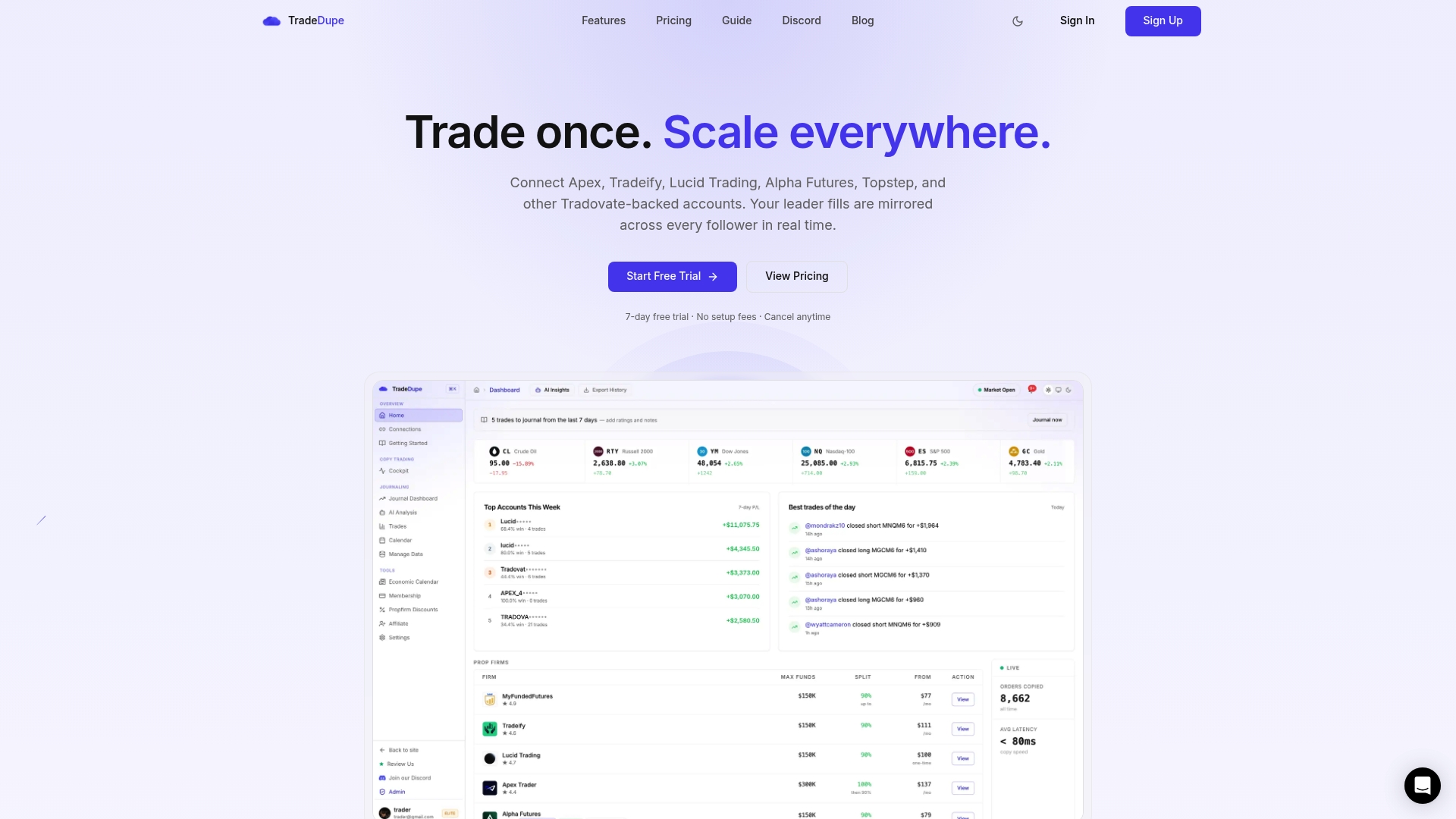
- Connects accounts through Tradovate's own OAuth flow, so credentials are never stored outside the broker
- Mirrors leader fills to follower accounts in real time over live WebSocket streams
- Includes rogue-trade detection, per-account copy toggles, and daily loss limits enforced directly on Tradovate
The service offers tiered subscription plans with a free trial period and one-click cancellation. If your desk already matches the workflow described above, the fastest way to see the fit is to get started with TradeDupe and connect your first pair of accounts today.
Sources
- NFA Compliance Rule 2-10: The allocation of bunched orders for multiple accounts
- Mark-to-market (CME Group educational material)
- CFTC guidance on delivery and retention of statements
FAQ
What is the best method for multi account P&L attribution?
There is no single required method, but equity-proportional and per-contract allocation are the two most commonly used because they scale cleanly across accounts of different sizes. The right choice depends on whether accounts are meant to carry equal dollar risk or equal relative exposure, and either method needs to be applied consistently and documented under NFA Compliance Rule 2-10.
How do you reconcile multi account P&L against broker statements?
Pull the exchange's daily settlement price, apply it to each account's recorded position, and compare the result line by line against the broker's monthly statement. Any mismatch beyond a small tolerance should be flagged and traced back to the specific fill or allocation decision that caused it.
Does TradeDupe support multi account P&L tracking?
TradeDupe mirrors fills in real time across Tradovate-based accounts and provides analytics, reports, and a trade journal that support per-account tracking. Plans start at $20 a month billed yearly with a 7-day free trial, and full details are available on the TradeDupe site.
What are NFA rules on allocating trades across multiple accounts?
NFA Compliance Rule 2-10 requires that bunched orders be allocated fairly, with documented procedures and periodic reviews showing no account is consistently favored. Managers must supply account identifiers and allocation counts at or before order entry, or follow a compliant post-execution allocation process with records retained.
Why use exchange settlement prices instead of platform prices for P&L?
Exchange daily settlement prices are the authoritative reference for futures mark-to-market calculations, while a platform's displayed price can lag or differ slightly. Using the settlement price as the base for every account's P&L avoids most reconciliation disputes before they start.
Recommended
- Audit Trade History Across Accounts: A Prop Firm Workflow
- Trade Reconciliation Automation for Tradovate Prop Desks: 6 Essentials
- 34ms Mirroring: Link Tradovate Accounts for Prop Desks
- How to Mirror Trades Across Prop Accounts: 2026 Playbook
For educational purposes only. Not financial advice. Futures trading involves substantial risk of loss and is not suitable for every investor.