
Event-Driven Trade Copying on Tradovate: How It Works
TradeDupe
10 min read
Event-driven trade copying mirrors each leader fill to your Tradovate prop accounts as it happens. See how it works, where fills differ and what to check.
Event-driven trade copying means your copier reacts to each fill on a leader account the moment it happens, then sends matching orders to your follower accounts. It does not check for changes on a timer, and it does not wait for you to click. If you run several prop firm evaluation or funded accounts on Tradovate, it is the difference between all accounts entering together and each account getting a slightly different trade.
This guide explains the mechanics, why follower fills still differ from the leader's, the safeguards worth demanding, and the rule checks to run with your firm before you copy anything.
TL;DR
- Event-driven copiers act on a pushed fill notification from a live connection. Polling copiers ask repeatedly whether anything changed, which adds delay between checks.
- Even a fast copier cannot guarantee identical prices. Followers are separate orders that reach the exchange after the leader's, so slippage on fast moves is normal.
- The safeguards that matter most are secure authorization (OAuth, not shared passwords), per-account toggles, rogue-trade detection and loss limits enforced by the broker.
- Copy only accounts you own and control, and confirm your firm's current copy trading and consistency rules before you scale up.
- TradeDupe is built for this setup on Tradovate, with a 7-day free trial.
Table of Contents
- What event-driven trade copying means for Tradovate traders
- How an event-driven copier works, step by step
- Setup and platform requirements
- Speed: what "real time" actually delivers
- Safeguards to look for
- Rules and risks to check before you copy
- Our perspective: copy to execute, not to hide
- Try it on your own accounts
- FAQ
- Sources
What event-driven trade copying means for Tradovate traders
An event is something that happens on an account: an order fills, a position changes, a stop triggers. In an event-driven copier, the leader account's fill is that trigger. The software receives it, translates it into an order for each enabled follower account and submits it.
Compare that with the two older approaches:
- Manual copying. You enter the trade on account one, then repeat it on accounts two through ten. By the time you reach the last account, price has often moved, and a missed click means an account sits out or carries the wrong size.
- Polling. A script asks the broker every second or few seconds, "has anything changed?" Whatever the interval is, that is the minimum delay you build in, and each request consumes connection capacity whether or not anything happened.
Tradovate's API documentation describes the push alternative. Its WebSocket user/syncRequest subscription pushes updates whenever the subscribed user data changes, so software does not have to keep making HTTP requests to find out. That push model is what event-driven copying is built on.
For a trader with, say, five Apex accounts and three Tradeify accounts, the practical result is simple: you place one trade on your leader, and the other seven see it as it fills.
How an event-driven copier works, step by step
The details vary by product, but the flow is consistent.
- Authorize access. You connect each Tradovate account. Tradovate's API uses OAuth access tokens, which means a copier can be granted access without you handing over your password.
- Choose a leader. One account is the source of truth. Every fill on it is an event.
- Enable followers. Each follower gets its own on/off state and, ideally, its own settings.
- Listen over a live stream. The copier holds an open WebSocket connection and receives leader events as they occur.
- Translate and submit. For each enabled follower, the copier builds a matching order and sends it to Tradovate.
- Confirm and monitor. It checks that each follower order was accepted and filled, and flags anything that does not match.
The last step is where good and mediocre copiers separate. A copier that only fires orders and never verifies leaves you to discover a missed follower by looking at your positions.
Setup and platform requirements
There are two routes, and they have very different requirements.
Building your own connection. Tradovate states that direct API access requires a live account with more than $1,000 in equity, an API Access subscription and an API key. That is a developer-style setup, and it is a poor fit for most evaluation accounts. You would also own error handling, reconnects and monitoring yourself.
Using a hosted copier. A service connects through Tradovate's official OAuth flow and runs the logic on its own servers. With TradeDupe, nothing runs on your PC or VPS, and your password is never stored. You authorize each account, pick the leader and switch followers on. Our walkthrough on Tradovate API authentication for multiple prop accounts covers the six steps in detail.
Before you start, have these ready:
- Every account's login for the one-time OAuth authorization.
- A list of which accounts belong to which firm, plus each firm's current copy trading policy.
- A decision about your leader: many traders pick an account with the most room to the drawdown limit, since it takes the first fill.
If you want the firm-by-firm picture, see which futures prop firms allow copy trading and the specifics for Apex copy trading on Tradovate.
Speed: what "real time" actually delivers
With a live stream and server-side execution, copied orders typically go out in under 100ms. That is fast enough that for most day-trading styles the follower entry lands within a tick or two of the leader.
It will not be identical, and understanding why prevents false alarms.
- Queue position. CME Group explains that the exchange processes orders in the order received. A follower order is submitted after the leader's, so it joins the queue later. On a limit order, the leader may fill while the follower waits.
- Market movement. In the interval between orders, the book can change. A market order on the follower can fill a tick worse, or occasionally better.
- Location. CME also notes that where an application sits can affect how quickly it interacts with Globex. A copier on a hosted server is not in the same position as software running on a home PC with a slow connection.
- Size. Large fills on thin books may be split across price levels differently per account.
The practical lesson: avoid copying limit-order entries into thin or fast markets without checking how followers behave. Around scheduled releases, spreads and slippage widen for everyone. Our economic calendar helps you see those windows before they arrive, and many traders simply stay flat through the highest-impact events.
Safeguards to look for
Copying multiplies a mistake as readily as a good trade. Ten accounts mean a wrong-size order is wrong ten times. These are the controls that matter.
Per-account toggles and execution controls
You need to switch any single follower off without disconnecting the rest. This is useful when one account is near its trailing drawdown, has passed its profit target or is in a payout waiting period.
Rogue-trade detection
A follower can receive trades the copier did not place, for example if you or someone else clicks on that account directly. Rogue-trade detection flags those so your accounts do not drift out of sync unnoticed.
Loss limits enforced by the broker
Tradovate's documentation describes account-level risk limits covering position size, products, daily and weekly loss, and trailing drawdown. It also notes that accounts falling below its health criteria are auto-liquidated. A limit that lives at the broker works even if your copier or internet connection drops. TradeDupe sets daily loss limits and profit targets directly on Tradovate for exactly that reason, so the broker enforces them.

Connection handling
On the engineering side, Tradovate's guidance for automated clients includes monitoring WebSocket heartbeats and connection limits, handling API errors, and flagging automated orders with isAutomated: true. You do not need to implement these yourself with a hosted copier, but it is fair to ask any provider how it handles disconnects and rejected orders.
Rules and risks to check before you copy
This is where most traders get into trouble, and it has little to do with software.
Confirm your firm's current policy. Each firm sets its own rules on copy trading, on copying between its own accounts and on copying across firms. Those rules change. Do not rely on a forum post or an old article, including this one. Read the firm's current rules or ask support in writing.
Understand consistency rules. If every account takes the same trade, every account also shows the same profit pattern. Where a firm has a consistency rule capping how much of your total profit can come from a single day, identical copies do not create a problem by themselves, but they make it easy to breach together. Compare them in our prop firm consistency rules table.
Copy your own accounts only. Mirroring between accounts you own and control is different from trading for other people. The NFA's rules state that a member or associate may not exercise discretion over a customer's futures account without the customer's or controller's written authorization. If someone else's account is involved, you are in different territory, so talk to the firm and, where relevant, a qualified professional before proceeding.
Watch correlated drawdown. One bad trade becomes eight bad trades. Size the leader so the worst day still leaves every account alive, using the smallest buffer among them as your reference.
Mind account sizes. Different account sizes carry different contract limits and drawdown amounts. Copying the same contract count to a small account and a large one may breach the small one's limit. Check each firm's maximum contracts.
If you want to see what your payouts could look like across accounts, try the prop firm profit calculator.
Our perspective: copy to execute, not to hide
We built TradeDupe only for Tradovate prop traders, and that narrow focus shapes how we think about event-driven copying.
First, authorization matters more than speed. Most traders will not notice the difference between a few milliseconds of latency, but they will notice a compromised login. That is why connections go through Tradovate's official OAuth and passwords are never stored.
Second, enforcement belongs at the broker. A copier is software, and software can disconnect. Daily loss limits and profit targets set on Tradovate keep working regardless, so we configure them there.
Third, a copier should tell you when something is wrong. Rogue-trade detection exists because the most expensive copy errors are the silent ones: a follower holding a position the leader does not.
Finally, copying does not replace judgment. It removes repetitive clicking, so your attention goes to the setup, the risk and the rules of each firm. It will not make a losing strategy profitable across ten accounts. It will make it lose ten times faster.
> — Andres
Try it on your own accounts
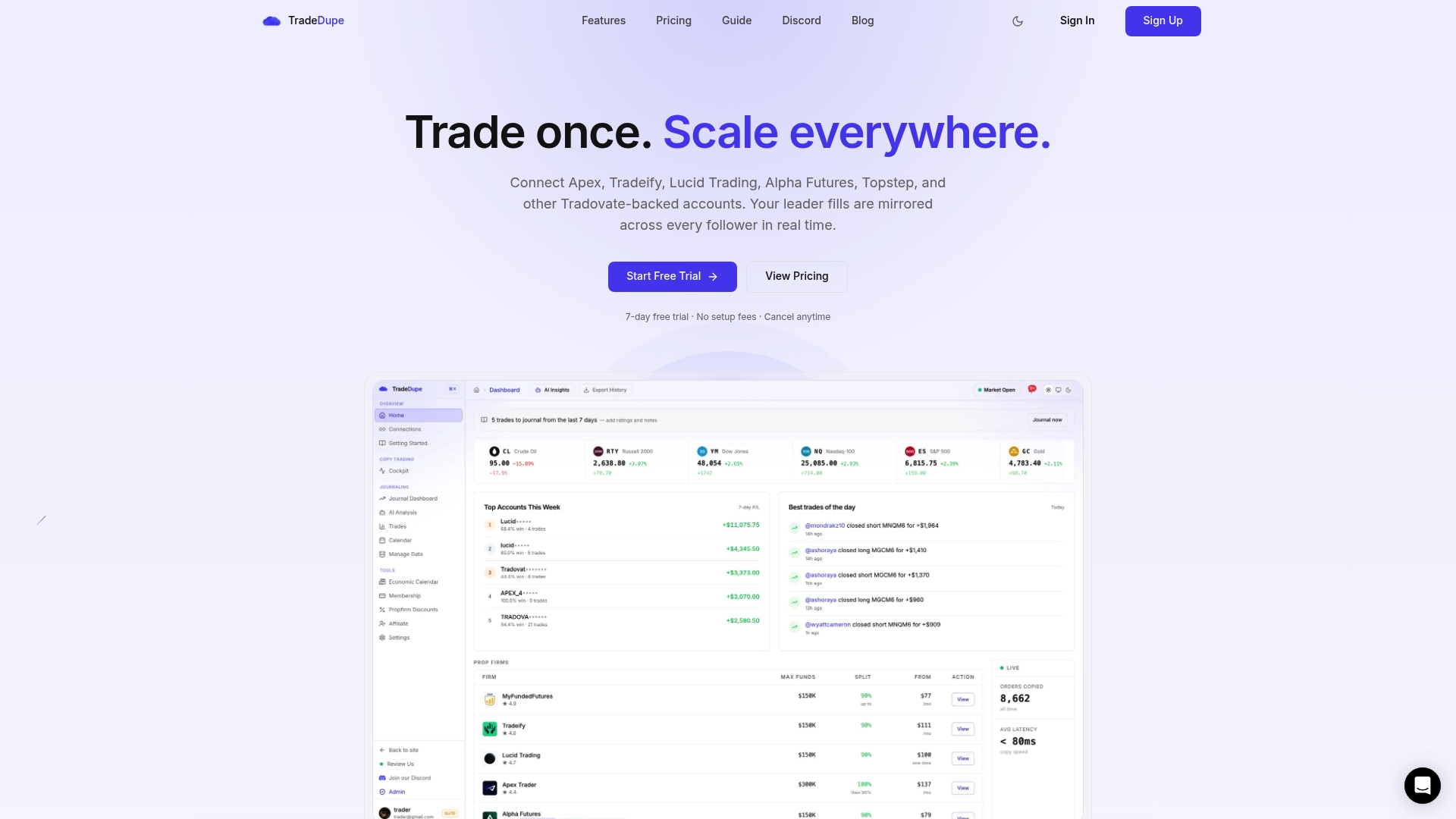
If you hold several Tradovate-based prop accounts, TradeDupe mirrors every leader fill to your enabled followers over live streams, typically in under 100ms. Plans start at $20/month billed yearly for Standard (2 connections, 10 accounts each), with Pro at $45/month and Elite at $90/month, both billed yearly. Every plan includes a 7-day free trial and one-click cancellation. See the plans and pricing or read about our Tradovate trade copier.
For a deeper look at multi-account configurations, our guide to Tradovate copy trading setups goes further, and the copy trading glossary entry covers the basics.
FAQ
Is event-driven copying faster than polling?
Usually, yes. An event-driven copier is told about a fill the moment it occurs, while a polling copier only learns of it at the next check. Tradovate's API supports this push model through its WebSocket subscriptions. Actual fill prices still depend on the market and queue.
Why did my follower fill at a different price than my leader?
The follower order is a separate order submitted after the leader's, so it joins the exchange queue later and may meet a different market. This is normal on fast moves and thin books. Review the difference as slippage rather than a copier fault, unless a trade is missing entirely.
Do I need an API key to copy trades on Tradovate?
Building your own direct API connection requires a funded live account, an API Access subscription and a key. A hosted copier that uses Tradovate's OAuth flow avoids that. Check the provider's own requirements before you sign up.
Can I copy trades across different prop firms?
Technically, a copier can mirror a leader to followers at several firms on Tradovate. Whether that is allowed is each firm's decision, and policies change. Confirm the current rules with every firm in writing before you enable copying.
What happens if my connection drops?
Orders already working or filled stay on Tradovate. Risk limits set at the broker, such as daily loss limits, remain enforced even if a copier disconnects. After a drop, check that every account's position matches the leader before trading again.
Sources
Recommended
- Protect Prop Desk Capital With 34ms Tradovate Selective Copy Trading
- Tradovate Trade Copier | Real-Time Account Sync
- What Is Real-Time Trade Synchronization for Prop Traders?
- Copy Trading Slippage: Why Fills Lag Across Tradovate Prop Accounts
For educational purposes only. Not financial advice. Futures trading involves substantial risk of loss and is not suitable for every investor.