
Server Colocation Trading Guide for Tradovate Prop Desks
TradeDupe
15 min read
Maximize your Tradovate trading efficiency with server colocation trading. Discover how low-latency setups enhance performance and reduce risks.
Server colocation trading for Tradovate copy trading means running your leader→follower mirroring logic on a dedicated, low-latency server rather than exchange co-location. Most Tradovate prop desks running more than five or six follower accounts should invest in it; solo traders with one or two accounts often get by with a well-placed managed VPS instead.
The dividing line comes down to scale and tail risk. If your follower count is growing, your p99 replication times spike unpredictably, or your prop firm's evaluation rules demand tight reconciliation, server-side hosting stops being optional.
Before spending anything, run two checks:
- Ping and traceroute your broker gateway from a candidate server location and confirm hop count and round-trip time.
- Simulate a burst of follower dispatches and measure p99 completion time, not just the average.
A platform like Tradedupe already runs this architecture for you, with median 34ms copying, rogue-trade detection, and auto-recovery built in, so many desks skip the DIY build entirely.
Key Takeaways
Server-side hosting fixes replication reliability and tail latency for multi-account Tradovate copy trading, but it cannot compensate for slow strategy code or unmeasured broker gateway distance.
| Point | Details |
|---|---|
| Measure before upgrading | Run ping, traceroute, and a p99 replication test before paying for a higher hosting tier. |
| Watch tail latency, not median | Reconciliation mismatch rate and p99 drift predict failures better than average ping. |
| Build a durable ledger first | Sequence numbers and idempotent replay prevent duplicate fills during reconnection events. |
| Match spend to strategy sensitivity | Managed VPS covers most desks; dedicated or proximity hosting suits tight p99 tolerances only. |
| Tradedupe handles the stack | Median 34ms copying, rogue-trade detection, auto-recovery, and per-account toggles come built in. |
Table of Contents
- How Server-Side Trade Mirroring Works for Tradovate
- What Latency Metrics Actually Matter Here?
- Deployment Checklist: Provisioning and Stress-Testing Your Setup
- Monitoring, Reconciliation, and Auto-Recovery Controls You Need Around the Clock
- What Should You Budget for Hosting Tiers?
- Server-Side Mirror Hosting Versus Exchange Co-Location: What's the Difference?
- Security Considerations for Colocated Trading Infrastructure
- What Compliance Rules Apply to Colocated Trading Servers?
- Integration Challenges Across Trading Platforms and APIs
- Scaling Your Setup as Account Count and Volume Grow
- Planning for Disaster Recovery and Business Continuity
- Production Lessons on Copy-Trading Failures
- Getting Tradovate Copy Trading Running the Right Way
- Sources
How Server-Side Trade Mirroring Works for Tradovate
Copy trading across multiple Tradovate accounts is really an event-processing problem wearing a trading costume. A leader account fires an order event, and that event has to travel through several stages before every follower account reflects it accurately.
The chain looks like this in practice:
- Leader event detection — the system detects a fill, modification, or cancellation on the leader account, usually via a WebSocket feed or polling loop against Tradovate's API.
- Ledger write — the event gets written to a durable, sequence-numbered ledger before anything else happens, so nothing is lost if a downstream step fails.
- Risk checks — per-account rules run against the event: is this account paused, does it violate a prop firm's daily loss limit, is the position size within bounds?
- Dispatch — the system fans the validated event out to every eligible follower account simultaneously.
- Broker request and fill acknowledgment — each follower's order hits Tradovate's gateway, and the acknowledgment (or rejection) gets logged back against that same sequence number.
Running this on a hosted server rather than a local desktop or laptop changes three things. First, you get centralized monitoring: one dashboard, one log stream, one place to see every account's sync status. Second, you get a single reconciliation point instead of chasing down which of twenty desktop instances missed a fill. Third, you control concurrency deliberately, dispatching to fifty followers in a coordinated burst rather than however fast twenty separate machines happen to wake up. That third point matters more than most traders expect. A local setup on a home internet connection can't guarantee dispatch order under load; a server built for it can.
What Latency Metrics Actually Matter Here?
Hosting location is one piece of a five-part latency stack: exchange feed, feed delivery to your system, your own processing and risk checks, broker gateway handling, and the broker's transport to the exchange. Server-side hosting mainly affects the middle three. It does very little for exchange feed generation and can't shrink poorly optimized strategy code.
The metrics worth tracking daily:
- p50, p95, and p99 replication completion time — from leader fill to last follower acknowledgment.
- Duplicate fill rate — how often a follower account receives the same order twice due to retry logic gone wrong.
- Reconciliation mismatch rate — the percentage of trades where follower position doesn't match leader position after dispatch completes.
- Tail latency spread — the gap between your p50 and p99; a wide spread means occasional bad events are getting buried by good averages.
A rigorous mirror-trading test records timestamps at leader receipt, follower dispatch, broker acceptance, and final fill deviation, because median numbers alone hide the tail events that actually break multi-account replication. Sub-50ms median copying helps when you're running scalping strategies with tight fill windows across many accounts. But if your p99 sits three or four times higher than your median, that's the number putting your prop firm evaluations at risk, not the average.
Deployment Checklist: Provisioning and Stress-Testing Your Setup
Before you commit to a hosting tier, walk through this sequence. Skipping steps here is how desks end up paying for infrastructure that doesn't match their actual risk.
- Verify broker gateway IPs and run traceroutes from any candidate server location to confirm real hop counts, not marketing claims.
- Request measured p50/p95/p99 latency data from the provider, not just an advertised "low latency" label. Managed VPS options near exchange or broker infrastructure typically deliver 80 to 90 percent of full co-location's latency benefit at a fraction of the cost, which makes that data request worth the friction.
- Match hosting tier to strategy sensitivity. If your p99 tolerance is tight (sub-100ms strategies, high follower count), escalate toward dedicated hardware. If you're running swing setups across a handful of accounts, a proximity VPS is plenty.
- Tune the hardware and OS. Prioritize single-thread CPU performance over core count, disable deep C-states to kill latency spikes, and tune NIC interrupt coalescing. Proximity to CME infrastructure in Chicago yields real propagation gains, but hardware tuning is what controls jitter within that geographic floor.
- Confirm a remote-hands SLA in writing before you sign, not after your first outage at 2 a.m.
- Stress-test before going live: run reconciliation scenarios with intentionally dropped connections, inject follower-side failures, push concurrent dispatch to your maximum expected account count, and confirm your system handles Tradovate API rate limits gracefully instead of silently dropping orders.
Pro Tip: Run your failure-injection tests during a low-volume session first. You want to see how your ledger and reconciliation logic behave under stress without risking real capital on a strategy that's fighting your infrastructure at the same time.
Monitoring, Reconciliation, and Auto-Recovery Controls You Need Around the Clock
A copy trading system without real-time monitoring is a liability wearing automation's clothes. The core requirement is a durable, sequence-numbered event ledger with idempotent replay, so a dropped connection or API timeout never turns into a duplicate order or a silently missed one.
> Most production mirror setups fail not because of network latency but because nobody built reconciliation and replay logic into the ledger from day one, so a single dropped packet cascades into mismatched positions across a dozen accounts.
The operational layer that catches problems before they compound includes:
- Rogue-trade detection that flags a follower position diverging from its leader beyond a set tolerance.
- Per-account toggles so you can pause one problem account instantly without halting the entire mirror.
- Alerting thresholds tied to reconciliation mismatch rate and p99 drift, not just uptime.
- Runbooks for the three or four failure modes that actually happen: API throttling, partial fills, stale connections, and duplicate dispatch.
Reconciliation shouldn't be a once-a-day audit. Run it continuously, or at minimum every few minutes during market hours, and treat any mismatch as an incident, not a rounding error.
What Should You Budget for Hosting Tiers?
Cost scales with how much of the latency chain you're willing to pay to control. Managed VPS options run roughly $50 to $500 a month, proximity hosting near broker infrastructure runs $500 to $2,000 or more, and full exchange co-location climbs to $2,000 to $15,000-plus.
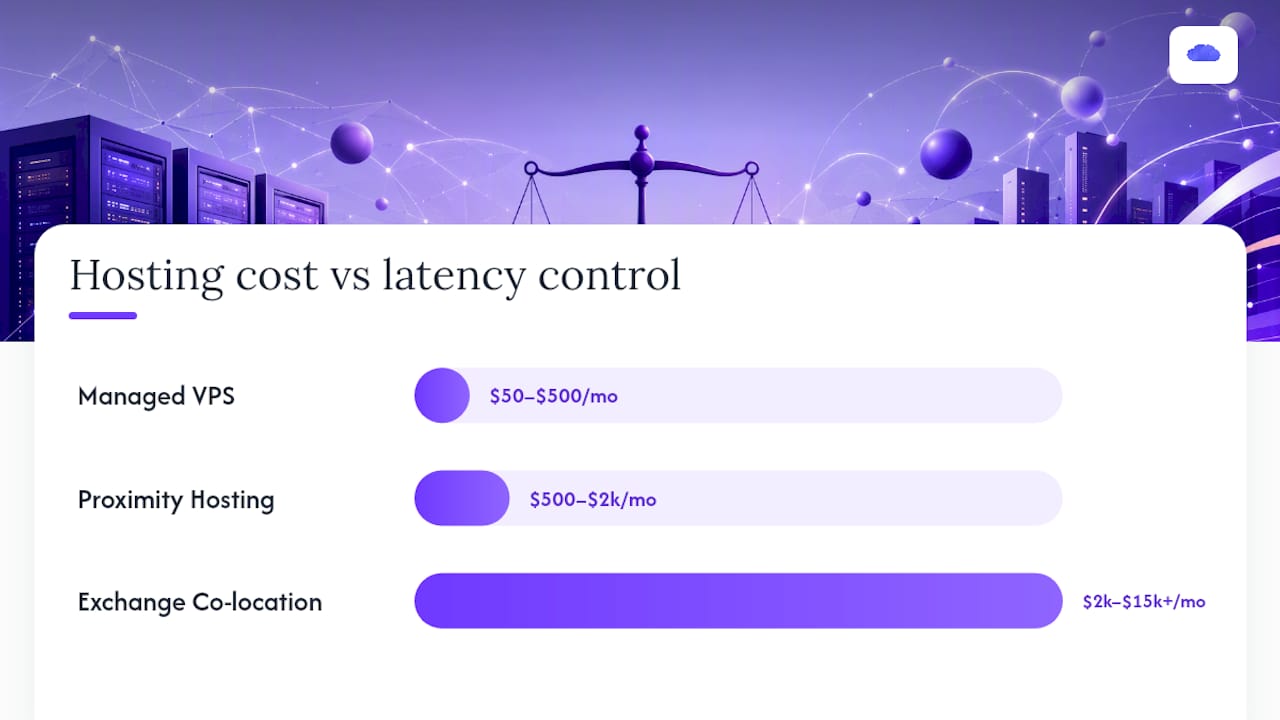
For most Tradovate copy trading desks, that top tier is overkill. The gains from full exchange co-location apply mainly to strategies competing on microsecond execution against other institutional order flow, not to mirroring fills across your own follower accounts.
Sizing decisions worth applying before you upgrade tiers:
- Escalate spending when p99 replication time, not median, is the bottleneck hurting your prop firm evaluation pass rate.
- Budget for guaranteed remote-hands support once you're managing more than a handful of accounts; a 2 a.m. outage with no support contract costs more than the upgrade would have.
- Size event log storage for at least 90 days of trade history, and confirm your follower concurrency limit doesn't bump against Tradovate's API rate ceiling during high-volume sessions.
Server-Side Mirror Hosting Versus Exchange Co-Location: What's the Difference?
These two terms get confused constantly, and the confusion costs traders money on infrastructure they don't need. Server-side colocation for copy trading means hosting your mirroring software, the leader-to-follower dispatch logic, on a server positioned near your broker's gateway or your own operational hub. It's a copy trading infrastructure decision, not an execution-speed arms race.
Exchange co-location is a different category entirely: physically placing servers inside or immediately adjacent to an exchange's own data center to shave microseconds off order transmission for high-frequency trading strategies. That's built for firms competing on raw execution speed against other institutional participants, often trading the same instrument thousands of times a second.
A Tradovate prop desk running copy trading across multiple funded accounts doesn't need exchange co-location. What you need is a server, whether a managed VPS, a dedicated box, or a managed service like Tradedupe, positioned to reliably detect leader events and dispatch them to followers with low, consistent latency. The goal is replication accuracy across accounts, not nanosecond execution advantage on a single order.
This distinction matters when you're evaluating providers. If a hosting company pitches you on "colocation" language borrowed from HFT marketing, ask specifically whether they mean proximity to your broker's API gateway or proximity to an exchange matching engine. Those are different products solving different problems, and paying HFT-tier prices for a copy trading use case is money wasted.
Security Considerations for Colocated Trading Infrastructure
A server running your copy trading logic holds broker API credentials for every account it touches, which makes it a concentrated target. Treat credential storage as the first line of defense: encrypt API keys at rest, rotate them on a schedule, and never hardcode them into scripts that might end up in a shared repository.
Network-level protections matter just as much. Restrict inbound access to your mirroring server with a firewall allowlist limited to known IP ranges, and use a VPN or private network link between your monitoring dashboard and the production server rather than exposing management ports to the open internet.
Access control inside the system itself deserves the same rigor. Multi-account setups should enforce role-based permissions so a single compromised login can't pause every follower account or alter risk parameters across the board. Logging every configuration change, every toggle flip, and every manual override gives you an audit trail if something goes wrong and needs to be traced back.
Physical and provider-level security also counts if you're leasing dedicated hardware or a managed slot. Confirm your hosting provider carries data center certifications, redundant power, and documented access controls for anyone who can physically touch the machine. A platform handling this for you, such as Tradedupe's approach to security and operational resilience, removes the burden of managing credential rotation and access control yourself across a growing account list.
What Compliance Rules Apply to Colocated Trading Servers?
Colocated infrastructure for copy trading doesn't trigger a separate regulatory regime in the way exchange co-location arrangements sometimes do for institutional order routing. What actually governs you is the combination of your broker's terms of service, your prop firm's evaluation and funded-account rules, and standard recordkeeping expectations for automated trading activity.
Prop firms typically require that automated or mirrored trading activity stay within documented risk parameters, including daily loss limits and position sizing rules specific to each funded account. Running copy trading through a server-side system doesn't exempt you from those rules; if anything, it makes enforcement easier since risk checks can run centrally before dispatch rather than depending on manual discipline across a dozen separate terminals.
Recordkeeping is where most desks underinvest. Maintain a durable, timestamped log of every leader event, every dispatch decision, and every fill or rejection across follower accounts. If a prop firm audits an account for rule violations, having a clean, sequence-numbered ledger showing exactly what your system did and when is the difference between a quick resolution and a frozen account while you reconstruct events from memory.
None of this constitutes legal advice, and rules vary by prop firm and by broker agreement, so read your specific account terms before assuming a given automation setup is compliant.
Integration Challenges Across Trading Platforms and APIs
Tradovate's API is well documented, but building reliable server-side mirroring against it still surfaces friction points that catch teams off guard. Rate limits are the most common one: dispatching to thirty or forty follower accounts simultaneously can bump against API call ceilings if your system doesn't queue and throttle requests intelligently.
Order type compatibility is another. Not every order type or modification behaves identically across every funded account structure, particularly when different prop firms (Apex, Tradeify, Lucid Trading, Alpha Futures) impose their own restrictions on order types or position sizing. A mirroring system built without accounting for those per-firm variations will occasionally dispatch a follower order that gets rejected for reasons that have nothing to do with your strategy.
Terminal-hosted plugins tend to scale poorly here because they depend on a desktop application staying open and connected, and they often produce ambiguous completion signals when a fill partially executes. A direct API integration with a server-side copier avoids that ambiguity by working directly against Tradovate's programmatic interface rather than simulating clicks in a terminal window.
Authentication token expiration is a quieter problem that causes real damage. If your system doesn't handle token refresh gracefully, you can lose connectivity to a follower account mid-session without an obvious error, which is exactly the kind of silent failure a good copy trading infrastructure build has to catch immediately.
Scaling Your Setup as Account Count and Volume Grow
The architecture that handles five follower accounts comfortably will not handle fifty without changes. Concurrency is the first constraint to hit: dispatching to a growing follower list means your system needs to fan out requests in parallel rather than sequentially, or your p99 replication time balloons as the queue backs up.
API rate limits become a real ceiling well before most desks expect it. Plan for request batching and intelligent throttling once you cross roughly a dozen active follower accounts, rather than waiting until you hit Tradovate's limits mid-session and start dropping orders.
Event log storage grows quietly but steadily. Every leader event, every dispatch, every acknowledgment adds a ledger line, and a busy desk running dozens of accounts across active sessions can generate a meaningful volume of log data in a single trading day. Compressed, append-only log storage keeps replay fast without heavy database overhead as that volume climbs.
Horizontal scaling, running dispatch logic across multiple worker processes rather than a single thread, becomes worth the added complexity once follower count and trade frequency both climb simultaneously. The desks that scale smoothly are the ones that build for this from the start rather than retrofitting concurrency handling after their first missed-fill incident during a high-volume session.
Planning for Disaster Recovery and Business Continuity
A copy trading server that goes down mid-session without a recovery plan doesn't just cost you the trades you missed. It risks leaving follower accounts in mismatched states relative to the leader, which is far worse than a clean outage.
The foundation of any real disaster recovery plan is the durable event ledger discussed earlier. If your server crashes or loses connectivity, sequence numbers and idempotent replay windows let the system pick up exactly where it left off once it reconnects, rather than replaying events that already succeeded or skipping ones that didn't.
Failover planning should account for both hosting-level outages and connectivity drops between your server and Tradovate's gateway. A secondary instance on standby, even a modest one, that can take over dispatch duties if the primary server becomes unreachable prevents a single point of failure from freezing every follower account simultaneously.
Business continuity also means having a manual override path. If automated recovery can't resolve a mismatch on its own, someone on your team needs a clear runbook for pausing affected accounts, verifying position state against Tradovate directly, and resuming mirroring only once reconciliation confirms everything lines up. Desks that skip this step tend to find out how important it is during their first real outage, which is the worst possible time to learn it.
Production Lessons on Copy-Trading Failures
The failures that actually take down multi-account copy trading setups rarely come from a slow ping. They come from a follower account that missed one reconnection event and then silently drifted out of sync for twenty minutes before anyone noticed. Rogue-trade detection catching that drift, and a per-account toggle isolating it, does more real-world work than shaving ten milliseconds off your median.
Teams chase median latency because it's the number vendors advertise. The number that actually determines whether your accounts stay in sync is your reconciliation mismatch rate, and whether your recovery logic can replay missed events without duplicating fills. A platform like Tradedupe treats that as the core engineering problem rather than a footnote to a latency benchmark, which is the right priority order for anyone running real capital across multiple funded accounts.
Getting Tradovate Copy Trading Running the Right Way
Everything covered above, the event ledger, the risk checks before dispatch, the rogue-trade detection, the per-account isolation, is exactly what Tradedupe runs as a managed platform instead of a build-it-yourself project. Median copying latency sits around 34ms, and the auto-recovery and reconciliation logic that took this whole guide to explain comes built in rather than requiring your team to engineer it from scratch.
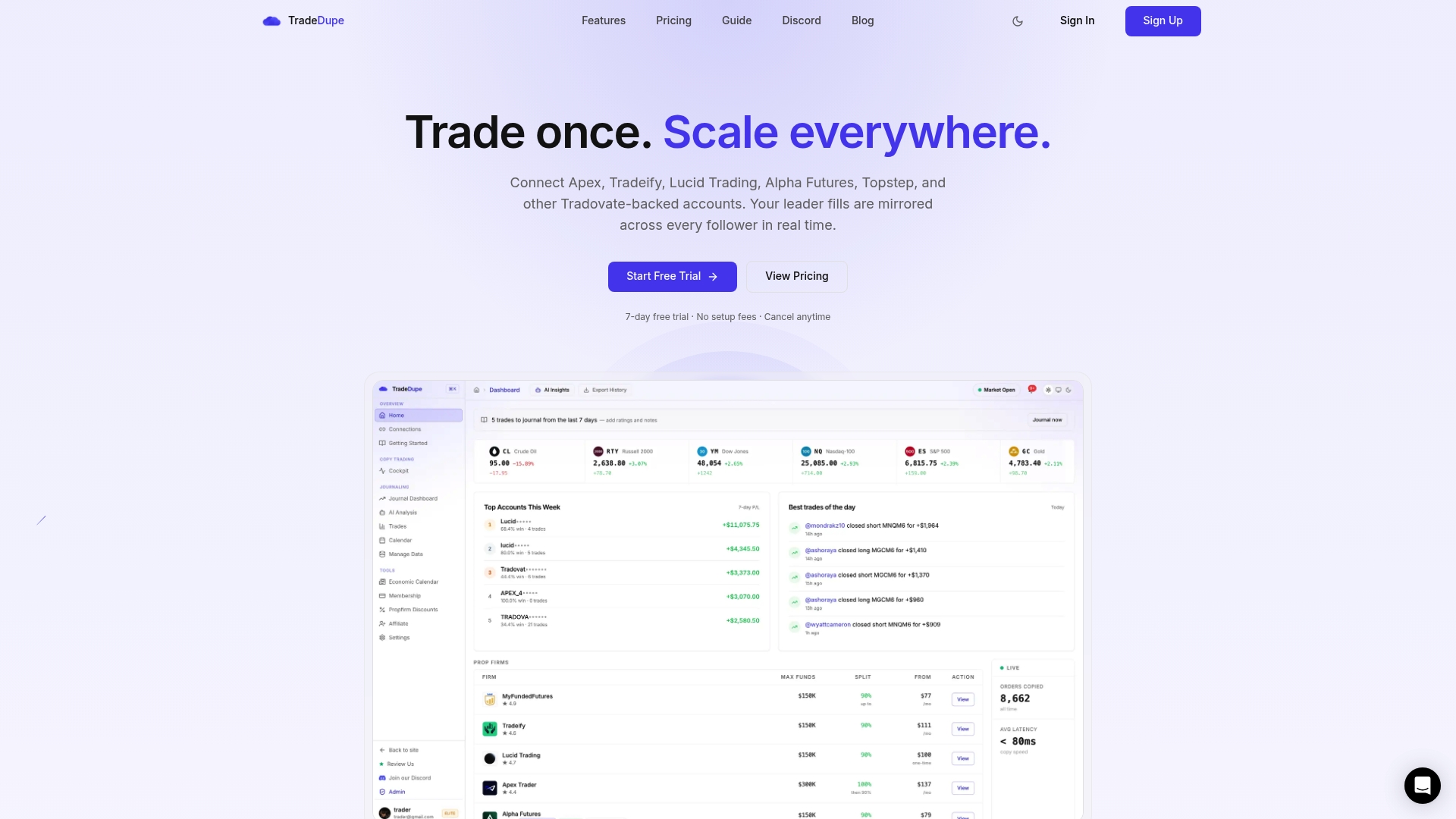
That's the practical advantage for a Tradovate prop desk weighing infrastructure options: you get server-side mirroring with the operational controls a growing follower list actually needs, without provisioning hardware, tuning NIC settings, or writing your own ledger replay logic. Broker connections are unlimited across supported prop firms including Apex, Tradeify, Lucid Trading, and Alpha Futures, and the dashboard gives you real-time visibility into sync status across every account from one screen.
Setup takes about fifteen minutes through the getting-started page, where you connect your leader account, add followers, and configure per-account toggles before your next session. If you're currently running mirroring manually or through a terminal plugin, that's the next step worth taking.
Sources
- Mirror Trading Execution: Technical Performance Analysis
- Server location trading latency in 2026: The complete optimization guide